










Netflix’s 2026 Book Options Reveal What Stories It May Be Betting On Next
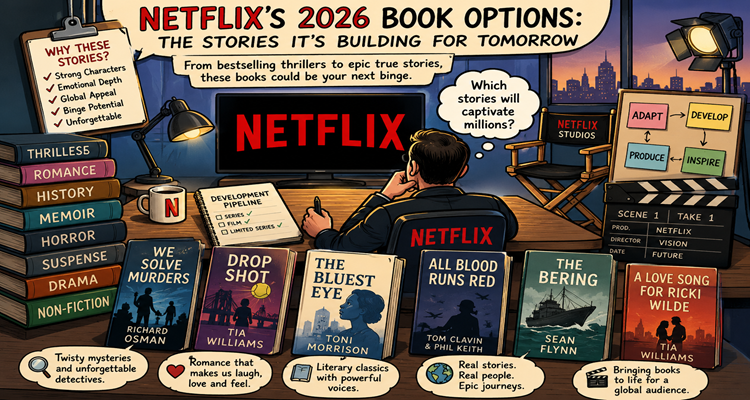
Netflix’s development pipeline is often visible long before a viewer sees a trailer. One of the earliest signals is the quiet acquisition of adaptation rights to books, memoirs, and other written works. A newly reported batch of options gives an unusually revealing look at the kinds of stories the streamer is positioning for possible film and television development.
The important distinction is that an option is not a production order. It gives a studio the contractual right to develop a work for a period of time, but a project can still be rewritten, delayed, abandoned, or never reach production. That makes the current list less a release calendar than a snapshot of Netflix’s creative risk-taking.
What stands out is not simply the number of books involved. The selections span commercial thrillers, romance, literary fiction, historical nonfiction, memoir, psychological horror and stories built around technology and moral responsibility. Taken together, they suggest a strategy that combines recognizable authors and existing audiences with material capable of producing very different kinds of screen experiences.
Key Takeaways
- Netflix’s reported book options are development signals, not guarantees that the projects will reach screens.
- Crime and thriller properties remain important, particularly where an author or character can support multiple adaptations.
- Romance and emotionally driven stories occupy a significant part of the reported pipeline.
- Literary and historical works give Netflix opportunities beyond conventional franchise entertainment.
- The strongest options may be those combining recognizable source material with unusually adaptable real-world or contemporary themes.
The real significance of an option is what comes after it
The easiest mistake for audiences is to treat every optioned book as an upcoming Netflix title.
That is not how development works.
An option can represent an early-stage attempt to secure intellectual property before competitors do. Producers may then search for writers, directors, actors and financing structures while testing whether the material works as a feature, limited series or continuing television property.
The difference between rights acquisition, development, production and release matters enormously.
Netflix’s own current Myron Bolitar example illustrates the distance between those stages. The Harlan Coben adaptation has moved far beyond a speculative rights deal: Netflix says production has begun, with Colin Woodell, KJ Apa and Diane Guerrero among the cast, although the series still has no announced release date.
That makes the reported 2026 options interesting primarily as early indicators. They tell us what Netflix may want to explore, rather than what subscribers should expect to watch next month.
Crime remains one of Netflix’s safest adaptation languages
A large portion of the reported acquisitions sits somewhere inside crime, mystery, or thriller territory.
Richard Osman’s We Solve Murders is particularly notable because it arrives with an established publishing audience and a recognizable relationship between the author and screen adaptations. The novel introduces a new detective team rather than continuing the characters from The Thursday Murder Club.
That distinction could be strategically important.
Netflix does not necessarily need every successful author to deliver the same franchise indefinitely. It can instead use a writer’s existing audience as a bridge to another intellectual property.
Harlan Coben represents an even clearer version of this strategy. Netflix’s Myron Bolitar series is already in production, extending a partnership that has produced numerous Coben adaptations. The streamer describes Bolitar as Coben’s iconic character and says the new series expands that creative relationship further.
The reported option for Drop Shot, the second Myron Bolitar novel, therefore deserves caution. It may indicate interest in the broader literary universe, but it should not automatically be interpreted as confirmation of a second season or a specific adaptation plan.
That distinction is precisely why option tracking is useful: it reveals the possibility of a franchise before the franchise becomes official.
Romance is becoming more than a side category
The reported acquisitions also reveal a sizeable romance component.
Tia Williams appears twice, with Seven Days in June and A Love Song for Ricki Wilde. The author’s existing connection to screen adaptation is significant: The Perfect Find, based on Williams’ novel, became a Netflix film.
Other reported options, including Katherine Center’s The Things You Save in a Fire, Kate Young’s Experienced, Jane L. Rosen’s On Fire Island and Emily Everett’s All That Life Can Afford, occupy different corners of the romance and emotionally driven fiction market.
The more interesting point is that these aren’t interchangeable romance stories.
They offer different production possibilities:
- workplace and professional settings;
- family drama;
- queer romance;
- grief and supernatural elements;
- wealthy social worlds;
- international locations.
For a streaming service, that variety matters. Romance can be produced at very different scales, from relatively contained character dramas to visually expansive international stories.
It also provides a useful counterweight to the idea that streaming development is dominated exclusively by crime, fantasy and large-scale franchises.
Literary prestige gives the pipeline another dimension
One of the most consequential reported acquisitions is Toni Morrison’s The Bluest Eye.
The 1970 novel is fundamentally different from a commercial thriller. It is a demanding literary work dealing with race, beauty, childhood, poverty and the psychological consequences of oppressive social standards. The reported Netflix option therefore carries a different kind of potential value: cultural prestige as well as audience reach.
The same broader pattern appears in Shirley Jackson’s The Bird’s Nest, another older literary property reported in the group.
This is significant because established literary works can give a streaming service something that newly invented intellectual property cannot easily provide: a history of critical discussion and cultural recognition before production even begins.
But that advantage comes with greater creative risk.
A famous book arrives with expectations. Readers already have mental images of its characters, tone and themes. A screen adaptation can attract attention precisely because the source is respected, but the same familiarity can make departures from the book more controversial.
Netflix is also looking for stories that sound like screen events
Some of the nonfiction options are revealing for another reason.
All Blood Runs Red, about Eugene Bullard, has an extraordinary real-life premise involving aviation, war, boxing, Parisian nightlife and espionage. The reported project already has French filmmaker Paul Mignot attached and a proof-of-concept short associated with the material.
The Gunfighters: How Texas Made the West Wild approaches American history through the violence and mythology surrounding the Old West.
The King of Confidence explores the remarkable story of James Jesse Strang, a 19th-century religious leader and self-proclaimed monarch.
And The Bering centers on the sinking of the fishing vessel Alaskan Ranger and the rescue effort involving its crew.
These projects share an important characteristic: their underlying stories already contain cinematic structure.
There is conflict, survival, transformation, historical consequence, or extraordinary human behavior before a screenwriter adds anything.
That can make nonfiction particularly attractive in a crowded development market. The challenge is not inventing a compelling premise; it is finding the right form and production scale to tell it.
Some of the most interesting projects sit at the intersection of technology and morality
Bruce Holsinger’s Culpability may be one of the most contemporary concepts in the group.
The novel uses an autonomous vehicle accident to ask who is responsible when technology, human decisions, and machine behavior become entangled. The premise places artificial intelligence inside a family drama rather than treating it simply as a futuristic spectacle.
That distinction matters.
Technology stories increasingly work best on screen when the technology creates a human dilemma rather than becoming the entire subject. The question is not merely whether an autonomous system can make a decision. It is who accepts responsibility when that decision causes harm.
That kind of premise can remain relevant even if the underlying technology changes.
It is also consistent with a broader entertainment trend toward using technological anxiety as a vehicle for stories about trust, responsibility and human relationships.
The strongest strategy may be the combination of familiarity and variety
Looking across the reported options, a pattern becomes clearer.
Netflix appears to be combining several different kinds of intellectual property rather than relying on one formula.
Established authors provide recognition.
Popular genres provide accessible audience entry points.
Literary works offer prestige.
Historical nonfiction provides real-world drama.
Memoirs provide emotionally authentic material.
Contemporary premises create relevance.
That mix is strategically useful because streaming platforms need both dependable audience propositions and projects that can generate cultural conversation.
The danger is that an option can look stronger on paper than it becomes during development. A bestselling novel does not automatically translate into a compelling series. A remarkable true story may prove prohibitively expensive. A prestigious literary work may require an unusually careful adaptation. A viral premise may lose its relevance before production is complete.
The development process is therefore where most of the uncertainty remains.
What viewers should watch next?
Rather than treating the reported list as a catalogue of upcoming Netflix releases, audiences should look for a few specific signals.
The first is creative attachment. A named writer, director or producer usually tells us more about a project’s seriousness than an option alone.
The second is format confirmation. A book initially acquired without a defined format can eventually become a feature, limited series, ongoing series, or nothing.
The third is casting and production announcements. Once principal talent and production dates appear, a project has moved considerably further through the pipeline.
The fourth is Netflix’s own confirmation. The company has already publicly documented the development and production of projects such as Myron Bolitar, demonstrating the difference between an independently reported option and an officially announced production.
For readers following adaptation news, these stages are more useful than simply asking whether Netflix “bought” a book.
The bigger story is Netflix’s continued dependence on stories that already have audiences
The reported slate points to a larger entertainment-industry reality: original programming does not necessarily mean original intellectual property.
Books offer studios something extremely valuable: a story that has already passed through a basic audience test.
That does not eliminate adaptation risk. Readers may dislike a screen version, the story may prove difficult to translate, or production costs may undermine the economics. But a recognizable title gives a project a starting point that an entirely unknown screenplay does not have.
Netflix’s relationship with Harlan Coben demonstrates how powerful that model can become when one successful author turns into a continuing pipeline of adaptations. The company’s current Myron Bolitar production is the clearest example of that strategy developing beyond individual titles into an author-centered relationship.
The 2026 options suggest Netflix is continuing to search for that same combination elsewhere: known stories, distinctive voices, and enough narrative flexibility to support screen development.
Conclusion
Netflix’s reported book options for 2026 are best understood as a map of possibilities rather than a list of guaranteed releases.
The collection is notable because it stretches across commercial thrillers, romance, literary fiction, historical nonfiction, memoir, and technology-driven drama. Some properties have obvious franchise potential; others appear designed for prestige or limited-series treatment. A few stand out because their real-world stories are already unusually cinematic.
But the most important lesson is simple: an option is the beginning of a conversation, not the announcement of a show.
The titles worth watching are those that move from rights acquisition into active development, attract significant creative talent and eventually receive formal production confirmation.
For audiences, that distinction prevents a common misunderstanding. For Netflix, these quiet acquisitions reveal something more interesting: the company is not only deciding what to stream next. It is deciding which stories might be worth turning into screen worlds several years from now.
This content is published for informational or entertainment purposes. Facts, opinions, or references may evolve over time, and readers are encouraged to verify details from reliable sources.
Related News
- Why Video Game Adaptations Are Finally Winning Over Audiences
- From Fan Fiction to Blockbusters: How Online Communities Are Changing Storytelling
- The Death of Channel Surfing: How Streaming Changed the Way We Discover Entertainment
- Why We Rewatch Old Movies: The Psychology Behind Comfort Entertainment