








The Death of Channel Surfing: How Streaming Changed the Way We Discover Entertainment
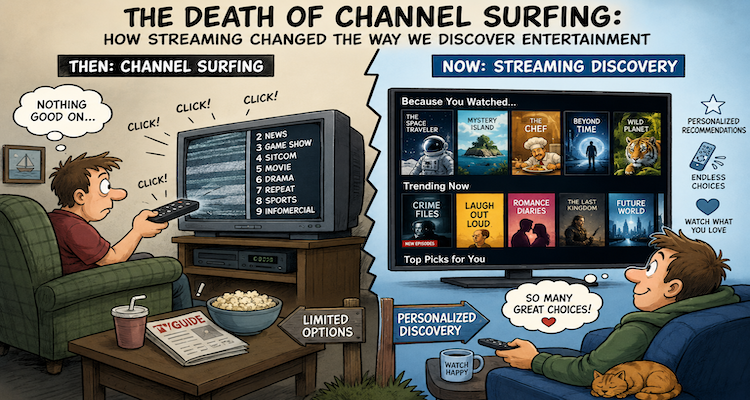
There was a particular kind of entertainment discovery built into television for decades: pressing a button and seeing what happened to be on.
A viewer might begin with a news channel, pass through a sitcom, pause at a movie already halfway finished, discover a documentary they had never planned to watch, and eventually settle on something almost by accident. Channel surfing was inefficient, but that inefficiency had a cultural function. It made discovery partly accidental.
Streaming changed the basic architecture of that experience. Instead of moving through a limited sequence of scheduled channels, viewers now enter enormous libraries organized by search, categories, trending lists, autoplay previews and increasingly personalized recommendations. The question is no longer simply, “What’s on?” It is often, “What does this platform think I should watch next?”
That shift matters because streaming has become central to television viewing. In the United States, Nielsen reported that streaming accounted for 44.8% of total TV usage in May 2025, exceeding broadcast and cable viewing combined for the first time.
But the more interesting change is not merely where people watch. It is how entertainment is discovered.
The remote control once allowed viewers to wander through programming. Streaming increasingly turns discovery into a process of prediction. Platforms observe viewing behavior, rank options and attempt to reduce the time between opening an app and pressing play. The result is more convenient, but it also changes who or what acts as the gatekeeper between audiences and culture.
Key Takeaways
- Streaming replaced much of channel surfing with search, scrolling and algorithmic recommendation systems.
- Personalized interfaces can reduce discovery friction but may narrow the role of accidental discovery.
- Viewers now spend significant time choosing content, even as recommendation technology becomes more sophisticated.
- Fragmentation across platforms has made finding a title nearly as important as producing one.
- AI and conversational search may become the next major layer in entertainment discovery.
From “What’s On?” to “What Should I Watch?”
Traditional television was organized around schedules.
A channel had a recognizable identity, a finite lineup and a sequence determined by a programmer rather than an individual viewer. If nothing appealed at one moment, the viewer could move elsewhere. Discovery happened through movement across a shared landscape.
Streaming reversed that relationship.
The catalog is available on demand, and the interface increasingly reorganizes itself around the individual. Netflix, for example, says its recommendation system uses signals including viewing history, ratings, information about titles, preferences of members with similar tastes, time of day, language, device and how long a title was watched. The platform also changes how titles are ranked and positioned within rows on its interface.
This represents a fundamental change in the discovery model.
Channel surfing asked viewers to explore the television environment.
Streaming increasingly attempts to interpret the viewer and reorganize the environment around them.
That can be genuinely useful. A person looking for a particular type of comedy, thriller or documentary no longer needs to wait for a programmer to schedule it. Yet the convenience comes with a subtle trade-off: discovery is less dependent on chance and more dependent on systems designed to predict preference.
Streaming Did Not Eliminate Browsing It Turned It Into Scrolling
The phrase “death of channel surfing” should not be taken literally. People still browse.
They simply browse differently.
Instead of jumping from Channel 12 to Channel 47, viewers move vertically and horizontally through rows of thumbnails. The modern equivalent of channel surfing may be the endless scroll through “Because You Watched,” “Trending,” “Popular,” “Continue Watching” and genre collections.
Research from Ofcom illustrates the shift. In its 2025 Video-on-Demand survey, 43% of UK adults and teenagers who wanted to watch something without having a specific title in mind said they went to a subscription video-on-demand service first, compared with 28% who went to TV channels first. Among 13–24-year-olds, only 7% said TV channels were their first destination, while Netflix and YouTube were substantially more common starting points.
The browsing behavior itself remains important. Ofcom found that scrolling until something catches the viewer’s eye was a common way of choosing content, particularly on Netflix.
The difference is that scrolling is rarely neutral.
The order of a traditional channel lineup was relatively stable. A streaming homepage is a ranked environment. What appears first, what is emphasized and which thumbnail or label is shown can influence what the viewer notices.
In other words, modern browsing is increasingly curated by software.
The New Problem: Too Much Entertainment
Streaming was supposed to solve the problem of limited choice. It did.
That success created a different problem: abundance.
Nielsen reported in 2023 that, based on its Streaming Content Consumer Survey, audiences spent an average of 10.5 minutes searching for something to watch, up from nearly 7.5 minutes in early 2019. The same Nielsen analysis said that 20% of audiences sometimes began looking without knowing what they wanted, failed to find something and chose to do something else instead.
This is one of the central contradictions of streaming.
More choice does not automatically mean easier choice.
A traditional channel guide limited the universe. Streaming expands it while simultaneously dividing it across multiple services, catalogs and interfaces. A viewer may know that a film exists but still need to determine which service carries it in a particular market.
This makes discovery a major competitive function.
The streaming company that helps a viewer find something satisfying quickly may have an advantage over one with an equally strong library but a frustrating interface. Recommendation systems, metadata, search and interface design are therefore no longer secondary technical features. They are part of the entertainment product itself.
Algorithms Became the New Programming Layer
Television programmers once decided which shows occupied valuable time slots.
Streaming platforms have not eliminated programming decisions. They have redistributed them.
The homepage is now a form of programmable storefront, where titles can be arranged differently for different people.
Netflix describes its system as ranking titles according to the estimated likelihood that a viewer will enjoy them. The company says recommendations can change based on recent activity and that interactions with the service continuously provide new signals to its recommendation systems.
The company’s 2025 redesign pushed this idea further. Netflix said its updated television interface was designed to provide more responsive recommendations and make information relevant to viewing decisions more visible.
That illustrates a broader industry direction: the entertainment interface is becoming an active participant in the decision.
The viewer is not merely entering a digital library. They are entering a system that has already ranked parts of that library.
This does not mean algorithms completely determine what people watch. Search, word of mouth, reviews, social media, cultural events and personal curiosity remain powerful discovery mechanisms.
But the interface increasingly determines what is easiest to notice.
And in an environment containing thousands of options, visibility itself is valuable.
What We May Lose When Discovery Becomes Predictive
The strongest argument for personalized recommendations is obvious: people often want relevant suggestions.
But accidental discovery has value precisely because it is not always predictable.
A viewer may discover an old film because it happened to be playing after another program. They may encounter a genre they would never have searched for. They may watch something outside their usual preferences because there was little friction involved in staying on the channel.
Recommendation systems can certainly introduce unfamiliar titles. Netflix, for example, says its system can use information from members with similar tastes and can present diverse or popular titles when it has limited information about a new profile.
Still, the central logic of personalization is prediction.
The system attempts to estimate what an individual is likely to enjoy. That is useful, but it raises an editorial and cultural question: if discovery becomes increasingly optimized around past behavior, how much room remains for productive surprise?
This should not be overstated as a proven “filter bubble” effect for entertainment. Recommendation systems vary, and platforms do not publicly reveal every aspect of their ranking methods.
The more defensible point is simpler: the mechanisms of discovery have changed. Chance has not disappeared, but it increasingly operates inside interfaces shaped by ranking systems.
Fragmentation Has Made Discovery a Business Problem
The old television landscape was fragmented by channels. The streaming landscape is fragmented by services.
A popular series may be exclusive to one platform, a live sporting event to another and a classic film to a third. Free ad-supported services have added further options, while YouTube occupies a different position by combining professionally produced entertainment with creator-driven video.
Nielsen’s June 2025 report noted that streaming had reached 44.8% of total U.S. television usage, while broadcast and cable combined represented 44.2%.
That milestone reflects more than a migration from one delivery system to another. It also signals a growing competition over the viewer’s starting point.
The service that a person opens first has an opportunity to shape the rest of the viewing session.
This is why platforms are investing in better search, recommendation technology and interface redesign. Netflix’s 2025 changes, for example, emphasized more visible shortcuts, responsive recommendations and richer information about titles.
Content remains essential. But in a fragmented market, helping people find content is becoming a strategic challenge of its own.
The Next Shift May Be Conversational Discovery
The next replacement for channel surfing may not be more scrolling.
It may be conversation.
Instead of navigating categories, a viewer could increasingly ask for something specific: a light mystery under two hours, a science-fiction film suitable for teenagers, or a drama with the emotional tone of another show.
Netflix announced in 2025 that it was exploring generative AI for an opt-in mobile search beta that could respond to conversational requests such as wanting something funny and upbeat.
By 2026, Nielsen’s Gracenote reported evidence that AI tools were already influencing entertainment discovery. In a survey of 4,003 U.S. AI chatbot users aged 13 to 79, 57% said AI tools could become or already were their preferred way to get information about why, where and when to watch content. Among the surveyed Gen Alpha respondents aged 13 and 14, 49% selected web- and app-based AI chatbots as the best source for TV and movie recommendations.
The findings also reveal an important limitation: adoption and trust are not the same. Nielsen reported that traditional search still outperformed chatbots on perceived trustworthiness and accuracy among the survey respondents.
That distinction matters.
Entertainment discovery systems are only useful if viewers can trust that the answer is accurate, that a title is actually available, and that recommendations reflect reliable information rather than incomplete or outdated metadata.
The future may therefore involve a combination of systems: recommendation algorithms, conversational AI, human curation, social recommendations and traditional search.
The Real Change Is Who Curates the Screen
Channel surfing was never a perfect system. It could be repetitive, frustrating and dependent on whatever programmers had scheduled.
Streaming solved many of those problems. Viewers gained control over time, access to deeper libraries and increasingly personalized recommendations.
But something important changed in the process.
The old television experience made the schedule visible. The new streaming experience often hides its editorial structure behind personalization. A homepage can look like a simple collection of choices even though those choices may already have been selected, categorized and ranked by software.
That is the deeper story behind the decline of channel surfing.
We have not stopped searching for entertainment. We have changed the system that searches with us.
The remote control encouraged viewers to move through a shared media environment, sometimes finding something because it was there at the right moment. Streaming transformed that process into a more individualized experience, where platforms increasingly try to anticipate the next decision before the viewer makes it.
The likely future is not a return to endless channel hopping. It is a contest to become the most useful guide through an overwhelming entertainment universe.
For viewers, that may mean less time wandering and more time watching. For the entertainment industry, it means that discovery is no longer simply what happens before the content begins.
It is part of the product.
Conclusion
Channel surfing is fading not because people no longer enjoy discovering something unexpected, but because the technology of discovery has changed. Streaming replaced the fixed television lineup with searchable libraries, personalized interfaces and recommendation systems designed to anticipate preference.
That has made entertainment more accessible while making discovery more dependent on the systems that organize attention. The next stage conversational and AI-assisted discovery could make finding something to watch even easier.
The unanswered cultural question is whether the best discovery tools will merely become better at predicting what viewers already like, or whether they can preserve one of television’s old pleasures: finding something you never intended to watch.
This content is published for informational or entertainment purposes. Facts, opinions, or references may evolve over time, and readers are encouraged to verify details from reliable sources.