










Why Video Game Adaptations Are Finally Winning Over Audiences
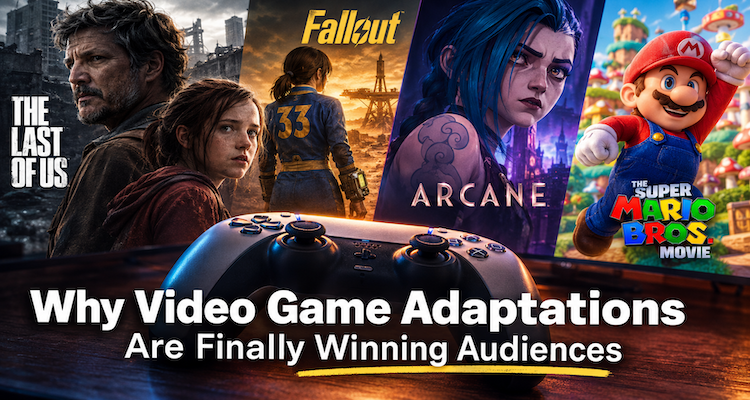
For decades, “video game adaptation” was often shorthand for creative compromise: familiar characters, recognizable costumes, and little confidence that the games themselves contained stories worth understanding. That assumption has changed. Recent successes such as The Last of Us, Fallout, Arcane, The Super Mario Bros. Movie and Sonic the Hedgehog point to a broader shift in how studios approach game worlds and how audiences respond to them.
The important change is not simply that Hollywood has found better games to adapt. It is that many of the strongest adaptations have stopped treating games as raw material to be “fixed” for film or television. Instead, they are increasingly treating them as established fictional worlds with their own tone, characters, visual language and communities. The result is a new production model: preserve what makes the property meaningful, then adapt the experience rather than mechanically reproducing the gameplay.
Key Takeaways
- Successful adaptations increasingly preserve a game’s identity instead of using its name as a marketing shortcut.
- Television gives complex game worlds more room for character development and world-building.
- Creators are learning to translate gameplay experiences rather than literally recreating gameplay on screen.
- Direct involvement from game creators can help adaptations retain the source material’s distinctive perspective.
- The strongest projects work for existing fans while remaining understandable to audiences unfamiliar with the games.
- The recent success does not mean every game adaptation will work; creative fit still matters more than brand recognition.
Why the “Video Game Movie Curse” Is Fading
The old assumption that video games cannot be adapted well was partly built on a category mistake. Games and films do not fail for the same reasons, and a faithful adaptation does not necessarily mean reproducing every mission, mechanic or plot point.
A game gives players agency. They explore, fail, repeat tasks and sometimes create their own relationship with a fictional world. Film and television cannot reproduce that agency. The successful adaptations have largely stopped trying.
Instead, they ask a more useful question: What made people care about this game in the first place?
For The Last of Us, the answer was not simply infected creatures or post-apocalyptic action. The emotional relationship between Joel and Ellie was the narrative core. For Fallout, the attraction was not one mandatory storyline but a distinctive world: retro-futurism, dark comedy, moral ambiguity and the strange logic of life after nuclear catastrophe. Arcane used the League of Legends universe as a foundation for a character-driven animated drama rather than attempting to turn a multiplayer match into a conventional plot.
That distinction is central to the current success. The better adaptations preserve the identity of the game while accepting that the screen version must become its own work.
Television Has Changed the Economics of Adaptation
The rise of prestige and streaming television has also given game adaptations something earlier projects often lacked: time.
A two-hour film can struggle to introduce a dense fictional universe, explain its stakes and develop relationships without becoming overloaded. Episodic storytelling offers another option. A series can devote an episode to a character, explore a side of the world that the game only suggested, or build emotional context before a major narrative turn.
The Last of Us demonstrated the advantage clearly. Its first season did not merely compress the game into a feature-length narrative. It used television to expand selected parts of the story while retaining the central journey. The approach was rewarded with both audience attention and major awards recognition: HBO said the first-season premiere drew 4.7 million U.S. viewers across HBO and HBO Max, while the finale reached 8.2 million on its premiere night. The Television Academy currently lists the series with 40 Emmy nominations and nine wins.
The broader lesson is not that every game should become a television series. Some properties are better suited to animation or feature films. The lesson is that format is now increasingly being chosen around the material rather than forcing every game into the same Hollywood structure.
The Best Adaptations Understand That “Faithful” Does Not Mean Identical
This may be the most important creative shift.
Fans often want an adaptation to respect the source material, but respect and literal duplication are different things. A scene designed to be interactive can become repetitive or dramatically unnecessary when viewers are no longer holding the controller.
The strongest adaptations therefore make choices about what to preserve:
- Character relationships
- The emotional tone of the original
- The rules and identity of the fictional world
- Recognizable imagery, music or cultural details where they serve the story
- The themes that gave the game lasting meaning
What they can change is the delivery mechanism.
Fallout provides a particularly useful example. Rather than retelling one existing game’s protagonist story, the television series is set within the broader Fallout universe and introduces new central characters. That approach allowed the show to feel connected to the games without requiring audiences to know a particular storyline before watching. Amazon described the series as based on the Fallout franchise while building its narrative around new characters in its post-apocalyptic setting.
The critical response suggests why that strategy resonated. Rotten Tomatoes described the first season as an adaptation that felt like a true extension of the games while also working for newcomers and longtime fans.
That is a more sophisticated model than the old choice between “faithful” and “unfaithful.” An adaptation can be faithful to a world, tone and creative philosophy without becoming a scene-by-scene reproduction.
Game Creators Are No Longer Always Kept at Arm’s Length
Another important development is the greater involvement of people connected to the original properties.
Neil Druckmann, who helped create The Last of Us games, served as an executive producer on the HBO series alongside Craig Mazin. The Television Academy’s credits for the show reflect that continuing involvement from creators and producers connected to Naughty Dog and PlayStation Productions.
Nintendo also highlighted its direct involvement in the production of The Super Mario Bros. Movie. In an investor presentation, the company said it viewed the film as an important part of expanding access to Nintendo intellectual property and noted that the audience included people with and without gaming experience.
This does not mean that a game’s original creator must control every creative decision. Creative collaboration can also introduce limitations. But direct involvement can reduce a longstanding problem: filmmakers adapting a property they recognize primarily as a brand rather than as a culture with its own internal logic.
The result is a subtle but important change in the relationship between Hollywood and games. Video game companies are increasingly participating as active partners rather than simply licensing characters and settings.
Animation Has Proved Especially Powerful
Not every successful adaptation has tried to become live action.
Arcane showed how animation can preserve the heightened visual identity of a game world while also creating an aesthetic language suited to television. Its success is particularly significant because League of Legends is not primarily known for a single linear narrative comparable to a traditional novel or screenplay.
The adaptation built a character story from a much larger fictional universe.
The Television Academy lists Arcane with eight Emmy wins and records its 2025 win for Outstanding Animated Program, reinforcing that game-based adaptations are now competing within mainstream television categories rather than being treated as a separate novelty.
That matters because animation removes one of the false assumptions that shaped many earlier adaptations: that a game must become “more realistic” to become more legitimate. Sometimes the opposite is true. A stylized world may survive translation better when the adaptation preserves its visual imagination.
Commercial Success Has Changed the Industry’s Attitude
Creative improvement alone does not explain the surge in adaptations. The business case has become difficult to ignore.
The Super Mario Bros. Movie generated more than $1.36 billion worldwide, according to Nintendo’s published investor material, which described it as the highest-grossing film based on a video game at the time of the presentation. Nintendo also reported that Universal Pictures estimated the film had been seen by roughly 169.8 million people worldwide.
The scale matters because it demonstrates something Hollywood once underestimated: successful game adaptations do not have to appeal only to players.
Nintendo explicitly emphasized that the Mario film reached audiences both with and without gaming experience. That may be the commercial formula the strongest adaptations increasingly share. Existing fans provide cultural recognition and scrutiny, while the adaptation must still function as entertainment for people who have never played the source material.
This creates a productive creative constraint. Fan service alone is not enough, but ignoring the source material can alienate the audience that made the property valuable in the first place.
The strongest projects have to satisfy both groups.
Why Audiences May Be More Ready for These Stories Now
There is also a cultural shift worth considering.
Video games are no longer an unusual source of fictional worlds. Several generations have grown up with characters and franchises that are as familiar to them as superheroes, fantasy novels or television dramas.
That does not automatically make every game adaptable. Interactivity remains a real challenge. A game built primarily around player freedom, repetitive systems or mechanical mastery may not have an obvious screen equivalent.
But the industry’s understanding of games has matured. Creators increasingly recognize that games can contain:
- Fully developed fictional universes
- Long-running character relationships
- Established visual languages
- Deep communities of interpretation and fandom
- Stories that can be expanded rather than merely retold
The current wave is therefore less about Hollywood suddenly discovering that games are popular. Studios have known that for decades.
What has changed is a growing recognition that popularity is not the same thing as narrative value and that understanding a game’s appeal is more important than simply owning its intellectual property.
Success Is Still Far From Guaranteed
It would be premature to declare the adaptation problem solved.
The recent record remains uneven. Rotten Tomatoes’ overview of game-based television includes highly acclaimed series but also examples that received significantly weaker critical or audience responses.
The packed development pipeline creates another risk: success can encourage imitation.
Once a business category becomes attractive, studios may pursue recognizable properties because the name itself reduces marketing uncertainty. But brand recognition cannot answer the basic creative question of whether a particular game has a compelling screen format.
A survival game may be well suited to a tense film. A vast role-playing universe may require a long-running series. A visually distinctive property may work best as animation. Some games may simply be more effective as games.
That last possibility is important. A successful adaptation should not be treated as proof that the original medium was inadequate. The best projects add another way to experience a world. They do not replace the reason the game existed.
The Bigger Shift: Adaptation Has Become Translation
The strongest evidence of progress is not that recent adaptations are more expensive or feature bigger stars. It is that the creative process is becoming more medium-aware.
Earlier adaptations often treated a video game as a rough outline waiting to be transformed into “real” entertainment. The current successes are more likely to begin with the opposite assumption: the game already works, but it works because of qualities that may need to be translated rather than copied.
That is why The Last of Us, Fallout, Arcane and The Super Mario Bros. Movie can look so different while revealing a similar industry lesson. There is no universal formula for adapting games. The useful formula is to identify what the audience actually values and then choose the storytelling form that can carry those qualities forward.
The so-called video game adaptation curse did not disappear because Hollywood finally found a perfect template. It is fading because creators are increasingly abandoning the search for one.
The next generation of successful adaptations will probably come from the same principle: respect the source, understand the medium, and build a screen story that can stand on its own even when the controller is gone.
This content is published for informational or entertainment purposes. Facts, opinions, or references may evolve over time, and readers are encouraged to verify details from reliable sources.
Related News
- Netflix’s 2026 Book Options Reveal What Stories It May Be Betting On Next
- From Fan Fiction to Blockbusters: How Online Communities Are Changing Storytelling
- The Death of Channel Surfing: How Streaming Changed the Way We Discover Entertainment
- Why We Rewatch Old Movies: The Psychology Behind Comfort Entertainment