








Why Sleep Is Becoming a Luxury and What It Is Doing to Our Health
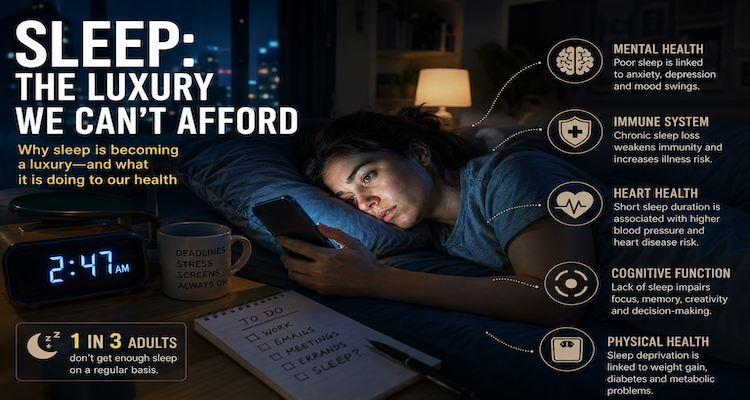
For most of human history, sleep was treated as an ordinary biological necessity. You worked, you ate, and eventually you slept. Today, getting enough sleep can feel less like a default and more like something that must be protected, scheduled, defended and sometimes purchased.
A quiet bedroom may require living space that many people cannot afford. A consistent bedtime may be difficult for shift workers, parents, caregivers and people holding multiple jobs. Smartphones, streaming platforms and round-the-clock work communication compete for the same hours that the body needs for recovery. Even the growing market for premium mattresses, sleep trackers and wellness technology reflects a striking contradiction: societies increasingly recognize the importance of sleep while making uninterrupted sleep harder to obtain.
The problem is not simply that people are choosing to stay up late. Sleep is shaped by work schedules, income, caregiving responsibilities, commuting, stress, living conditions and health. That makes the modern sleep problem more than a matter of personal discipline. Increasingly, the ability to get sufficient, regular and high-quality rest can depend on resources and circumstances that are unevenly distributed.
The health consequences are significant. Major health institutions link insufficient sleep with impaired attention and decision-making, reduced productivity and safety, and increased risks associated with cardiovascular and metabolic health problems. For healthy adults, expert consensus recommends at least seven hours of sleep per night on a regular basis, while recognizing that individual sleep needs vary.
Key Takeaways
- Sleep is increasingly shaped by work, income, caregiving and living conditions, not simply personal habits.
- Adults generally need at least seven hours of sleep regularly, although individual sleep needs vary.
- Chronic sleep deficiency can affect cognition, emotional regulation, physical health and everyday safety.
- Long hours, multiple jobs and shift work can turn adequate sleep into a structural challenge.
- Sleep technology may help some people monitor habits, but it cannot substitute for sufficient time and conditions to sleep.
- Treating sleep as a private lifestyle choice can obscure the social and economic conditions that determine who gets enough rest.
Sleep is a biological need, but access to it is increasingly unequal
The phrase “sleep is becoming a luxury” should not be taken literally. Sleep itself is free. The conditions required for healthy sleep often are not.
Adequate sleep requires time. It also benefits from regularity, an environment suitable for rest and a schedule that does not repeatedly conflict with the body’s internal clock. Those conditions can be difficult to secure when someone works irregular hours, holds more than one job, provides care to children or relatives, or has a long commute.
The U.S. National Heart, Lung, and Blood Institute specifically identifies people working long hours or multiple jobs, caregivers and shift workers among groups more likely to experience sleep deficiency.
That distinction matters because public conversations about sleep often focus heavily on individual behavior: put the phone away, avoid caffeine late in the day, keep a regular bedtime. Those habits can be useful. But they do not solve the problem of a worker who finishes a late shift and must begin another job early the next morning, or a parent whose sleep is repeatedly interrupted by caregiving.
The modern sleep gap, in other words, is partly a time problem.
For some people, the question is, “How can I sleep better?” For others, the more basic question is, “When can I sleep enough?”
The evidence is clear on one point: chronic short sleep carries consequences
Sleep is not simply downtime. During sleep, the body and brain carry out processes important for physical health and normal cognitive functioning.
The National Institutes of Health notes that sleep deficiency can interfere with learning, focus, reaction time, decision-making and emotional regulation. It can also affect performance at work and school and increase the likelihood of mistakes.
Over longer periods, insufficient sleep is associated with a range of health problems. NIH and CDC resources link inadequate or short sleep with cardiovascular and metabolic health concerns, obesity, diabetes, depression and other conditions. These associations do not mean that sleep loss alone causes every one of these outcomes; health is influenced by many interacting factors. But the evidence is strong enough that sleep is widely regarded as a major component of overall health.
A recent umbrella review synthesizing systematic reviews and meta-analyses also reported broad associations between sleep deprivation and adverse cardiovascular, metabolic and mental health outcomes. As with much sleep research, the strength and nature of evidence vary by outcome, and observational associations should not automatically be interpreted as direct causation.
The more immediate effects can be easier to recognize. Poor sleep can mean slower reactions, reduced attention and impaired judgment. The consequences may be felt in offices, classrooms, hospitals, factories and on roads not only in the bedroom.
That is one reason sleep should be viewed partly as a public safety issue rather than exclusively as a private wellness preference.
Seven hours is a public-health benchmark, not a universal magic number
Sleep advice is often reduced to a simple command: get eight hours.
The science is more nuanced.
The American Academy of Sleep Medicine and the Sleep Research Society recommend that adults aged 18 to 60 sleep seven or more hours per night on a regular basis to promote optimal health and reduce the risk of adverse outcomes. The recommendation also recognizes individual variability in sleep needs.
The important point is not that every adult requires exactly the same number of minutes in bed. Sleep duration is only one part of sleep health. Quality, timing and regularity also matter, and sleep disorders or other medical conditions can affect how rested someone feels.
This is also why consumer culture can sometimes oversimplify sleep. Buying a new mattress, downloading a sleep app or checking a wearable score may provide information or improve comfort, but none of these products can create additional hours in a schedule that has no room for rest.
The most expensive sleep technology cannot solve a shortage of time.
The hidden contradiction of the sleep economy
Sleep has become a major commercial category.
Consumers can now buy smart rings, watches, mattresses, cooling systems, white-noise devices, sleep subscriptions and apps designed to track or improve rest. Some of these products may be useful for particular purposes. But the expansion of the sleep economy also reveals a deeper contradiction.
The same society that increasingly treats sleep as measurable and optimizable often rewards behavior that competes with it: late-night availability, irregular work schedules, extended screen time and the idea that productivity should fill every available hour.
This does not mean technology is the enemy of sleep. Digital tools can help people observe patterns, build routines or identify issues worth discussing with a healthcare professional. The limitation is more fundamental: measurement is not the same as restoration.
A device can tell someone that they slept poorly. It cannot guarantee that their employer will provide a predictable schedule. An app can recommend an earlier bedtime. It cannot shorten a commute, remove a second shift or take over caregiving responsibilities.
That is where the idea of sleep as a luxury becomes useful. It draws attention to the gap between knowing what healthy sleep requires and having the practical ability to obtain it.
Work is one of the biggest forces shaping who gets to rest
Modern discussions of productivity frequently celebrate efficiency. Yet the relationship between work and sleep contains a basic tension: extending waking hours can create the appearance of more productive time while reducing the cognitive performance needed to use that time well.
According to the NHLBI, sleep deficiency can make people less productive, slower to react and more prone to mistakes. The agency also notes that repeated sleep loss can substantially impair daytime functioning.
This creates an uncomfortable cycle. Someone who is short on time may sacrifice sleep to create more waking hours. But inadequate sleep can make those hours less effective.
For employers and policymakers, this raises questions that go beyond individual wellness programs. Predictable scheduling, reasonable working hours, protections for shift workers and attention to fatigue can influence whether people have a realistic opportunity to obtain adequate rest.
Not every sleep problem can be solved through workplace policy. Insomnia, sleep apnea, mental health concerns, chronic illness and other conditions can disrupt sleep regardless of work schedules. But structural constraints should not be ignored simply because sleep is experienced individually.
The health cost may be gradual and easy to normalize
One of the difficulties with chronic insufficient sleep is that people can adapt psychologically to feeling tired without fully recovering their performance.
NIH information on sleep deficiency warns that people may underestimate how impaired they are. Sleep loss can affect attention, reaction time and decision-making even when someone believes they are functioning adequately.
This is particularly relevant in cultures where exhaustion is sometimes treated as evidence of ambition.
Being busy can be visible. Being well-rested is not.
That may encourage a distorted social hierarchy in which sacrificing sleep appears admirable while protecting it appears indulgent. Yet health evidence points in the opposite direction: regular, sufficient sleep is not a reward earned after everything else is finished. It is one of the conditions that helps people function safely and effectively in the first place.
Better sleep advice must go beyond blaming the sleeper
Individuals can take practical steps to support healthier sleep. CDC guidance includes maintaining a regular sleep schedule, getting natural light earlier in the day, staying physically active and reducing exposure to artificial light near bedtime. A cool, dark and quiet sleeping environment may also help.
But good advice should recognize the difference between a modifiable habit and a constraint.
A useful way to think about sleep problems is to separate three questions:
- Do I have enough time allocated for sleep?
- Is my sleep environment and routine supporting rest?
- Could a medical or sleep-related condition be interfering with sleep?
The answers may require different solutions. Someone consistently sleeping five hours because of work demands faces a different problem from someone spending eight hours in bed but waking unrefreshed. The latter may need to discuss persistent sleep problems with a qualified healthcare professional rather than simply buying another consumer sleep product.
This distinction can prevent both extremes: blaming individuals for structural problems and assuming every sleep difficulty is caused by modern lifestyles.
Sleep may become an increasingly important measure of inequality
The most important implication of the “sleep as luxury” idea may be what it reveals about inequality.
Time, quiet, privacy, predictable schedules and freedom from constant economic pressure are not distributed evenly. Neither are the conditions that make consistent sleep easier.
That does not mean every affluent person sleeps well or every lower-income worker sleeps poorly. Sleep is affected by biology, health, family circumstances and many other factors. But the ability to protect time for rest can itself be a form of advantage.
The emerging challenge is to stop treating sleep exclusively as a personal optimization project.
Sleep hygiene matters. Medical care matters. Technology can sometimes help. Yet a society serious about sleep health must also ask whether its work patterns, schedules and expectations make healthy sleep realistically possible.
Conclusion
Sleep is not becoming biologically more valuable than it was before. What is changing is the environment around it.
For a growing number of people, sufficient rest must compete with economic pressure, irregular schedules, caregiving, digital distractions and a culture that often treats constant availability as normal. That makes sleep a revealing measure of modern life: a universal human need whose protection increasingly depends on time, stability and control.
The health message is straightforward even if the solution is not. Adults generally need adequate, regular sleep, and chronic sleep deficiency can affect how people think, feel, work and maintain physical health.
The deeper question is whether healthy sleep should be treated merely as another individual responsibility—or as something that workplaces, communities, technology companies and public-health systems should make easier to achieve.
Protecting sleep may begin with a bedtime routine. But it should not end there.
This article is provided for general informational and educational purposes. It is not medical advice, diagnosis, or a substitute for consultation with a qualified healthcare professional. Health evidence can change, and individual circumstances vary.