




Why Preventive Health Is Becoming More Data-Driven and More Complicated
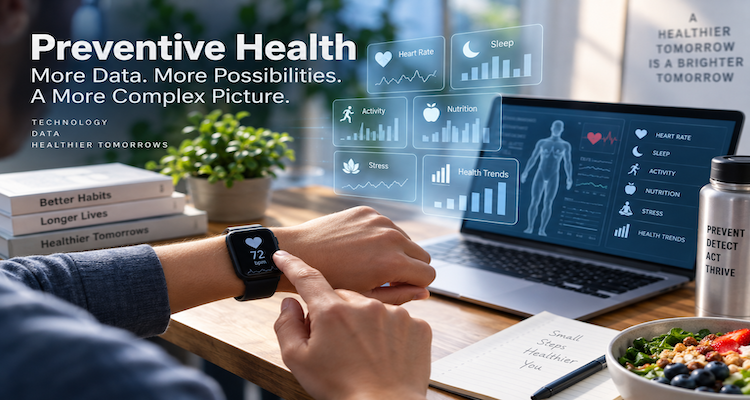
Preventive health used to revolve largely around periodic checkups, blood tests, vaccinations, screenings, and conversations with a clinician. Increasingly, another layer is being added: a continuous stream of data generated between those appointments.
Smartwatches and fitness trackers can record activity, heart rate, sleep patterns and other measurements. Digital health systems can combine these data with electronic health records, surveys and physical measurements. Researchers are also exploring how wearable signals can become “digital biomarkers” that reveal changes over time rather than a single snapshot.
That shift could make prevention more personalized and responsive. But it also introduces a difficult question: when more health data become available, does that automatically mean better preventive care?
The answer is no. More data can reveal useful patterns, but it can also introduce measurement errors, false alarms, privacy risks, unequal access and a new burden of interpreting information. The emerging challenge is therefore not simply collecting more health data. It is determining which data are reliable, clinically meaningful and worth acting on.
Key Takeaways
- Wearables can provide continuous measurements that complement, rather than replace, conventional preventive care.
- Digital biomarkers may help researchers identify health patterns that are difficult to capture during occasional clinical visits.
- More measurements do not automatically produce better decisions because wearable data can contain noise, missing information and algorithmic uncertainty.
- Health data become more useful when they can be connected responsibly with clinical records and other reliable information.
- Privacy, cybersecurity, interoperability and demographic representation are becoming central parts of preventive-health technology.
- The most important shift may be from collecting health data to deciding which signals deserve medical attention.
From Periodic Checkups to Continuous Signals
Traditional preventive medicine is built around defined interventions: screening people for certain conditions, providing vaccinations, identifying risk factors and encouraging behaviors that reduce the likelihood of disease.
The U.S. Preventive Services Task Force, for example, evaluates preventive services according to evidence of benefits and harms rather than simply recommending more testing. Its recommendations cover screenings, behavioral interventions and preventive medications, with recommendations changing as evidence develops.
Digital technology adds a different dimension.
Instead of measuring a person only when they visit a clinic, connected devices can produce observations across ordinary life. A wearable may record activity throughout the day, while sleep measurements can accumulate over weeks or months. In research, those longitudinal records can be combined with electronic health records to examine relationships between everyday behavior and health outcomes.
The NIH’s All of Us Research Program illustrates the scale this approach can reach. Its research infrastructure includes electronic health records, surveys, physical measurements and wearable-device information. A recent description of its expanded wearables dataset reported Fitbit data from more than 59,000 participants, providing millions of observations that researchers can use to investigate relationships between digital measurements and health.
That does not mean a smartwatch can diagnose disease simply because it produces a large amount of information. The value lies in the longitudinal pattern and how that information is interpreted.
The Rise of the Digital Biomarker
One of the more important developments is the movement from raw measurements toward digital biomarkers.
A step count is a measurement. A pattern of physical activity collected over an extended period may provide a different kind of information. Similarly, individual heart-rate readings may be less informative than changes in patterns observed over time and interpreted alongside other evidence.
Researchers increasingly describe wearable signals as potential digital biomarkers, but the transition from sensor reading to clinically useful biomarker is not automatic.
Research published in npj Digital Medicine has highlighted the methodological challenges involved in developing digital biomarkers from wearable sensor data. The process involves decisions about data collection, signal quality, analysis, validation and translation into meaningful health outcomes.
This distinction matters for consumers.
A device can measure something accurately without that measurement being sufficiently validated to diagnose a particular medical condition. A software algorithm can detect a statistical pattern without establishing what that pattern means for an individual person’s health.
The difference between measurement, prediction and diagnosis is therefore becoming increasingly important.
Why More Data Can Also Create More Uncertainty
The appeal of continuous monitoring is easy to understand. A single medical appointment captures a limited period of someone’s life. A wearable can potentially observe behavior and physiological signals across much longer periods.
But continuous measurement creates its own problems.
Wearable sensors can be affected by device placement, movement, skin contact, environmental conditions and differences between devices. Algorithms may also interpret the same physiological signal differently. Missing data can occur when a device is removed, loses power or fails to record properly.
Researchers studying commercial wearables and early detection have identified challenges including sensor noise, differences between individuals, confounding factors and inaccurate labels used to train or evaluate detection systems.
That creates an important paradox: the more data a system collects, the more opportunities there are to find a pattern but also more opportunities to find a misleading one.
For prevention, that distinction matters because unnecessary concern can itself become a problem. A consumer may interpret a change in a wearable metric as evidence of illness when the measurement has not been clinically validated for that purpose.
Preventive technology therefore works best when data are treated as information to interpret, not as automatic medical conclusions.
The Real Opportunity Is Connecting Different Kinds of Data
The strongest potential may not come from wearables operating alone.
Research programs are increasingly interested in combining wearable measurements with electronic health records, surveys, physical measurements and other forms of health information. The NIH’s All of Us program provides an example of this multimodal approach.
Combining sources can provide context that a single device cannot.
A change in activity might mean something different in a person recovering from an injury than in someone whose medical history is otherwise unchanged. Sleep patterns may need to be interpreted alongside medications, work schedules, age and other factors. A heart-rate measurement may have a different meaning depending on the circumstances in which it was collected.
This is where preventive health starts to resemble a data-integration problem as much as a medical one.
The useful question is no longer simply, “What did the device measure?”
It becomes:
What does this measurement mean when considered alongside everything else we reliably know about the person?
Privacy Becomes Part of Preventive Medicine
More personalized prevention also means more personal information.
Health data can include activity patterns, sleep behavior, physiological measurements, medical histories and information inferred from those records. When data from different systems are linked, the resulting picture can become considerably more detailed than any individual dataset.
The World Health Organization has emphasized that effective health-data governance requires attention to privacy, security, data quality, interoperability and responsible access. Its 2025 work on health-data governance and AI specifically notes that high-quality, representative datasets are important for developing safe and reliable AI systems.
This creates a second layer of preventive-health responsibility.
A health technology should not be judged only by whether it can collect information. Questions about who can access that information, how it is protected, how long it is retained, whether it can be transferred between systems and how it may be reused are also relevant.
Cybersecurity is particularly important because digital health systems increasingly include cloud services, mobile applications, connected medical devices and AI-enabled systems. The WHO’s European Region has identified cybersecurity and privacy assessment as important components of digital-health infrastructure.
In other words, protecting health data is becoming part of protecting health itself.
Data Quality and Representation Matter
Another complication is that health technology does not necessarily collect an equally representative picture of everyone.
Wearable ownership and participation in digital-health research can vary by income, education, age and other demographic factors. Research from the All of Us wearables program has specifically examined issues of representation and data quality.
This matters because an algorithm trained largely on one population may not perform identically across another.
A prevention system that works well for people who own particular devices, use them consistently and have strong digital access may be less useful for people who do not fit that profile.
The technological challenge is therefore connected to an equity challenge.
Digital prevention cannot become genuinely personalized if some populations are systematically missing from the data used to develop and evaluate the technology.
The Difference Between Monitoring and Medical Care
One of the most important distinctions for consumers is that health monitoring is not the same thing as medical care.
The FDA has issued guidance concerning digital health technologies used to acquire data remotely in clinical investigations. Such technologies can make research participation and data collection more convenient, but the existence of a digital measurement does not by itself establish that a consumer device is suitable for diagnosing or managing a particular disease.
This distinction is easy to lose in an environment where smartphones and wearables can display health metrics instantly.
A useful preventive-health system should help people identify meaningful patterns and know when professional evaluation may be appropriate. It should not encourage people to replace evidence-based screening, medical assessment or treatment with a dashboard.
Conventional preventive medicine remains important because many interventions are supported by evidence accumulated through clinical research—not simply because they produce measurable data.
Prevention May Become More Personalized, but Not Fully Automated
The most realistic future is unlikely to be a world in which an algorithm manages every aspect of prevention.
A more plausible model is collaborative.
Individuals generate more information about their daily lives. Devices and software organize that information. Algorithms identify patterns that may deserve attention. Researchers determine whether those patterns are meaningful. Clinicians provide medical interpretation when appropriate. Patients remain involved in decisions about what happens next.
That model preserves an important principle: data can improve decision-making without replacing judgment.
It also explains why preventive health is becoming more complicated. The challenge is no longer simply identifying risk factors. It increasingly involves determining which measurements are reliable, which algorithms are validated, which datasets are representative, which findings are clinically meaningful and which information should remain private.
What Consumers Should Do With All This Data
For individuals using health-tracking technology, a practical approach is to treat wearable information as a source of context rather than an independent diagnosis.
Useful habits include:
- Look for longer-term patterns rather than reacting to one unusual reading.
- Understand what a device actually measures and what its manufacturer claims about the metric.
- Check whether a health feature has been clinically validated for the specific purpose being considered.
- Continue recommended preventive screenings and routine medical care.
- Discuss persistent or concerning changes with an appropriate healthcare professional rather than relying solely on a device notification.
- Review privacy settings and understand how health information is stored and shared.
The goal is not to collect the maximum possible amount of health information.
The goal is to collect information that can support better decisions.
Conclusion
Preventive health is becoming more data-driven because technology makes it possible to observe health-related behavior and physiological signals continuously rather than only during occasional encounters with the healthcare system.
That creates genuine opportunities. Large research datasets can help scientists investigate relationships between everyday behavior and health outcomes. Wearable sensors may contribute to digital biomarkers. Connected systems can potentially give clinicians a richer picture of patients over time.
But the same expansion of data creates new problems involving accuracy, interpretation, privacy, cybersecurity, interoperability and representation.
The defining question for the next phase of digital prevention may therefore not be how much health data we can collect. It may be whether we can build systems capable of separating useful signals from noise and turning those signals into evidence-based decisions without sacrificing privacy, equity or human judgment.
More data can make prevention smarter. It can also make it more complicated. The value will depend on what happens between those two points.
This article is intended for general awareness and educational purposes only. It should not be considered medical advice. Readers are encouraged to consult qualified healthcare professionals for personal health decisions.