









Why Modern Homes Are Becoming Part of the Health Equation
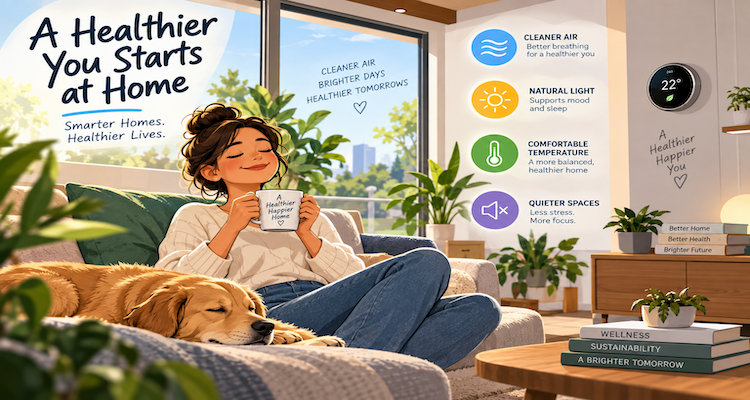
A home is usually judged by familiar measures: location, size, appearance, energy efficiency, price and comfort. But another set of characteristics is becoming harder to ignore what the building itself does to the health of the people living inside it.
Indoor air, ventilation, moisture, temperature, building materials, noise, lighting, water quality and even the way rooms are designed can influence people’s exposure to environmental risks. The World Health Organization describes housing as an important determinant of health and identifies risks ranging from indoor air pollution and dampness to extreme temperatures, unsafe construction materials, pests, noise and poor accessibility.
That does not mean a modern home is automatically healthy or that every building-related exposure causes illness. It means the traditional distinction between “home” and “health environment” is becoming increasingly difficult to maintain.
Key Takeaways
- Indoor air quality depends heavily on ventilation, pollution sources, moisture and the way a home is operated.
- Dampness and mould can contribute to respiratory problems, particularly for people with asthma or other sensitivities.
- Energy-efficient homes can reduce exposure to temperature extremes, but ventilation must be properly considered.
- Building materials and household products can introduce chemical exposures that deserve greater attention.
- Healthy-home design extends beyond air to include thermal comfort, noise, lighting, water, safety and accessibility.
- The most useful health improvements are often basic building and maintenance decisions rather than expensive technology.
The Home Is an Environmental Exposure
People spend a substantial portion of their lives indoors, making the indoor environment an important part of everyday exposure to pollutants and environmental conditions.
The WHO identifies several housing-related pathways through which health can be affected, including indoor air pollution, toxic materials, radon, dampness and mould, extreme heat and cold, pests, unsafe water and sanitation, neighbourhood noise and characteristics of urban design.
This changes the way a home can be viewed.
A poorly ventilated kitchen is not simply a design inconvenience. Cooking can introduce particles and other pollutants into indoor air. A persistent water leak is not merely a maintenance problem. Moisture can create conditions that support mould growth. An overheated bedroom is not only uncomfortable; excessive indoor heat can become a health concern, particularly for vulnerable people.
The building becomes part of the exposure pathway.
That is why public-health researchers increasingly use broader concepts such as the healthy building or healthy home, rather than focusing on individual pollutants alone.
Harvard’s Healthy Buildings program, for example, identifies ventilation, air quality, thermal health, moisture, dust and pests, safety and security, water quality, noise, and lighting and views as interconnected foundations of healthier buildings.
Why Indoor Air Deserves More Attention
Indoor air is one of the clearest examples of how building design and health intersect.
The U.S. Environmental Protection Agency notes that indoor pollution sources and inadequate ventilation are major contributors to indoor air-quality problems. Indoor sources can release gases or particles, while insufficient ventilation prevents those pollutants from being adequately diluted or removed. Temperature and humidity can also influence concentrations of some pollutants.
The answer is not simply to open every window all the time.
Outdoor air quality matters too. During periods of wildfire smoke, heavy outdoor pollution or other environmental events, bringing outdoor air indoors may not be desirable without appropriate filtration or other controls.
The more useful principle is managed ventilation: reducing pollution at its source, providing appropriate outdoor air when conditions allow, and using filtration or air cleaning where it is useful.
Harvard’s healthy-home guidance describes three broad approaches to improving indoor air: source control, dilution through ventilation and air cleaning.
This is an important distinction for modern homes because greater energy efficiency can make buildings more airtight. Airtight construction can reduce unwanted energy loss, but the building still needs an effective strategy for managing fresh air and indoor pollutants.
Energy efficiency and healthy indoor air are therefore not inherently competing goals. The challenge is designing and operating the building so that both are addressed.
Moisture Can Turn a Building Problem Into a Health Problem
Few household problems illustrate the connection more clearly than persistent dampness.
Leaks, condensation, flooding and poorly controlled humidity can create conditions that support mould. The CDC notes that indoor mould exposure has been associated with upper-respiratory symptoms, cough and wheeze in otherwise healthy people and can worsen asthma symptoms in people with asthma.
The practical lesson is straightforward: moisture should be treated as a building problem early, rather than waiting until visible mould becomes extensive.
The CDC recommends preventing water accumulation, fixing leaks, drying wet materials promptly and keeping indoor humidity below 50% where possible as part of mould prevention and asthma-control measures.
This also shows why health-conscious housing is not necessarily about buying more products.
A dehumidifier may help in some circumstances, but it cannot substitute for fixing a leaking roof, plumbing problem or persistent source of water intrusion.
The building envelope and maintenance regime can matter more than the gadget sitting inside the room.
Materials Matter, But Context Matters Too
Modern homes contain a large number of manufactured materials: paints, adhesives, flooring, furnishings, insulation, coatings, plastics and composite products.
Some materials and household products can emit chemicals into indoor environments. Harvard’s built-environment research specifically examines exposures involving volatile organic compounds, PFAS and other chemicals, as well as asbestos, lead, moulds, fungi and pathogens. Researchers are also studying ways to reduce these exposures through materials, filtration, ventilation and building design.
But this is an area where exaggerated claims can easily outrun the evidence.
The presence of a chemical in a product does not automatically mean that using the product will cause illness. Risk depends on factors including the substance, concentration, route of exposure, duration and characteristics of the exposed population.
For homeowners, the sensible approach is therefore not to treat every synthetic material as dangerous. It is to pay attention to product information, ventilation, proper installation and established guidance particularly during construction, renovation and periods when new materials may release higher levels of certain compounds.
Temperature Is Becoming a Housing Issue
A home’s ability to keep occupants within a safe and comfortable temperature range is another part of the health equation.
WHO identifies both excessive heat and excessive cold as housing-related health risks. Its housing guidance specifically addresses indoor temperatures and emphasizes the relationship between housing conditions and health.
This becomes especially important as climate conditions change.
A home that performs well during an ordinary summer may behave differently during an extreme heat event. Likewise, inadequate insulation or heating can make winter conditions more difficult for occupants.
The answer is not simply adding more air conditioning or heating capacity. Building orientation, insulation, shading, ventilation, windows, thermal mass and efficient heating and cooling systems can all influence indoor conditions.
In this sense, climate resilience and healthy-home design increasingly overlap.
A Healthy Home Is More Than Clean Air
Air quality attracts much of the attention because it can be measured and discussed in terms of pollutants. But the broader indoor environment is considerably more complicated.
Harvard’s healthy-building framework includes noise and lighting alongside air, temperature, moisture, water and safety.
That broader view matters because people do not experience buildings as isolated air-quality measurements.
A bedroom exposed to persistent traffic noise may affect sleep. Poor lighting can make a space less comfortable and functional. Unsafe stairs or inaccessible layouts can increase injury risks or make a home difficult to use for people with mobility limitations.
WHO’s housing guidance also addresses issues such as crowding, injury hazards and accessibility, demonstrating that healthy housing extends beyond environmental pollutants.
The result is a more complete definition of a healthy home: one that supports safe, comfortable and functional living while reducing avoidable environmental exposures.
What Homeowners Can Actually Do
The idea of a “healthy home” can sound expensive if it is presented mainly through smart sensors, advanced filtration systems and premium construction materials.
Many useful interventions are considerably more basic.
Homeowners and occupants can start by paying attention to:
- Ventilation: Use kitchen and bathroom exhaust systems appropriately and maintain mechanical ventilation where installed.
- Moisture: Repair leaks and investigate recurring condensation or dampness instead of simply cleaning visible mould.
- Humidity: Monitor indoor humidity when dampness or mould is a recurring concern.
- Cooking emissions: Use effective kitchen exhaust ventilation, particularly when cooking produces substantial smoke or particles.
- Air filtration: Where filtration is appropriate, select and maintain systems suited to the home’s needs.
- Temperature: Pay attention to indoor heat and cold during extreme weather, especially for vulnerable occupants.
- Renovation materials: Follow manufacturer instructions and provide appropriate ventilation during and after renovation work.
- Safety: Address trip hazards, unsafe stairs, smoke risks and other preventable household hazards.
- Noise and light: Consider bedroom placement, window design, shading and lighting when modifying living spaces.
- Maintenance: Treat building maintenance as part of healthy-home management rather than a cosmetic exercise.
None of these measures guarantees perfect health. Their value lies in reducing avoidable exposures and improving the conditions in which people live.
The Next Evolution of Home Design
The growing interest in healthy buildings points toward a broader shift in how residential construction may eventually be evaluated.
A house could increasingly be assessed not only for its energy consumption and visual design but also for its ability to maintain good indoor air, manage heat and moisture, reduce harmful exposures and provide safe, accessible living conditions.
Technology can support this transition. Sensors can help occupants understand temperature, humidity or air-quality conditions; ventilation systems can be automated; filtration can reduce certain airborne particles; and building-management systems can respond to changing conditions.
But technology is not the foundation.
A sensor can tell a homeowner that humidity is high. It cannot repair the leaking pipe causing the problem. An air purifier can reduce some airborne particles. It cannot replace adequate ventilation or eliminate the source of pollution. A smart thermostat can control temperature. It cannot compensate for fundamentally poor insulation or an unsuitable building envelope.
The most effective approach is therefore likely to combine good design, sound construction, appropriate maintenance and targeted technology.
Why This Matters Beyond Individual Homes
The health implications of housing also extend into public policy.
WHO describes housing as an increasingly important determinant of health amid urbanization, demographic change and climate pressures. It also notes that improvements in housing can contribute to disease prevention, quality of life and climate-related goals.
That makes healthy housing more than a lifestyle trend.
For homeowners, it can mean fewer avoidable environmental problems. For builders, it creates a stronger reason to consider health alongside energy performance and aesthetics. For landlords and housing authorities, it raises questions about maintenance and minimum living conditions. For cities, it connects housing policy with public health, climate resilience and inequality.
There is also an important equity issue. A household with resources can often purchase filtration, repair moisture problems quickly or improve insulation. People living in poorly maintained or overcrowded housing may have far fewer options.
A health-oriented approach to housing therefore has to consider not only what an ideal home looks like, but who has access to one.
Conclusion
The idea that a home affects health is not new. What is changing is the degree to which building science, public health and residential design are being considered together.
The evidence does not support the simplistic idea that every modern building is making people sick. It supports something more useful: the conditions created by housing can influence environmental exposures, comfort, safety and well-being, and many of those conditions can be improved through better design and maintenance.
For the homeowner, that means the healthiest upgrade is not necessarily the most expensive one. Fixing moisture, improving ventilation, controlling indoor temperature, reducing pollution sources and maintaining essential systems can be more meaningful than adding another layer of smart-home technology.
The modern home may be connected, automated and energy efficient. Increasingly, it also needs to be understood as something else: a health environment.
This article is intended for general awareness and educational purposes only. It should not be considered medical advice. Readers are encouraged to consult qualified healthcare professionals for personal health decisions.