





Technology Is Making More Decisions Invisible to Us
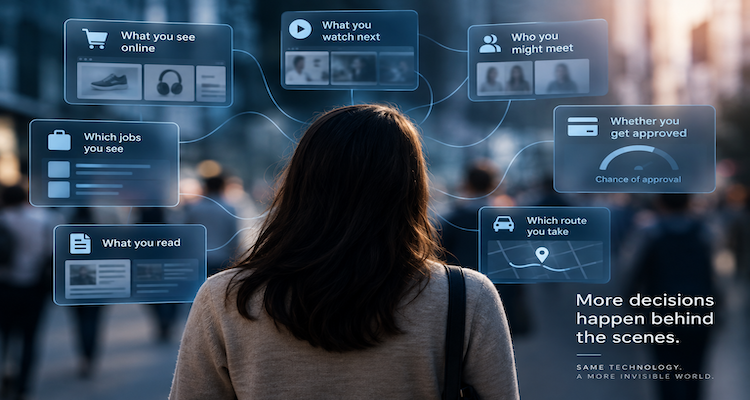
A growing share of everyday decisions no longer arrives as an obvious decision made by a person. Instead, software ranks what we see, predicts what we might want, flags transactions, recommends actions, allocates work and, in some settings, contributes to decisions about employment, credit and access to services.
The important change is not simply that machines are making decisions. Algorithms have been doing that for years. The deeper shift is that the decision-making process is increasingly embedded inside ordinary digital systems, making it difficult for people to recognize when a choice has already been filtered, prioritized or constrained before they make it.
That distinction matters. A recommendation is not the same as a final decision, and an automated process is not necessarily fully autonomous. But when people routinely accept machine-generated rankings and recommendations without knowing how they were produced, technology can influence outcomes without appearing to make a decision at all.
Key Takeaways
- Many digital systems influence choices through ranking, filtering and recommendations rather than explicit automated decisions.
- Workplace software is increasingly being used to instruct, monitor and evaluate workers across several countries.
- Algorithms can reproduce patterns in human behaviour because they learn from data generated by those behaviours.
- The most important question is often not whether AI made a decision, but how much human judgment remained in the process.
- Regulators are increasingly focusing on transparency, traceability, human oversight and the ability to challenge consequential automated decisions.
The Decision May Be Hidden Inside the Interface
Consider an ordinary online experience.
A person searches for a product. The platform decides which results appear first. A streaming service selects what appears on the home screen. A navigation application proposes a route. An email service determines what belongs in spam. A financial system can automatically evaluate information associated with a transaction.
In each case, the user still appears to be making the final choice.
But the available choices have already been processed.
This is an important distinction between decision-making and decision-shaping.
A system does not need to say “yes” or “no” to influence an outcome. It can change the order of options, remove some from immediate view, assign a probability, recommend one action over another or determine which information reaches the user first.
That makes algorithmic influence unusually easy to overlook.
NIST’s AI Risk Management Framework defines AI systems broadly enough to include systems that generate predictions, recommendations or decisions that influence real or virtual environments.
The implication is significant: the relevant technology is not limited to humanoid robots or chatbots. Much of the important decision automation is already embedded in software people use every day.
From Automation to Decision-Shaping
Older automation was relatively easy to identify.
A calculator performed a calculation. A database retrieved a record. A payroll system calculated wages according to programmed rules.
Modern systems can operate differently.
Machine-learning systems can identify patterns in large datasets and use those patterns to generate predictions or recommendations. Their output may then become one input into a human decision.
That creates a spectrum:
Human decision → AI-assisted decision → AI-recommended decision → automated decision
The boundaries are not always obvious.
A manager might technically make the final hiring decision while relying heavily on software that has already ranked candidates. A customer may technically choose a product while seeing only items selected by a recommendation engine. A manager may remain responsible for assigning work while software determines schedules according to constantly changing data.
The human is still present, but the structure around the human decision has changed.
Research on algorithmic human-resource management distinguishes between automated and augmented decision-making for precisely this reason: algorithms can replace parts of a decision process without completely replacing the person responsible for the final decision.
Workplaces Offer a Clear Example
The workplace provides one of the clearest demonstrations of how invisible decision-making is becoming.
An OECD survey published in December 2025 examined algorithmic-management software across France, Germany, Italy, Japan, Spain and the United States. The survey defined algorithmic management as software that partially or fully automates managerial functions such as instructing, monitoring or evaluating workers.
The results show substantial adoption.
The OECD reported that 90% of surveyed U.S. managers said their firms had adopted at least one algorithmic-management tool. The average across the four European countries surveyed was 79%, while Japan was at 40%.
The same research illustrates the tension surrounding these systems.
Managers using algorithmic-management tools commonly reported improvements in their own decision-making, citing greater access to information, faster decisions and increased autonomy. At the same time, nearly two-thirds of managers using such tools expressed concerns about their effects on workers. Unclear accountability for incorrect decisions was the most frequently reported concern.
That combination is revealing.
A system can make an organization feel more informed and efficient while simultaneously making responsibility harder to locate.
If software recommends that a worker receive fewer shifts, be monitored more closely or receive a particular evaluation, who actually made the decision?
The manager?
The software?
The people who selected the software?
The people who designed its rules?
The answer can be more complicated than the interface suggests.
Algorithms Learn From Human Behaviour Including Its Biases
Another reason invisible decisions matter is that algorithms do not necessarily begin with neutral information.
Many systems learn from historical or behavioural data. But historical data can contain the consequences of previous human decisions, institutional practices and social patterns.
A 2023 Nature Human Behaviour commentary highlighted an important mechanism: algorithms designed to learn preferences from user behaviour can inherit problems when that behaviour itself reflects psychological biases.
This creates a feedback problem.
Suppose a system repeatedly observes that users prefer certain content. It may show more of that content. Users then interact with the content the system has prioritized, producing more behavioural data. That data can subsequently reinforce the system’s future recommendations.
The resulting pattern can look like an objective measurement of preference even though the system has helped shape the behaviour it is measuring.
This does not mean every recommendation system is biased or harmful. It means that data generated by human choices should not automatically be treated as a neutral representation of human preferences.
That distinction becomes particularly important when algorithmic outputs are used in consequential environments.
When “Human in the Loop” Is Not the Whole Story
Organizations often emphasize human oversight as an important safeguard.
It is an important safeguard, but simply having a person somewhere in the process does not tell us how much meaningful control that person actually has.
Imagine a system that evaluates thousands of cases and presents a manager with a recommended action. The manager can technically override it, but the recommendation arrives with a high confidence score and supporting information while alternatives require additional investigation.
The formal decision remains human.
The practical decision may be heavily influenced by the machine.
This is why responsible AI frameworks focus on more than whether a human is technically present. NIST’s AI Risk Management Framework emphasizes characteristics including validity and reliability, safety, security, accountability, transparency, explainability, privacy and fairness.
The question therefore becomes more useful when phrased differently:
Can the human meaningfully understand, question and override the system?
That is a much stronger standard than simply asking whether a human clicked the final button.
Transparency Is Becoming a Practical Requirement
Governments and regulators are increasingly addressing this problem through transparency and accountability requirements.
In the European Union, existing data-protection rules already address solely automated individual decision-making and profiling. The European Commission notes that such systems can be used in areas including banking, finance, taxation and healthcare, and that certain decisions can significantly affect individuals. Where the relevant conditions apply, safeguards can include information about the right to human intervention and the ability to contest a decision.
The EU AI Act adds another layer for certain high-risk AI systems.
Article 86 provides, under specified conditions, a right for affected individuals to obtain a clear and meaningful explanation of the role of a high-risk AI system and the main elements of an individual decision when that decision significantly affects them.
The Act also emphasizes transparency, logging and human oversight for high-risk systems.
Meanwhile, transparency obligations under Article 50 began applying from August 2, 2026, covering specified AI interactions and certain AI-generated or manipulated content.
These rules do not mean that every algorithm must reveal every internal calculation to every user. Rather, they demonstrate a broader regulatory direction: people should increasingly know when AI is involved in certain important interactions and decisions, and organizations need mechanisms for accountability.
The Real Problem Is Not Automation Alone
Automation can be extremely useful.
A system that detects fraudulent transactions faster than a human team could manually review them can protect customers. A recommendation system can help users navigate enormous amounts of information. Workplace software can reduce administrative tasks. AI can help people analyze information that would otherwise take hours to process.
The concern begins when efficiency removes visibility.
A person who knows that a machine has filtered information can question the filter.
A person who does not know the filter exists may simply assume that what appears in front of them is the complete or natural set of choices.
That is where invisible decision-making becomes a social and business issue rather than merely a technical one.
The central challenge is therefore not to eliminate automated decision systems. It is to make their role, limitations and consequences understandable enough for people to exercise meaningful judgment.
What People Should Ask
As algorithmic systems become embedded in ordinary products and workplaces, users do not need to understand machine-learning mathematics to ask useful questions.
For consequential decisions, five questions are particularly practical:
- Was an automated system involved?
- What information did it use?
- Was its output a recommendation or the actual decision?
- Can a qualified person review or override the result?
- Can the decision be challenged if the result appears wrong?
Organizations can ask an additional set of questions:
- What happens when the model is wrong?
- Is the system’s performance monitored after deployment?
- Who is accountable for the outcome?
- Are important decisions logged?
- Can affected people understand the system’s role?
These questions are consistent with the broader risk-management approach advocated by NIST, which organizes responsible AI practices around governing, mapping, measuring and managing risks.
The Next Stage of Digital Decision-Making
The most consequential development may not be the arrival of systems that make decisions completely without people.
It may be the gradual normalization of systems that make thousands of small decisions around people, while humans continue making the final visible choices.
A search ranking changes what someone sees. A recommendation changes what they consider. A scheduling system changes when someone works. A risk score changes which application receives scrutiny. An automated filter determines which message receives attention.
None necessarily looks like a dramatic AI decision.
Together, however, they can reshape the environment in which human decisions are made.
That is why transparency matters even when a machine is not technically the final decision-maker.
Conclusion
Technology is moving decision-making from the visible layer of human judgment into the infrastructure surrounding it. Increasingly, software does not have to make the final choice to influence the outcome; it can determine what information, options and recommendations reach the person making that choice.
The useful response is neither to assume that algorithmic decisions are inherently harmful nor to treat automated systems as neutral simply because they are mathematical.
The more important question is where the decision actually happens.
When people can identify the role of an algorithm, understand its limitations, question its output and obtain meaningful human review when necessary, automation can remain a tool rather than becoming an invisible authority.
That distinction will become increasingly important as AI moves from applications people consciously open to systems that quietly operate in the background of everyday life.
The information presented in this article is based on publicly available sources, reports, and factual material available at the time of publication. While efforts are made to ensure accuracy, details may change as new information emerges. The content is provided for general informational purposes only, and readers are advised to verify facts independently where necessary.
Continue Exploring
- iPhone 17 Pro vs iPhone 16 Pro: The Biggest Upgrades and How It Stacks Up Against Samsung & Google
- Declining Costs of Batteries and Fuel Cells to Drive Electrification of Heavy-Duty Vehicles
- Why Modern Homes Are Becoming Part of the Health Equation
- Why Some Empty Places Feel Like They Are Waiting for Someone