



The Hidden Cost of Technology That Never Reaches Finished
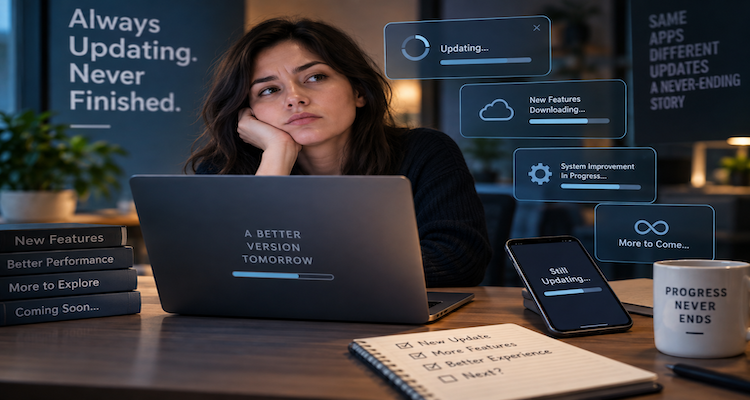
Software used to arrive with a clearer psychological boundary: install it, learn it, and eventually consider the product finished. Modern technology has largely erased that boundary.
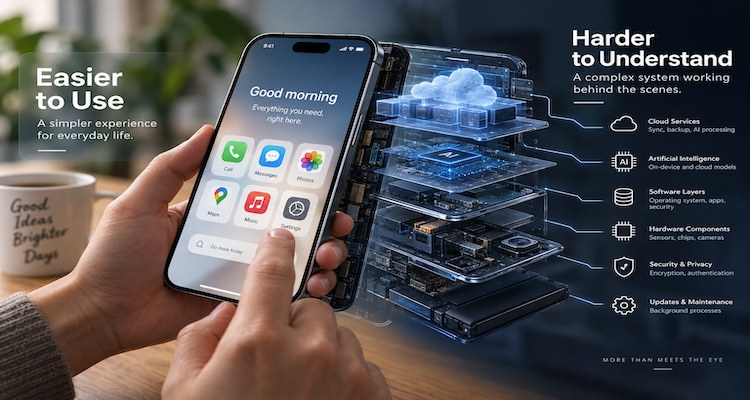
Phones receive operating-system updates. Apps change their interfaces and business models. Cloud services continuously add features. Artificial-intelligence products are updated while their capabilities, pricing and limitations evolve. Hardware increasingly depends on software long after it leaves the factory.
That continuous change is not inherently a problem. In many cases, it is essential. Security vulnerabilities have to be patched, compatibility has to be maintained and products have to respond to changing user needs. NIST notes that software commonly requires updates after release because of bugs, newly discovered vulnerabilities and changes in functionality. But NIST also warns that patches themselves can introduce cybersecurity and operational risks if they are not managed properly.
The less obvious problem is what happens when “ongoing improvement” becomes the permanent operating model: the product may never really be finished, and neither is the user’s relationship with it.
Key Takeaways
- Continuous software updates are often necessary for security, compatibility and changing requirements.
- Perpetual development can increase complexity and make technology harder to understand and maintain.
- Subscription models can turn ownership into an ongoing financial and administrative relationship.
- Digital design can make continuing engagement or payment easier than stopping it.
- Regulation is increasingly treating durability, repairability and software support as consumer concerns.
- The real question is not whether technology should evolve, but who carries the cost of that evolution.
Software Was Never Really Finished
The idea that software must continually change is older than the smartphone era.
Software-evolution research associated with computer scientist Meir M. Lehman identified a fundamental pattern: systems operating in the real world have to adapt or they become progressively less satisfactory. His later formulation also observed that complexity tends to increase as software is changed unless deliberate work is performed to maintain or reduce it.
That distinction matters.
An update can solve a genuine problem while simultaneously adding another layer of complexity. A new feature may improve a product for one group of users while making the interface harder to navigate for another. Compatibility improvements can create new dependencies. Security patches can require testing across an increasingly complicated collection of hardware, operating systems and third-party services.
In other words, software evolution is not simply a straight line from version 1 to a better version 2.
It is closer to maintaining a living system.
The longer a widely used product survives, the more relationships it accumulates: user expectations, databases, APIs, devices, operating systems, regulations, security requirements and business dependencies. Keeping everything working becomes part of the product itself.
The Good Reason Technology Keeps Changing
It would be misleading to treat perpetual updates as evidence of bad technology.
Security alone makes a permanent maintenance cycle necessary.
Apple, for example, continues to issue security updates for supported versions of its operating systems, including older versions when necessary. In April 2026, Apple said it had released updates extending protection to older devices that could not move to the newest operating system.
That is valuable precisely because the alternative is worse: a device could remain physically functional while its software becomes increasingly exposed to known threats.
NIST similarly describes software updating as an important part of maintaining security, while warning that changes need to be managed carefully because patches can themselves create new risks.
This creates a fundamental paradox of modern technology:
A product may need continuous change to remain dependable, but continuous change also creates maintenance costs and complexity.
The problem therefore isn’t updating itself. The problem is when the user has no clear understanding of what is changing, why it is changing, what it will cost, or how long the product will remain useful.
When “Improvement” Becomes a Permanent Relationship
The shift becomes more significant when technology moves from products toward services.
Traditional software could be purchased and installed. Modern services increasingly operate through accounts, subscriptions, cloud infrastructure and recurring payments.
That model has legitimate advantages. A company can continuously maintain infrastructure, provide security fixes and develop new capabilities without asking customers to purchase an entirely new product every few years.
But it also changes the relationship between the user and the technology.
The question is no longer simply:
“What did I buy?”
It becomes:
“What am I continuing to pay for, maintain and depend on?”
This distinction is particularly important for businesses. A company relying on cloud software may accumulate years of data, workflows, integrations and employee knowledge around a platform. Leaving the platform can become much more difficult than signing up for it.
Recent reporting on enterprise software pricing illustrates another layer of this problem: some software vendors are increasingly moving beyond straightforward per-seat pricing toward consumption-based measures, including AI-related usage. That can make costs harder for organizations to forecast and compare.
The technology may be improving continuously, but so is the complexity of managing it.
The Attention Economy Adds Another Layer
There is also a difference between technology that needs to stay active and technology designed to keep the user active.
Social networks, entertainment platforms, shopping services and many mobile applications compete for attention. Their interfaces can change continuously because companies can measure how users respond to those changes.
That produces an unusual feedback loop.
A feature is introduced. User behavior is measured. The interface changes. The resulting behavior is measured again. Another change follows.
The product is therefore not only being updated; it is continuously being optimized around human behavior.
There is nothing inherently deceptive about experimentation. But some design techniques can cross into what regulators and consumer-protection organizations call “dark patterns” interfaces that can steer people toward decisions they might not otherwise make.
A 2024 international review coordinated with the U.S. Federal Trade Commission examined 642 subscription websites and mobile apps across multiple countries. Nearly 76% showed at least one possible dark pattern, while nearly 67% showed multiple possible patterns. The authorities emphasized that identifying a possible dark pattern did not itself establish that a practice was unlawful.
The important lesson is broader than the statistic.
When technology is designed to continuously convert attention into revenue, the endpoint of the interaction may no longer be obvious.
There may be no natural “finished” moment.
Subscriptions Change What Ownership Means
Subscription services make this particularly visible.
A person may subscribe to software, storage, entertainment, productivity tools, security services or AI platforms. Each individual payment may appear small compared with the cost of buying an equivalent product outright.
But the economic relationship is fundamentally different.
With ownership, the transaction has a recognizable endpoint. With a subscription, the transaction becomes a continuing condition of access.
That creates a new category of consumer responsibility: remembering what services exist, monitoring price changes, understanding renewal conditions and deciding whether continued access remains worthwhile.
Regulators have increasingly focused on the cancellation side of this relationship. In 2024, the FTC announced a “click-to-cancel” rule intended to make cancelling recurring subscriptions as easy as signing up, alongside requirements concerning disclosures and informed consent. The FTC has also brought enforcement actions alleging that companies used difficult cancellation processes or other interface techniques to impede consumers.
The policy debate is significant because it recognizes something easy to overlook:
A digital product can create costs not only through its price, but through the friction surrounding its continued use.
Hardware Is Becoming Part of the Same Cycle
The “never finished” problem is not limited to software.
A modern device may depend on operating-system updates, firmware, cloud services, app compatibility, security support and replacement parts.
That means physical durability alone does not determine how long a product remains useful.
The European Union’s Ecodesign framework explicitly addresses this issue. Its regulation identifies durability, reliability, upgradability, repairability and maintenance among relevant product characteristics. It also recognizes premature obsolescence that can result when software stops working after an operating-system update or when software updates are no longer provided.
The EU’s right-to-repair rules add another important development. From July 31, 2026, new rules began applying to covered products, promoting repair and extending product lifetimes. The European Commission says the measures include obligations concerning repairability, reasonable repair conditions and access to spare parts for applicable products.
This is more than an environmental debate.
It reflects a changing definition of what a technology product actually is.
A smartphone is not simply a piece of glass, metal and silicon. Its useful life depends partly on whether the software ecosystem around it continues to function.
The Hidden Cost Is Often Complexity
The greatest cost of perpetual technology may not be the subscription bill or the price of a new device.
It may be complexity.
People have to learn new interfaces. Businesses have to retrain employees. IT teams have to test updates. Developers have to maintain integrations. Consumers have to understand changing privacy settings and subscription terms.
Even security creates work.
A company cannot simply purchase software and forget about it. It has to monitor updates, vulnerabilities, permissions, compatibility and vendor support.
NIST’s recent work on software-update controls reflects this reality: updating software is necessary, but updates have to be managed so that new changes do not create new operational or security problems.
The paradox is striking. Technology promises to automate complexity, while the technological environment itself can become more complex.
What Should a “Finished” Technology Look Like?
Perhaps the answer is not that technology should stop changing.
A better standard is that users should be able to understand the boundaries of change.
A well-designed long-lived product should make several things reasonably clear:
- What functionality is included now?
- Which features depend on an active subscription?
- How long will security updates be provided?
- What happens when support ends?
- Can data be exported?
- Can the product be repaired?
- Can a user downgrade or leave without losing essential information?
- Which changes are optional, and which are unavoidable?
These questions turn “continuous improvement” into something measurable.
They also give users greater control.
For businesses, the same principle can be applied to technology procurement. The purchase price is only one part of the cost. Migration difficulty, training, integration, support, data portability, renewal terms and exit options can matter just as much over several years.
The Future May Be About Better Endpoints, Not Fewer Updates
Technology will probably continue to evolve continuously.
AI systems will change. Operating systems will be patched. Cloud applications will add capabilities. Connected devices will receive firmware updates. Companies will continue experimenting with pricing and user interfaces.
The more useful question is therefore not whether technology should ever be “finished.”
It is whether the technology has been designed with clear boundaries, sustainable maintenance and meaningful user choice.
A product can remain alive without becoming endless in every dimension.
Security updates can have defined support periods. Subscriptions can be easy to cancel. Data can be portable. Hardware can be repairable. Major changes can be communicated clearly. Businesses can plan an exit before becoming completely dependent on a platform.
That would make continuous technology less of a permanent obligation and more of a managed relationship.
Conclusion
Technology that never stops evolving has delivered enormous benefits. Continuous software maintenance keeps systems secure, compatible and useful, while cloud services allow products to improve without requiring users to start again from scratch.
But the same model can transfer hidden costs to the people using the technology: attention, learning time, recurring payments, compatibility problems, migration risk and maintenance work.
The important distinction is therefore not between finished technology and unfinished technology.
It is between technology that evolves with understandable rules and user control, and technology whose continuous evolution quietly becomes an obligation.
As software becomes more deeply embedded in everyday products, services and businesses, knowing when something changes may be nearly as important as knowing what changed.
The information presented in this article is based on publicly available sources, reports, and factual material available at the time of publication. While efforts are made to ensure accuracy, details may change as new information emerges. The content is provided for general informational purposes only, and readers are advised to verify facts independently where necessary.