









Why Old Technology Is Suddenly Becoming Valuable Again
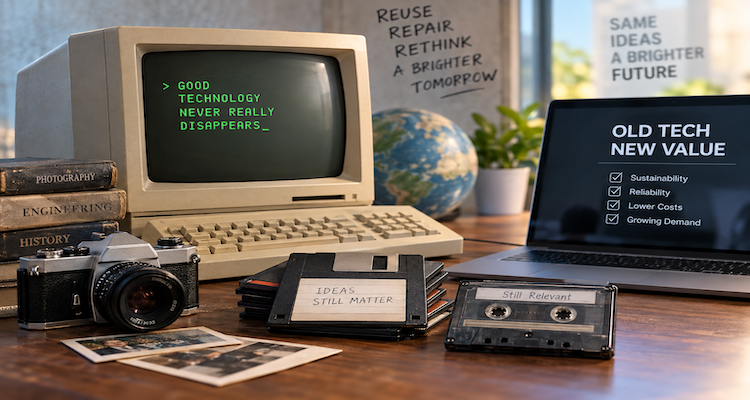
A computer from the 1980s, a cassette player from the 1990s, or a decades-old piece of electronic equipment can look worthless beside today’s thinner, faster and AI-powered devices. Yet some forms of old technology are finding new buyers, new users and, in certain cases, surprisingly high prices.
The reason is more complicated than nostalgia. Vintage computers are being collected and restored, while repairability and longer product lifespans are becoming more important to consumers and regulators. At the same time, modern electronics have become increasingly complex and difficult to repair, making older, simpler machines attractive for entirely practical reasons.
The result is a curious reversal: technology once considered obsolete can acquire a second life precisely because the newest technology does some things differently.
Key Takeaways
- Scarcity, historical importance, repairability and cultural nostalgia can all increase the value of older technology.
- Vintage computers are attracting a growing international community of collectors, restorers and preservationists.
- Modern repairability rules are making product longevity an increasingly important technology-market issue.
- Some older devices remain useful because they are simpler, understandable and independent of modern software ecosystems.
- Collectible value is highly selective; most old electronics are not automatically worth significant money.
- The broader trend points toward technology being valued for longevity and ownership, not only specifications.
Old Does Not Automatically Mean Valuable
The first misconception to clear up is that age itself does not create value.
Millions of old electronic devices have little financial worth. Their condition may be poor, replacement parts may be unavailable, and demand may be minimal. A ten-year-old laptop with a dead battery is not necessarily a collectible simply because it has become old.
Value emerges when several factors overlap.
A device can become desirable because it is historically important, unusually rare, technically interesting, aesthetically distinctive, difficult to replace, or associated with a particular cultural moment. Working condition and original accessories can matter as well.
This explains why a common old device can remain almost worthless while a much older but historically significant machine can become highly sought after.
The difference is not simply age. It is scarcity combined with relevance.
Vintage Computing Is Becoming a Form of Technology Preservation
One of the clearest examples is the renewed interest in vintage computers.
In August 2026, the Vintage Computer Festival in Mountain View, California, attracted more than 3,500 people, according to Associated Press reporting. Collectors displayed and restored machines from companies and eras that helped establish modern personal computing. Similar gatherings have expanded across North America and Europe.
The attraction is partly nostalgic, but restoration also offers something modern computing often hides: visibility.
A person working on an older computer can sometimes understand much more of the machine’s hardware and software architecture. Components are physically accessible, operating systems can be examined directly, and the relationship between hardware and software is easier to observe.
That makes vintage technology interesting not only to collectors but also to people interested in computing history.
The Xerox Alto is an especially useful example. Developed at Xerox PARC in the 1970s, it helped pioneer the graphical user interface, mouse-based interaction and other concepts that became fundamental to personal computing. Restoring such a machine is therefore not simply preserving an old computer; it is preserving part of the technological lineage behind today’s interfaces.
Scarcity Can Change the Economics of Old Technology
Technology normally becomes cheaper as it ages. But that pattern can reverse when supply falls faster than demand.
When a product is new, manufacturers can produce replacement units and components at scale. Decades later, production may have stopped completely. Working examples disappear, accessories become harder to find and specialist repair knowledge becomes less common.
That creates a different economic environment.
A rare working computer can be worth more than a large number of newer machines that are still widely available. The same principle appears across collectibles, musical equipment, cameras, game consoles and other technology categories.
Recent reporting on the retro market illustrates the point. German publication Computer Bild, citing an eBay analysis, reported notable resale values for several classic game consoles and handheld systems in 2026, including the Neo Geo, PlayStation, Nintendo 64 and Game Boy Color. These figures represent marketplace observations rather than a universal valuation of old electronics, but they demonstrate how demand can develop around particular models.
The important lesson for consumers is simple: the existence of a retro market does not mean every old device is an investment.
Condition, model, rarity, provenance, completeness and actual buyer demand matter enormously.
The Repairability Problem Is Making Older Designs Look Different
There is another reason old technology is being reconsidered: modern products have created a stronger conversation about repair.
The European Environment Agency has documented how electronics can lose economic and material value when products that could potentially be repaired are discarded instead. Repairability can be limited by product design, high repair costs and the availability of parts and services.
This creates an interesting comparison.
An older device may be technically inferior but physically accessible. A newer device may be dramatically more capable while being harder to open, repair or upgrade.
That does not mean older engineering was universally better. Older electronics could be inefficient, bulky, fragile, difficult to source parts for, or unsupported by modern networks and software.
But it does mean that repairability itself has become a feature worth valuing.
A product that can remain useful for another five years after replacing one component may have a different economic and environmental value from a product that must be discarded when a single component fails.
Regulation Is Reinforcing the Shift Toward Longer-Lived Technology
This is no longer just a hobbyist issue.
The European Union’s right-to-repair rules began applying from 31 July 2026. The framework is designed to encourage repair and extend the useful lives of products covered by EU reparability requirements. It includes measures relating to repair obligations, repair information and access to spare parts.
The EU has also introduced ecodesign requirements for smartphones and tablets placed on the EU market from June 2025. These requirements address areas including reparability, upgradability and battery life. The European Commission estimates that increasing the average lifetime of a mid-range smartphone from three years to 4.1 years could reduce annual sales while maintaining the same installed stock of devices.
That changes the context around “old” technology.
A product that survives longer is no longer simply an outdated product. It can become an example of a different ownership model: buy, maintain, repair and continue using.
New Companies Are Borrowing an Old Idea: Make the Device Yours
The revival of repairability is also influencing new hardware.
Framework is one prominent example. The company explicitly designs laptops around repairability, modularity and user upgrades. Its current products allow users to replace or upgrade components, while the company provides repair documentation and replacement parts.
The significance is not that a modern modular laptop is equivalent to an old computer.
It is that some characteristics associated with older technology accessibility, replaceable components and user control—are being deliberately reintroduced into contemporary products.
That is an important shift in the definition of technological progress.
For decades, progress was often communicated through smaller dimensions, faster processors, thinner devices and greater integration. Increasingly, another question is entering the conversation:
How long can I keep this device useful?
Why Simplicity Can Become Valuable
There is also a practical reason some people return to older technology: simplicity.
Modern devices depend on layers of software, cloud services, authentication systems, app stores, operating-system updates and network infrastructure.
Older equipment may have fewer capabilities, but sometimes it also has fewer dependencies.
A vintage computer can run a particular program without requiring a contemporary cloud account. A mechanical or electronic device can continue performing a narrow task without depending on a manufacturer’s online service.
That can be attractive for education, experimentation, preservation and specialist applications.
However, this advantage has limits. Old technology can depend on obsolete connectors, unavailable media, aging capacitors, discontinued software or unsupported communication standards. Simplicity in one area can therefore create difficulty in another.
The attraction is not that old technology is universally superior. It is that different technologies fail differently.
The Environmental Argument Is Bigger Than Nostalgia
There is a broader economic issue underneath the retro-tech revival.
The European Commission and European Environment Agency increasingly frame longer product lifetimes as part of a circular economy, where repair, reuse and refurbishment can retain the value already embedded in products and materials.
The European Commission’s Joint Research Centre reported in April 2026 that electrical and electronic equipment placed on the EU market increased from 7.6 million tonnes in 2012 to 14.4 million tonnes in 2022, while around 4 million tonnes were recycled or prepared for reuse.
This helps explain why the question of technological value is changing.
The value of a device is not necessarily exhausted when a newer model appears.
A working older device can retain value through direct reuse. A repairable device can retain value through maintenance. A collectible can retain cultural value. Components can retain value as spare parts. And historically significant machines can retain educational and archival value.
In other words, technology can have several lives.
Old Technology May Also Preserve Skills
There is one less obvious form of value: knowledge.
When a technology disappears, the skills required to understand and repair it can disappear with it.
Vintage computer communities preserve not only machines but also documentation, repair techniques, operating systems, programming knowledge and historical context. Universities and technology museums likewise use restored machines to demonstrate how earlier generations approached computing.
This matters because technology history is not only a story about successful products.
Understanding why earlier systems were designed in particular ways can reveal the engineering constraints, business decisions and user assumptions that shaped today’s technology.
Preservation therefore becomes a form of technical education.
What This Means for People With Old Electronics at Home
Finding an old device in a cupboard does not automatically mean finding a valuable collectible.
Before selling or discarding older technology, however, several questions are worth asking:
- Is the exact model identifiable?
- Does it still work?
- Is it complete with original accessories, packaging or documentation?
- Is there an established collector community?
- Is the product historically significant?
- Are replacement parts or working examples difficult to find?
- Is there evidence of actual completed sales rather than optimistic asking prices?
- Could it be reused or refurbished instead of discarded?
The last question may be more important than the resale price.
Germany’s Federal Environment Agency notes that repair can be economically difficult because labor and replacement parts can cost more than buying inexpensive new products. It also points to the importance of repair information, spare parts and product design in determining whether electronics can realistically be repaired.
So the best use of an old device may not always be selling it.
Sometimes its value is simply that it still works.
The Technology Market Is Starting to Value Longevity Differently
The renewed interest in old technology does not mean society is abandoning new technology.
People still want faster processors, better cameras, more capable software and increasingly powerful AI systems.
What is changing is the definition of what makes a product desirable.
Performance remains important, but other characteristics are becoming more visible: repairability, upgradeability, durability, compatibility, ownership and longevity.
That creates an unusual technological cycle.
The industry spends enormous resources creating new capabilities, while another part of the technology ecosystem is rediscovering the value of keeping existing capabilities alive.
Vintage computing makes the trend easy to see, but the larger movement is broader. Repair legislation, refurbishment, modular hardware, collector communities and circular-economy policies are all pointing toward the same question: what if technological progress is measured not only by how quickly we replace devices, but also by how long we can keep useful technology working?
Conclusion
Old technology is becoming valuable again for several different reasons, and nostalgia is only one of them.
Some machines have become collectibles because they are rare or historically significant. Others remain useful because they are repairable, understandable or suited to specialized tasks. Still others represent a different economic idea: technology does not have to become worthless simply because something newer exists.
The most important change may therefore be less about vintage computers than about how technology itself is valued.
A device that can be repaired, upgraded, reused or understood has value beyond its original release date. As electronic waste, repair costs and product longevity receive greater attention, some qualities once dismissed as old-fashioned may become increasingly relevant to the next generation of technology.
The future of technology may not be entirely new.
It may also include learning how to keep the useful parts of the old technology alive.
The information presented in this article is based on publicly available sources, reports, and factual material available at the time of publication. While efforts are made to ensure accuracy, details may change as new information emerges. The content is provided for general informational purposes only, and readers are advised to verify facts independently where necessary.