






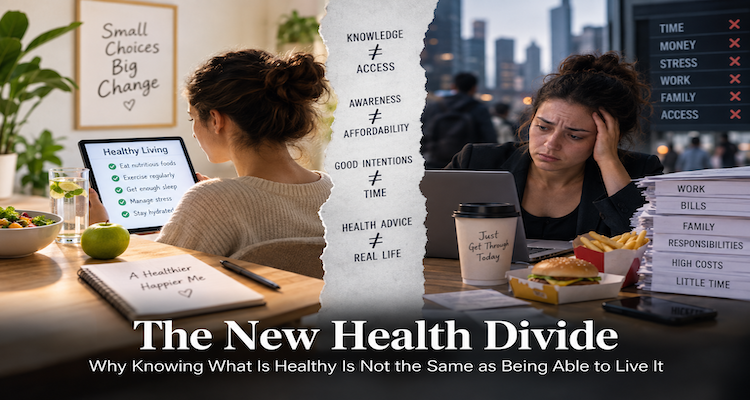
The New Health Divide: Why Knowing What Is Healthy Is Not the Same as Being Able to Live It
Knowing what constitutes a healthy lifestyle has never been easier. People can find nutrition guidance, exercise plans, sleep recommendations and health information within seconds. Yet access to information does not automatically create access to health.
A person may know that vegetables, whole grains and legumes are important, understand the benefits of regular physical activity, and recognize the value of sleep and preventive care. But acting on that knowledge depends on circumstances that may have little to do with motivation: food prices, working hours, housing, transport, neighborhood safety, education, social support and access to services.
That distinction is becoming increasingly important in how health inequalities are understood. The World Health Organization (WHO) describes these wider conditions as social determinants of health and notes that income, education, employment, housing, environment and social relationships can substantially shape health outcomes.
The emerging health divide, therefore, is not simply between people who know healthy behaviors and people who do not. It is also between people who have the resources and environments that make those behaviors realistically achievable and those who do not.
Key Takeaways
- Health knowledge can help, but income, housing, work and neighborhood conditions can determine whether healthy choices are practical.
- A healthy diet is shaped not only by nutrition knowledge but also by affordability, availability, culture and the surrounding food environment.
- Physical activity depends partly on whether people have safe, affordable and convenient opportunities to move.
- Health inequalities can persist even when people receive similar information because their everyday resources and constraints differ.
- Improving health may require changing environments and systems alongside encouraging individual behavior.
The Information Problem Is Only Part of the Health Problem
Public health messaging often assumes that better information will lead to better decisions. Information certainly matters. Understanding nutrition, exercise, smoking, alcohol, sleep and preventive healthcare can help people make informed choices.
But information is only one component of behavior.
Consider food. A person can understand the principles of a balanced diet and still face a very different decision-making environment depending on their income, location, working schedule and access to shops.
WHO’s current guidance emphasizes that healthy diets are based on adequacy, balance, moderation and diversity, with minimally processed and unprocessed foods forming an important foundation. At the same time, WHO explicitly identifies income, food prices, availability, cultural traditions and geographical factors as influences on dietary behavior.
This creates a gap between knowing and being able to do.
That gap is easy to overlook because individual choices are visible while the conditions surrounding those choices are often invisible.
The Price of a Healthy Choice Matters
Affordability is one of the clearest examples.
The 2024 State of Food Security and Nutrition in the World report examined the affordability of healthy diets globally. FAO reported that about 2.83 billion people 35.4% of the world’s population could not afford a healthy diet in 2022.
That does not mean every person in that group lacks nutrition knowledge. It demonstrates something different: knowing what a healthy diet looks like does not guarantee the economic ability to follow it.
Food prices also operate within a broader environment. WHO noted in its 2024 guideline on fiscal policies that energy-dense, nutrient-poor foods can be readily available, heavily marketed and relatively cheap, creating challenges for consumers trying to make healthy and affordable choices.
This changes the question.
Instead of asking only, “Why doesn’t this person eat more healthily?”, a more complete question is:
What makes the healthier option affordable, available and practical in this person’s circumstances?
That is a fundamentally different way of thinking about health behavior.
Exercise Is Also an Environmental Issue
Physical activity provides another example.
The conventional message is simple: move more and sit less. The health benefits of physical activity are well established, and WHO recommends activity for people across different ages and circumstances, with appropriate adaptations where necessary.
But opportunities to be active are not distributed equally.
Someone living in an area with safe sidewalks, accessible parks and reliable public transport may be able to incorporate walking into ordinary life. Someone working long shifts, living far from employment or lacking safe outdoor spaces may face a very different set of options.
WHO specifically identifies the wider social, cultural, environmental and economic factors that influence opportunities to be physically active. It also points to safer walking and cycling infrastructure, workplace policies, schools and accessible recreational facilities as ways communities can make physical activity easier.
The distinction matters because it prevents a common mistake: treating every inactive person as though inactivity were simply the result of insufficient discipline.
Sometimes the barrier is personal motivation. Sometimes it is time. Sometimes it is cost. Sometimes it is infrastructure. Often, several factors interact.
Work Can Compete With Healthy Intentions
The workplace is another place where health knowledge meets reality.
A person may know that adequate sleep, regular movement, nutritious meals and stress management matter. But working conditions can influence whether those behaviors are feasible.
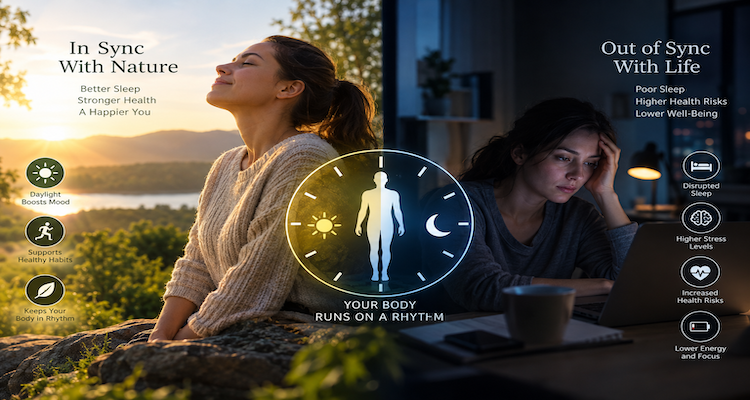
Long or irregular working hours can make regular meals and exercise difficult to organize. A job with little control over working conditions can create different pressures from a job offering greater flexibility. Commuting can consume time that might otherwise be used for physical activity, cooking or rest.
WHO’s framework on health determinants includes employment and working conditions among the circumstances that influence health.
This does not mean workplace conditions determine every individual’s health. Nor does it eliminate personal agency. It means individual behavior takes place inside a structure of available choices.
The same recommendation”get more exercise”can therefore require dramatically different amounts of time, money and effort from different people.
Housing, Transport and Neighborhoods Shape Daily Health
Health is also influenced by places that are rarely described as “health products.”
Housing is one example.
Safe housing, reliable transportation, clean air, neighborhood conditions and access to services can all influence people’s ability to maintain healthy routines. WHO identifies the physical environment, housing, employment, education, income and social support among the broader determinants of health.
The CDC similarly defines social determinants of health as nonmedical conditions influencing health outcomes and highlights areas including economic stability, education, healthcare access, social and community context, and the neighborhood and built environment.
This has a practical implication: a health intervention that focuses only on individual behavior can miss some of the conditions that make behavior difficult.
A recommendation to walk more has a different meaning in a neighborhood with safe pedestrian routes than in one where walking is inconvenient or unsafe.
A recommendation to cook fresh meals has a different meaning for someone with predictable working hours and nearby food retailers than for someone facing long shifts, limited kitchen facilities or food insecurity.
The advice may be identical. The circumstances are not.
Health Literacy Still Matters But It Cannot Carry the Whole Burden
None of this makes health education unnecessary.
Knowing how to interpret nutrition information, recognize health risks, navigate healthcare systems and distinguish reliable evidence from misinformation remains valuable. Health literacy can help people make better decisions within the choices available to them.
The problem occurs when education is treated as though it can compensate for a lack of resources.
WHO’s work on social determinants emphasizes that health is shaped by both individual characteristics and the social and physical environments in which people live.
The distinction can be summarized simply:
Health literacy answers, “What should I do?”
Health equity also asks, “Can I realistically do it?”
The second question is where many health discussions become more complicated and more useful.
The New Divide Is About Opportunity, Not Just Knowledge
Calling this a “new health divide” does not mean that traditional health inequalities have disappeared. Income, education, healthcare access and living conditions have long influenced health.
What is changing is the context in which health information is delivered.
People now have unprecedented access to advice. Search engines, smartphones, wearable devices, health applications and social platforms can provide an enormous amount of information. Yet abundant information can coexist with unequal access to the conditions required to act on it.
The result is a paradox: the democratization of health information does not necessarily democratize the ability to live healthily.
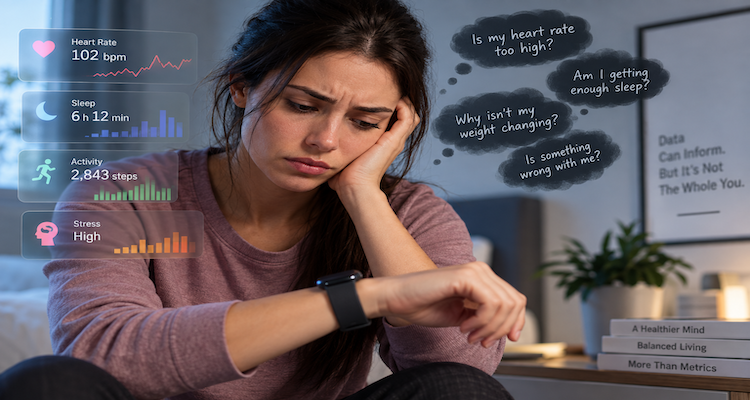
This is particularly relevant as digital health expands. A person may receive reminders to exercise, track sleep through a wearable and access nutrition advice online. Those tools can be useful, but they do not remove the cost of food, the availability of safe public spaces, working conditions or housing constraints.
Technology can improve information and monitoring. It cannot automatically remove every structural barrier.
What a More Practical Health Strategy Looks Like
A more complete approach combines individual support with healthier environments.
For individuals, practical strategies may include choosing realistic goals, making affordable dietary changes, incorporating movement into existing routines and seeking professional healthcare advice when appropriate. The objective is not perfection but sustainable behavior within real-life constraints.
For communities and institutions, the questions become broader:
- Are nutritious foods affordable and readily available?
- Are public spaces safe and accessible for physical activity?
- Do schools and workplaces make healthy choices practical?
- Can people access healthcare and preventive services?
- Does transportation allow people to reach employment, food retailers and healthcare?
- Are health messages understandable and culturally appropriate?
WHO’s recent work increasingly emphasizes this environmental dimension. Its 2026 guidance on urban food environments examines how urban planning, food retail, digital food delivery, food marketing and the availability of highly processed foods can shape access to healthy diets.
This does not replace personal responsibility. It recognizes that responsibility works better when people have meaningful options.
The Practical Lesson for Individuals
There is also a personal lesson in this broader picture.
If someone struggles to maintain a healthy routine, the most productive response may not be to assume a lack of willpower. It can be more useful to identify the actual constraint.
Is healthy food too expensive?
Is there insufficient time to cook?
Is work disrupting sleep?
Is exercise difficult because of transportation or safety?
Is reliable health information difficult to distinguish from marketing?
Is stress consuming the capacity needed to maintain new habits?
Finding the constraint can make the solution more realistic.
A sustainable health plan is usually not the plan that looks perfect on paper. It is the one that can survive the person’s actual circumstances.
Conclusion
The central health challenge is no longer simply getting people to understand what healthy behavior looks like. Increasingly, it is closing the distance between health knowledge and health opportunity.
The evidence from WHO, CDC and international food and nutrition research shows that health is shaped by a combination of individual behavior and the conditions surrounding that behavior. Income, food prices, housing, employment, transportation, education, social support and neighborhood environments can influence how easily people can turn good intentions into daily routines.
That perspective does not remove individual agency. It makes the discussion more realistic.
People still make choices. But choices are made from a menu of possibilities shaped by time, money, environment and opportunity.
The next stage of health improvement, therefore, may depend as much on expanding those possibilities as on providing more advice. Knowing what is healthy remains important. Making healthy living genuinely achievable is the larger challenge.
This article is intended for general awareness and educational purposes only. It should not be considered medical advice. Readers are encouraged to consult qualified healthcare professionals for personal health decisions.