





The Strange Health Effects of Modern Comfort: How Convenience Can Change the Way Our Bodies Work
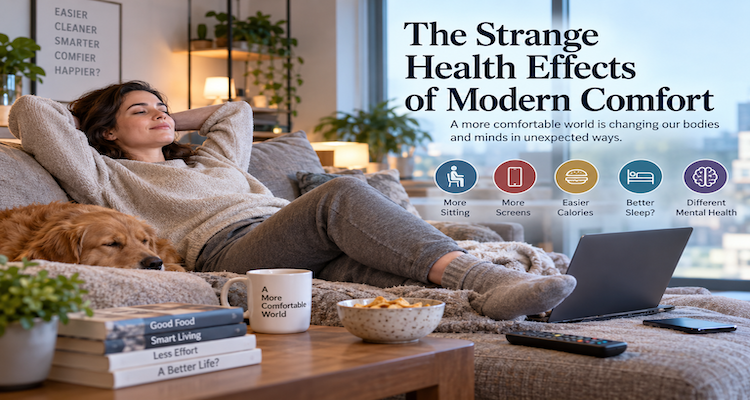
Modern life has removed many of the small physical demands that once shaped everyday routines. We can work without walking, eat without cooking, communicate without leaving a room, and illuminate our homes long after sunset. Air conditioning, elevators, cars, food delivery, streaming services and smartphones have made life easier but they have also changed the environment in which the human body operates.
The important point is not that comfort is unhealthy. Heating, cooling, sanitation, safe transportation, refrigeration and modern medical technology have delivered enormous health benefits. The more interesting question is what happens when convenience quietly removes movement, natural light, food preparation, outdoor exposure and other activities that once occurred automatically.
Research increasingly suggests that some of the health consequences are less about a single modern invention and more about the cumulative effect of a low-effort lifestyle. Prolonged sitting, highly processed diets, insufficient sleep, artificial light at night and poorly managed indoor environments can each influence health through different pathways.
Key Takeaways
- Convenience can reduce everyday physical activity even when a person occasionally exercises.
- Highly processed convenience foods are associated with several adverse health outcomes, although association does not prove causation.
- Artificial light at night can interfere with the biological timing systems that regulate sleep.
- Modern indoor life makes ventilation and indoor environmental quality increasingly important.
- The practical answer is not abandoning comfort, but deliberately restoring healthy activities that convenience has removed.
The Hidden Cost of Doing Less
For much of human history, ordinary activities required physical effort. Walking was transportation. Carrying water required strength. Preparing food involved time and movement. Household work was less automated.
Modern technology has changed that equation.
A person can now spend much of the day moving between a bed, chair, car seat and sofa. The body may receive a concentrated workout for 30 or 60 minutes while remaining sedentary for many other hours.
The distinction matters because exercise and sedentary behaviour are not identical concepts.
The World Health Organization recommends that adults undertake regular physical activity and accumulate at least 150–300 minutes of moderate-intensity aerobic activity per week, or an equivalent amount of vigorous activity. It also recommends limiting sedentary behaviour. WHO notes that replacing sedentary time with physical activity even light-intensity activity provides health benefits.
That creates a counterintuitive situation: someone can technically meet an exercise target while still spending a large portion of the remaining day sitting.
Research published in 2026 adds another layer. A systematic review and meta-analysis of randomized crossover trials found that short activity breaks during prolonged sitting reduced post-meal glucose and insulin responses compared with uninterrupted sitting. The researchers also found that walking breaks produced particularly notable effects, although these were acute metabolic outcomes rather than proof that brief movement breaks alone prevent disease.
The lesson is surprisingly simple: the body responds not only to workouts, but also to what happens between workouts.
When Convenience Changes What We Eat
Food may be the clearest example of comfort becoming biologically complicated.
Modern food systems make it possible to eat meals that require little preparation, remain shelf-stable for long periods and are highly convenient. Many of these products fall into the category of ultra-processed foods.
A major 2024 umbrella review published in The BMJ examined 45 pooled analyses involving nearly 9.9 million participants. Greater exposure to ultra-processed foods was associated with higher risks across numerous health outcomes, including cardiometabolic conditions and some mental-health outcomes. However, the researchers also emphasized that much of the underlying evidence was observational and that the certainty varied considerably between outcomes.
That qualification is important.
The research does not mean that every packaged food is inherently unhealthy or that a particular processed product directly causes a particular disease. Food processing exists on a spectrum, and packaged foods can include everything from relatively simple products to highly formulated ready-to-eat foods.
The deeper issue is what convenience can do to the overall diet.
When meals become effortless, the incentives to cook with basic ingredients, vary foods and pay attention to portions can change. At the population level, dietary patterns can therefore matter more than any individual food.
Convenience is not the enemy. But when convenience consistently favors highly energy-dense, highly processed foods over minimally processed alternatives, the long-term dietary pattern can become important.
The Strange Relationship Between Light and Sleep
Electric lighting is one of humanity’s most useful inventions. It allows people to work, study, travel and socialize after sunset.
But biology still responds to darkness.
Human circadian rhythms help coordinate sleep, wakefulness and numerous physiological processes. Artificial light at night can interfere with the environmental signals that help synchronize those rhythms.
A 2026 systematic review and meta-analysis published in Environmental Research examined 15 studies involving 765,838 participants. Across the studies included in the meta-analysis, people exposed to higher levels of artificial light at night had a higher risk of sleep disturbance. The authors also noted methodological limitations in much of the underlying research, particularly around exposure measurement and risk of bias.
This makes nighttime lighting more interesting than simply a question of screen brightness.
The modern evening can contain ceiling lights, televisions, smartphones, tablets, computer monitors, street lighting and illuminated advertisements. The result is an environment very different from the natural transition from daylight to darkness.
That does not mean every evening spent under a lamp is damaging. It means that light has biological effects beyond helping us see.
Sleep itself is also a health issue. U.S. National Center for Health Statistics data show that 30.5% of U.S. adults reported averaging fewer than seven hours of sleep in 2024. The CDC notes that adequate sleep is important for physical and emotional health.
Modern comfort can therefore produce a paradox: technology gives us the ability to remain active long after sunset while simultaneously making it easier to interfere with the biological conditions that encourage sleep.
The Indoor Life Has Its Own Environment
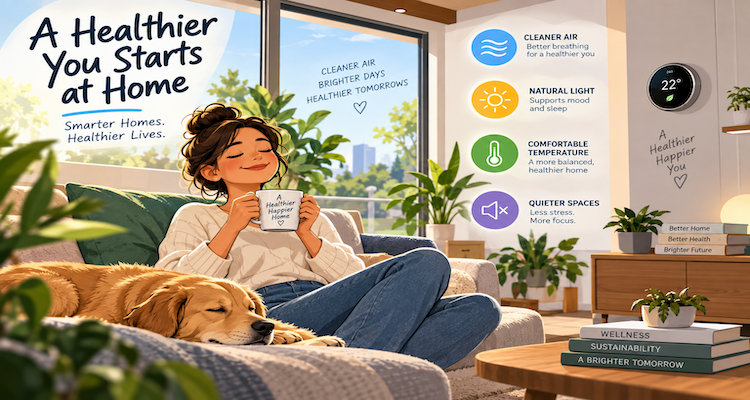
Comfort increasingly means spending more time indoors.
That can protect people from extreme weather, outdoor pollution and other hazards. But indoor environments are not automatically healthy environments.
Ventilation, humidity, building materials, heating systems, cooking methods and outdoor air quality all influence what people breathe indoors.
WHO identifies household air pollution as an important source of respiratory and cardiovascular harm, particularly where polluting fuels and inefficient stoves are used. Its 2025 guidance also emphasizes cleaner household energy and improved ventilation as important interventions.
The situation is different in homes using modern electricity, heating and cooling systems, but the principle remains relevant: an energy-efficient or comfortable building is not necessarily an optimally ventilated building.
WHO notes that inadequate ventilation can allow pollutants to accumulate and that damp, poorly ventilated environments can encourage mould growth. At the same time, ventilation has to be considered alongside outdoor air pollution because bringing polluted outdoor air indoors is not automatically beneficial.
This creates a modern health balancing act.
The goal is not simply to make a room warmer, cooler or more sealed. It is to create an indoor environment that is thermally comfortable while maintaining appropriate air quality.
Why the Problem Is Bigger Than Any One Gadget
It would be easy to blame smartphones, air conditioning, cars or processed food individually.
That would miss the more important pattern.
Modern comfort often works by removing friction.
The elevator removes stairs.
The car removes walking.
Food delivery removes shopping and cooking.
Streaming removes the need to travel for entertainment.
Remote work can remove commuting.
Artificial lighting removes the boundary created by sunset.
Climate control reduces exposure to outdoor temperatures.
Each change can be useful. The health issue emerges when many such changes accumulate.
The body does not necessarily need discomfort. It needs appropriate stimulation.
Muscles need movement. Circadian systems need appropriately timed light and darkness. Sleep needs sufficient duration and regularity. Metabolism responds to patterns of eating and activity. Indoor environments need appropriate ventilation and moisture control.
The modern challenge is therefore not comfort versus health.
It is comfort without losing the behaviours that support health.
Making Comfort Work for the Body
The solution does not require rejecting modern technology.
Instead, people can deliberately reintroduce small amounts of movement and environmental variation into otherwise comfortable routines.
That might mean walking for short trips when practical, taking movement breaks during long periods of sitting, using stairs when appropriate, preparing some meals from minimally processed ingredients, getting natural daylight earlier in the day, reducing unnecessary bright light late at night and paying attention to ventilation and indoor moisture.
None of these actions should be treated as a cure or universal prescription. Individual circumstances, disabilities, occupations, medical conditions, climate and living environments differ.
But the broader principle is supported by the evidence: health is influenced by the pattern of everyday life, not just by isolated healthy activities.
A one-hour workout cannot completely erase every other aspect of a sedentary day. A nutritious dinner does not automatically compensate for an otherwise poor dietary pattern. Turning off a phone at bedtime cannot compensate for chronically inadequate sleep.
Modern comfort becomes healthier when technology removes unnecessary burdens while people deliberately retain the biological behaviours their bodies still require.
Conclusion
The strange health effects of modern comfort are not really about comfort itself.
They are about what convenience can quietly replace.
Human biology has adapted to a world in which movement, daylight, food preparation, environmental variation and periods of darkness were woven into everyday life. Modern technology has separated many of those activities from daily survival.
That separation is neither entirely good nor entirely bad. It has produced enormous benefits, but it also means that some healthy behaviours no longer happen automatically.
The practical challenge of modern living is therefore surprisingly modest: use technology to make life easier, but do not allow convenience to make the body unnecessarily inactive, poorly nourished, sleep-deprived or disconnected from healthy environmental cues.
The healthiest modern life may not be the least comfortable one. It may be the one in which comfort is designed around what the human body still needs.
This article is intended for general awareness and educational purposes only. It should not be considered medical advice. Readers are encouraged to consult qualified healthcare professionals for personal health decisions.