








Animals Are Quietly Changing Their Daily Lives to Live Around Us
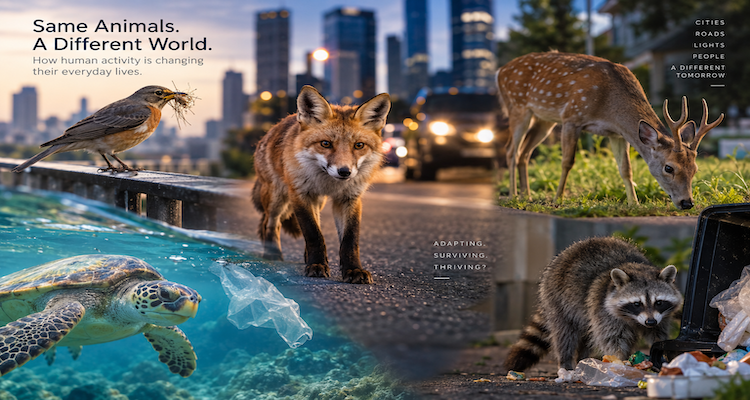
For many wild animals, surviving alongside people no longer means simply finding a new place to live. Increasingly, it means changing when they move, feed, communicate, explore and rest.
A growing body of research shows that human activity can reshape the daily schedules of wildlife. Roads, recreation, artificial light, urban development and other forms of disturbance can push some animals toward nighttime activity, alter where and when they forage, or change how they respond to unfamiliar objects. A global 2018 meta-analysis of 76 studies involving 62 mammal species found that animals exposed to human disturbance became, on average, 1.36 times more nocturnal.
But the story is more complicated than “animals are becoming nocturnal.” Responses differ sharply between species and environments. Some animals avoid people. Others learn to tolerate them. Some change their daily schedule, while others alter their behavior in less obvious ways.
That distinction matters because the hours an animal is active are part of its habitat too. If humans occupy the daylight hours, wildlife may increasingly be forced to use the hours left behind.
Key Takeaways
- Human disturbance can shift wildlife activity toward nighttime, but the response varies substantially among species.
- Roads, recreation, artificial light and urbanization can alter when animals feed, move, communicate and explore.
- A 2024 global study found mammal responses to changing human activity differed across species, landscapes and levels of development.
- New research suggests human disturbance can influence not only daily schedules but also animals’ responses to unfamiliar objects and food.
- Changing an animal’s schedule can reduce direct encounters with people while potentially creating new ecological costs.
The Hidden Habitat Called Time
Wildlife conservation has traditionally focused heavily on where animals live: forests, wetlands, grasslands, rivers and protected areas.
But researchers are increasingly paying attention to another dimension of habitat: time.
An animal may still occupy the same forest while using it very differently. A deer that once fed around dawn may delay activity until darker hours. A predator may avoid a popular trail during the day and pass through after visitors leave. A bird may alter its vocal behavior when traffic noise interferes with communication.
Research on eight mammal species across 10 U.S. cities found substantial variation in daily activity patterns, with relationships between activity and factors including human population density, built surfaces, vegetation and available greenspace. The researchers described temporal habitat as an important but often overlooked component of wildlife management.
This creates an important distinction: an animal can remain present without living the same daily life.
When Daylight Becomes the Busy Hour
One of the clearest documented responses to human disturbance is a shift toward nocturnal activity.
The 2018 global meta-analysis led by Kaitlyn Gaynor and colleagues examined 76 studies across six continents. Across the studies, mammals increased their nocturnality by an average factor of 1.36 in response to human disturbance. The effect appeared across different continents, habitats, mammal groups and types of human activity.
The reason is relatively straightforward.
Humans tend to concentrate activity into particular parts of the day. Hiking trails become busy. Roads fill with vehicles. Parks receive visitors. Construction and other activities generate noise and movement.
For wildlife capable of changing its schedule, nighttime can provide a temporary window with fewer encounters.
But that apparent solution can create another problem: the night is not simply an empty version of the day.
Animals that become more nocturnal may encounter different temperatures, predators, competitors and food conditions. Their new schedule can also change interactions with other species.
The shift may therefore reduce one form of human pressure while creating new ecological trade-offs.
Not Every Animal Makes the Same Adjustment
It would be misleading to describe wildlife as responding to people in one universal way.
A 2023 study of large mammals in southwestern British Columbia, for example, found species-specific responses. Black bears showed evidence of becoming more nocturnal in response to human detections, while coyotes were more nocturnal in areas with greater trail density. Snowshoe hares showed the opposite pattern in relation to trail density, becoming less nocturnal.
Research from recreation areas in Colorado similarly found that some mammals changed their activity patterns on trails, while others reduced habitat use instead. Species that naturally overlapped more with humans during daylight showed larger shifts toward nighttime activity.
That variation is important.
A species cannot simply “choose” another schedule without biological consequences. Its physiology, predators, food sources and social behavior constrain what is possible.
For conservationists, this means measuring only whether animals remain in an area may miss important changes.
Cities Can Change More Than an Animal’s Clock
Urban environments do not merely alter when wildlife is active. They can also influence behavioral traits.
A global meta-analysis published in the Journal of Animal Ecology in 2026 examined 81 studies covering birds, mammals, amphibians, reptiles and insects. The researchers found evidence that urban populations, on average, showed greater boldness, aggressiveness, exploration and activity than nonurban populations. However, birds were heavily overrepresented in the available research, and most behavioral differences among non-avian groups were not statistically significant except for boldness.
That limitation matters.
The findings do not mean that every city-dwelling animal becomes bolder. Instead, they suggest that urban environments can favor or select for certain behavioral characteristics in some populations.
Animals that tolerate noise, people, artificial structures and unfamiliar surroundings may have more opportunities to persist in human-dominated landscapes.
Others may disappear from those landscapes altogether.
What humans see in a city, therefore, can partly reflect which behavioral types are capable of living there.
The Sound of Humans Can Change Animal Communication
Time is not the only thing being reshaped.
Human noise can interfere with communication, particularly for animals that depend on sound to find mates, defend territories or maintain social relationships.
A recent study of white-handed gibbons in Malaysia, reported in September 2026, examined calling behavior at locations with different levels of human-associated noise. The researchers found that the group near a highway called in substantially fewer recordings than groups at quieter comparison locations. The study has not yet undergone peer review, so its findings should be treated as preliminary.
The significance extends beyond whether a forest sounds quieter.
For gibbons, vocalizations can serve social and territorial functions. If persistent background noise changes when or how animals communicate, the ecological effect may involve relationships between individuals rather than simply the amount of noise they experience.
It is another example of why habitat quality cannot always be measured from maps alone.
A forest can remain standing while its acoustic environment changes dramatically.
Animals May Also Be Changing How They Deal With the Unknown
One of the more revealing developments in recent research is that human disturbance may influence not only where animals go or when they move, but how they respond to unfamiliar things.
A 2026 Biological Conservation study examined wild wood mice along a gradient of human disturbance. The researchers recorded responses to novel objects and unfamiliar food in protected, buffer and non-protected areas.
The results were context-dependent. Mice in more disturbed areas showed greater avoidance of novel objects, while their willingness to forage on novel food increased with the degree of human presence and disturbance. The study involved 158 observations from repeated experimental trials.
This is particularly interesting because it challenges a simple idea of wildlife becoming either “fearful” or “fearless” around humans.
Different aspects of behavior can move in different directions.
An animal might become more cautious toward something unfamiliar while simultaneously becoming more willing to investigate a potential food source. Such flexibility may help some individuals cope with environments where unfamiliar sights, sounds and objects are frequent.
Human Activity Does Not Affect Every Landscape the Same Way
The global picture becomes even more complicated when the landscape itself is considered.
A 2024 study in Nature Ecology & Evolution examined camera-trap data from 163 mammal species across 102 research projects during the COVID-19 period, when human activity changed sharply in many places. The researchers found that responses varied according to species, landscape and changes in human activity. In undeveloped areas, mammals tended to become less active when human activity increased, while in developed areas the pattern could reverse; greater nocturnality was also observed under higher human activity.
This finding is useful because it moves the discussion away from a simplistic human-versus-wildlife model.
An animal’s response depends partly on what humans mean in a particular landscape.
A person walking through a forest, a vehicle moving along a highway and a densely built urban neighborhood create very different combinations of noise, light, food availability, shelter and perceived risk.
Wildlife responds to that entire environment rather than to the abstract concept of “human presence.”
The Cost of Avoiding Us
Changing a daily routine can be useful. It can allow wildlife to remain in places where direct encounters with humans would otherwise be difficult.
But avoidance has limits.
When an animal moves its activity into a narrower part of the day, it may have less time to feed or interact with other members of its species. Changes in activity can also alter predator-prey encounters and competition between species.
The 2018 global analysis explicitly warned that shifts away from natural activity patterns could have consequences for fitness, population persistence, community interactions and evolution.
That does not mean every shift toward nighttime is harmful.
Some animals may successfully exploit urban environments precisely because they can adjust their schedules. Others may benefit from human-provided food or reduced predation.
The important point is that behavioral flexibility is not the same as unlimited adaptability.
An animal may successfully change its routine while still paying an ecological price.
What This Means for Conservation
These findings suggest that protecting wildlife requires more than preserving physical space.
Conservation planning can also consider:
- Time: when people and wildlife use the same areas.
- Noise: whether traffic, recreation or development disrupts communication.
- Light: whether artificial illumination changes nighttime behavior.
- Recreation: whether trails and visitor activity overlap with important feeding or resting periods.
- Behavior: whether animals are avoiding areas, changing schedules or adapting to new stimuli.
This is especially relevant as protected areas and urban green spaces face increasing human use.
A systematic review of 274 studies on non-consumptive outdoor recreation found evidence of at least one effect on animals in more than 93% of the reviewed articles, although the evidence and response varied among taxa and activities. The authors also identified substantial geographic and taxonomic gaps in the research.
The practical lesson is not that people must disappear from nature.
Rather, it is that coexistence works better when the timing and intensity of human activity are considered alongside the amount of habitat available.
The Quietest Changes May Be the Most Important
Wildlife does not always respond to human expansion with an obvious retreat.
Sometimes the change is subtle.
A mammal appears on the same camera trap but two hours later. A predator crosses a trail after visitors leave. A bird changes when it sings. A small mammal becomes more cautious about unfamiliar objects but more willing to investigate unfamiliar food.
None of these changes necessarily means a population is declining.
But together they reveal something important about the human-shaped environment: animals are not simply occupying the spaces we leave behind. Many are reorganizing their lives around the schedules, sounds, lights and movements we create.
That makes time a conservation resource.
Protecting wildlife may increasingly depend not only on asking, “Where can animals live?” but also, “When can they live there without having to compete with us?”
For some species, that difference may determine whether human-dominated landscapes remain usable habitat or become places they can survive in only by continually changing the way they live.
This content is published for informational or entertainment purposes. Facts, opinions, or references may evolve over time, and readers are encouraged to verify details from reliable sources.