









Why Shiva Is So Often Shown Beyond the Boundaries of Ordinary Life
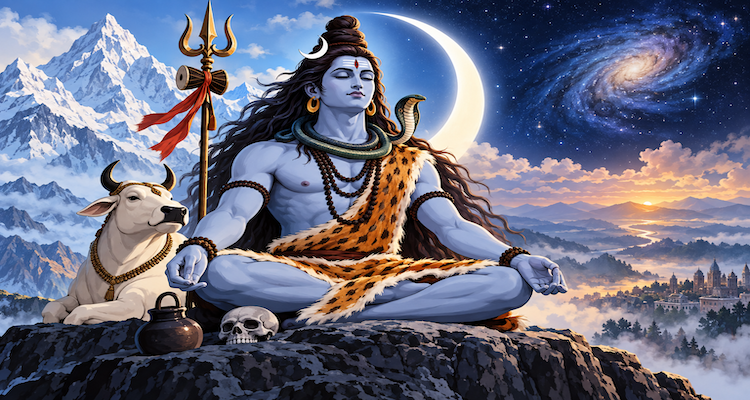
Shiva is rarely portrayed as a conventional divine ruler. He may appear as a serene yogi deep in meditation, a wild ascetic covered in ash, a dancer surrounded by flames, a figure associated with serpents and skulls, or a god standing at the meeting point of creation and destruction. These images can seem deliberately contradictory.
That contradiction is central to Shiva’s visual identity.
Across centuries of Hindu art and religious thought, Shiva has been represented through forms that challenge familiar boundaries: between stillness and movement, beauty and fear, life and death, wilderness and civilization, asceticism and household life. Rather than presenting a single easily defined personality, Shiva’s iconography repeatedly places opposing forces in the same image.
The result is a deity who is often depicted as existing beyond the ordinary categories through which people organize everyday life. Understanding that visual language helps explain why Shiva remains one of the most distinctive and recognizable figures in Indian religious art.
Key Takeaways
- Shiva’s unusual imagery often expresses the coexistence of forces that ordinary life tends to keep separate.
- The Nataraja image represents creation, preservation and destruction within a continuing cosmic cycle.
- Ashes, serpents, skulls and cremation-ground associations connect Shiva with impermanence and transformation.
- Shiva’s identity as a yogi emphasizes withdrawal from ordinary social attachments and disciplined spiritual practice.
- His imagery is symbolic rather than a literal portrait, with different traditions emphasizing different aspects of Shiva.
- The apparent contradictions in Shiva’s representations are part of the meaning rather than inconsistencies in the tradition.
A Deity Defined Through Contradiction
Many religious images emphasize recognizable qualities: kingship, beauty, protection, wisdom or power. Shiva can embody these qualities, but his iconography frequently goes further by combining characteristics that appear incompatible.
He can be a husband and father while also being the great ascetic. He can be associated with terrifying forms and yet be understood through names and traditions emphasizing benevolence. He can sit motionless in meditation while also appearing as Nataraja, the cosmic dancer.
This is why describing Shiva simply as a “god of destruction” misses much of the complexity of his representation.
The destruction associated with Shiva is not necessarily equivalent to evil or meaningless annihilation. In the Nataraja tradition, destruction appears within a larger cycle that also includes creation and preservation. The emphasis is therefore on transformation and cosmic process rather than destruction as an isolated event.
The visual language makes this idea unusually powerful because opposing concepts are placed together rather than explained separately.
Why Shiva Appears as an Ascetic
One of Shiva’s most important identities is that of the yogi.
Museum collections and studies of Indian art commonly identify Shiva through characteristics associated with ascetic practice: matted hair, meditation, the third eye, a restrained physical appearance and other attributes associated with yogic discipline.
This matters because the ascetic stands at a distance from many of the structures of ordinary social life.
An ascetic traditionally renounces possessions, status and conventional attachments in pursuit of spiritual liberation. Shiva therefore represents something different from a divine king whose authority resembles earthly political power.
His power can instead be portrayed as arising from withdrawal.
The image of Shiva meditating on Mount Kailasa, in wilderness settings, or in other remote environments reinforces this separation. The landscape itself becomes part of the symbolism: the divine is not confined to the ordered spaces of courts, cities or domestic life.
The Meaning Behind Ashes and the Cremation Ground
Some of Shiva’s most striking imagery involves death.
Shiva is associated in Hindu traditions with cremation grounds, ashes and forms that confront mortality directly. This is one reason his representations can appear unsettling to modern viewers accustomed to religious imagery that emphasizes serenity, beauty or heavenly environments.
But the cremation ground carries a deeper symbolic significance.
It is a place where distinctions that dominate ordinary social life become difficult to maintain. Wealth, social status, physical appearance and possessions ultimately have no permanence there.
Ash therefore becomes a particularly potent symbol.
The body covered with ash can be understood in relation to impermanence, death and the transformation of physical existence. In Shaiva traditions, sacred ash, or vibhuti, also has an established ritual significance and is used by devotees and ascetics.
The symbolism is consequently more complex than simply associating Shiva with death. Death becomes a reminder of the temporary nature of worldly identity.
That helps explain why Shiva can be represented in places and circumstances that other divine figures might avoid.
Nataraja: When the Universe Becomes a Dance
Perhaps nowhere is Shiva’s boundary-crossing character more clearly expressed than in the image of Nataraja, Shiva as Lord of Dance.
The famous Chola-period bronze sculptures present Shiva dancing inside a ring of flames. His upper hands hold a drum and fire; one hand makes a gesture associated with protection, while one foot presses down upon a small figure associated with ignorance or illusion.
The Metropolitan Museum of Art describes the composition as a visual representation of creation, preservation and destruction and connects the surrounding flames with the boundaries of the Hindu cosmos.
The symbolism is remarkably concentrated.
The drum represents primordial sound and creation. Fire represents destruction. The gesture of protection introduces reassurance. The raised foot offers a path toward refuge or release, while the figure beneath Shiva represents the forces of ignorance or illusion that obstruct liberation.
The most important detail may be the contrast between movement and stillness.
Shiva’s hair flies outward and his limbs appear to move rapidly, yet his face remains calm.
The image therefore does not simply depict a god dancing. It presents a larger philosophical idea: movement can exist around a center of stillness.
That is one reason the Nataraja image has remained so influential in Indian art.
Why Serpents, Skulls and Wild Symbols Appear
Shiva’s visual vocabulary frequently includes elements that conventional society may regard as dangerous or disturbing.
Serpents can appear around his body. Skulls may form part of his iconography. His hair is often represented as matted and wild rather than carefully arranged according to royal conventions. He may wear animal skin rather than luxurious clothing.
These details reinforce his relationship with worlds outside conventional social order.
The serpent, for example, is not simply a decorative element. Shiva’s iconography repeatedly associates him with snakes and with the ability to confront or master forces that inspire fear.
The skull has a different but related significance. It points toward mortality and the limits of bodily existence.
Together, such symbols make Shiva visually unlike a conventional ruler. His authority does not depend upon distancing himself from frightening or impure aspects of existence. Instead, the imagery brings those elements into the divine sphere.
Shiva and the Meeting of Opposites
Perhaps the most useful way to understand Shiva’s unusual representations is through the idea of opposites.
He can be simultaneously:
- ascetic and householder
- still and dynamic
- terrifying and compassionate
- associated with destruction and renewal
- connected to wilderness and civilization
- detached from worldly life while deeply involved in the cosmic order
This does not mean that every image of Shiva expresses all of these meanings at once.
Indian religious art developed many different forms and traditions of Shiva worship, and particular images have specific iconographic rules and stories behind them. A Nataraja sculpture should not automatically be interpreted in exactly the same way as a meditating Shiva or a fierce form such as Bhairava.
The broader pattern, however, is significant: Shiva’s identity has repeatedly provided artists and religious traditions with a way to represent realities that resist simple classification.
Beyond the Ordinary Does Not Mean Outside Reality
There is an important distinction here.
When Shiva is described as transcending ordinary life, this does not necessarily mean that he is portrayed as existing in an imaginary world disconnected from human experience.
Quite the opposite.
Many of the symbols associated with Shiva address experiences that are deeply human: aging, death, fear, desire, attachment, solitude, transformation and the search for liberation.
The cremation ground confronts mortality.
The ascetic confronts attachment.
The meditating yogi represents disciplined attention.
The cosmic dancer places change within a larger order.
The third eye is associated with a mode of seeing beyond ordinary perception.
The symbolism therefore moves from everyday experience toward a larger philosophical question: what remains when the categories through which people normally define themselves begin to fall away?
Why Shiva’s Imagery Still Feels Unusual
Modern audiences often encounter Shiva through posters, temple sculptures, paintings, television, digital art and social media. In these settings, individual symbols can easily become simplified.
A trident becomes merely a weapon. Ash becomes a visual marker. The third eye becomes a mystical “power.” The dancing figure becomes an attractive piece of religious art.
The historical iconography is more demanding.
The Metropolitan Museum’s collections demonstrate how specific attributes, gestures, postures and compositions communicate layers of meaning. In Nataraja imagery, for instance, the drum, fire, gestures, raised foot, flames and defeated figure work together rather than functioning as independent decorations.
That is an important lesson for viewing Shiva’s imagery: the meaning often lies in the relationship between the symbols.
A Visual Language Built for Paradox
Shiva’s representations are powerful partly because they refuse to make existence look tidy.
The figure of the peaceful yogi beside the imagery of death and destruction suggests that spiritual life cannot be separated entirely from mortality. The dancing Nataraja shows destruction and creation as parts of a continuing process. The ascetic’s withdrawal from ordinary society becomes another form of power.
This helps explain why Shiva is so often shown beyond the boundaries of ordinary life.
The purpose is not simply to make him appear mysterious or supernatural. The imagery gives visual form to ideas that are difficult to express through ordinary human categories.
Shiva can stand at the edge of those categories because the traditions surrounding him repeatedly use that edge to ask deeper questions about attachment, transformation, consciousness and mortality.
Conclusion
The unusual appearance of Shiva in Indian art is not an accident of artistic imagination. It is closely connected to the theological, philosophical and devotional traditions in which Shiva has been understood.
He is not always presented as a distant heavenly ruler. He may instead appear in the wilderness, in meditation, surrounded by flames, marked by ash, accompanied by serpents or dancing at the center of a cosmic cycle.
Those images place Shiva at boundaries: between life and death, stillness and movement, worldly attachment and renunciation, destruction and renewal.
That may be the most enduring reason his imagery feels so different from conventional representations of divinity.
Shiva’s visual world does not remove difficult aspects of existence from the sacred. It brings them into the center of the image—and asks the viewer to look at them differently.
This content is published for informational or entertainment purposes. Facts, opinions, or references may evolve over time, and readers are encouraged to verify details from reliable sources.