








Shaligram Stones: The Sacred Fossils of Lord Vishnu History, Religious Significance, Types, and Scientific Mystery
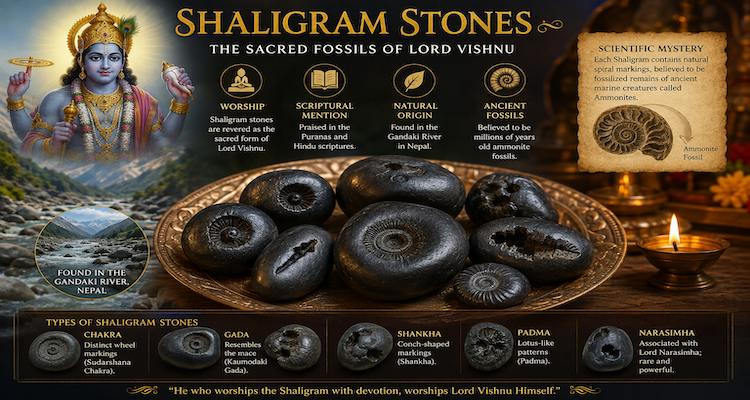
A small, dark stone picked from the Kali Gandaki River in Nepal can simultaneously be understood as a fossil, a geological record of an ancient sea, and a sacred manifestation of Lord Vishnu. That unusual overlap is what makes the Shaligram also spelled Shaligrama or Salagrama different from an ordinary religious object.
For Vaishnava Hindus, a Shaligram is not simply a stone carved to resemble a deity. It is traditionally regarded as a naturally occurring manifestation of Vishnu, often identified through its openings, spiral structures and markings. For paleontology, many classic Shaligrams are water-worn rocks containing fossil ammonites, marine animals that lived hundreds of millions of years ago. Scholars studying Shaligram traditions have found that these two interpretations are not necessarily treated as mutually exclusive by devotees. The fossil itself can be part of what makes the object sacred.
That intersection of geology and religion gives Shaligrams a remarkable history: an ancient marine ecosystem became part of Himalayan geology, the rocks were uplifted during the formation of the mountains, rivers exposed and transported the fossils, and religious traditions gave particular natural forms theological meaning.
Key Takeaways
- Shaligrams are sacred objects associated primarily with Vishnu and traditionally obtained from the Kali Gandaki region of Nepal.
- Many classic Shaligrams contain fossil ammonites preserved in dark Himalayan rocks.
- Their spiral and ribbed structures are traditionally interpreted as manifestations or symbols associated with Vishnu’s Sudarshana Chakra.
- Traditional Shaligram “types” are identified by physical characteristics, but classifications vary across religious texts and traditions.
- The fossils record a time when the region that became the Himalayas was part of an ancient marine environment.
- Their scientific and religious identities describe different dimensions of the same unusual natural object.
What Exactly Is a Shaligram?
The word Shaligram refers to a sacred stone associated particularly with the Gandaki or Kali Gandaki River system of Nepal. In Hindu practice, the stone is revered as a natural or self-manifest form of Vishnu rather than as an image manufactured by a sculptor.
This distinction matters. Conventional Hindu images may be sculpted, cast or otherwise created and then ritually consecrated. Shaligrams occupy a different category in many Vaishnava traditions because their natural form is itself central to their religious identity. Anthropologist Holly Walters, whose extensive ethnographic research examined Shaligram pilgrimage and worship in Nepal and South Asia, describes them as objects understood simultaneously as fossils, divine beings and intimate religious presences within families.
The stones are particularly associated with the Kali Gandaki valley in Mustang, a mountainous region of Nepal. The river cuts through geological formations containing fossil-bearing rocks, and erosion releases fossil material that can eventually become rounded by water.
This is why the location matters so much. A Shaligram is not simply any black stone with a spiral pattern. Its geographical origin, natural formation and characteristic fossil structures are all part of the tradition surrounding it.
Why Are Shaligrams Associated With Lord Vishnu?
The religious association is closely connected with the stone’s natural markings.
Many Shaligrams contain a coiled or spiral fossil structure. To devotees, these markings can resemble the Sudarshana Chakra, the discus traditionally carried by Vishnu. The ribs of an ammonite can create radial patterns that look remarkably like a wheel when viewed through an opening or on an exposed surface. The Natural History Museum in London notes that this resemblance is one important reason ammonite-bearing stones became associated with Vishnu’s chakra.
But the religious meaning goes beyond visual resemblance.
Traditional stories surrounding Shaligrams include narratives involving Vishnu, the goddess Tulsi and the transformation of divine beings into stone. Other traditions describe a supernatural agent known as the vajra-kita, sometimes interpreted in connection with the natural markings made by geological or fossil processes. Holly Walters’ research shows how these stories connect landscape, fossils, mythology and ideas of divine presence rather than treating the stone merely as a symbolic representation.
This creates an important distinction for readers:
Science explains how the physical structure formed. Religious tradition explains what that structure means within a sacred worldview.
Those are different kinds of explanations, and confusing them can make both the science and the religious tradition harder to understand.
The Ancient Fossil Inside the Sacred Stone
The scientific story is perhaps even more surprising.
Many classic Shaligrams contain ammonites, extinct marine cephalopods related to modern squid and cuttlefish. Their shells were generally coiled, and the internal or external structures of those shells can survive as fossils.
Research on Himalayan ammonites has documented Jurassic fossil assemblages in Nepal. A study published in the Journal of Asian Earth Sciences examined Jurassic ammonite faunas from Nepal and identified multiple successive assemblages extending from the Middle Jurassic toward the Jurassic–Cretaceous boundary.
The geological setting explains why marine fossils can be found in a region now dominated by some of Earth’s highest mountains.
The rocks containing these fossils were deposited when the area was part of an ancient marine environment associated with the Tethys Ocean. The Indian tectonic plate was once positioned much farther south than it is today. Over geological time, it moved northward and collided with Asia, producing the immense deformation and uplift associated with the Himalayas.
In other words, a fossil that began its existence in an ancient sea can now be found in a Himalayan river.
That is not a religious claim. It is a geological history supported by paleontological and tectonic research.
Why Do the Stones Look So Unusual?
A Shaligram’s appearance is produced by several geological processes rather than by a single “mystery” mechanism.
First, the fossilized organism and surrounding sediment became incorporated into sedimentary rock. Later geological processes transformed and uplifted those rocks. Erosion then exposed fossil-bearing material.
The Kali Gandaki River plays another important role. Water and sediment gradually wear exposed rocks, producing the rounded, dark forms commonly associated with Shaligrams.
The Natural History Museum describes Shaligrams as black limestone formations containing ammonites from Jurassic and Cretaceous rocks. Geological research on Nepal’s fossil record likewise documents ammonites in the Himalayan region.
The result is an unusual geological object: the stone may look almost deliberately carved even though its spiral and ribbed structures can be natural fossil features.
That apparent contradiction natural formation producing something that resembles a sacred symbol is one reason Shaligrams have attracted interest from both religious practitioners and fossil researchers.
Shaligram Types: Why Classification Is More Complicated Than a Simple List
Popular discussions often present long lists of Shaligram varieties, assigning names such as Lakshmi-Narayana, Narasimha, Sudarshana, Vamana, Damodara and others to stones with particular shapes and markings.
There is a genuine traditional basis for this classification, but it should not be presented as though there is one universally standardized scientific taxonomy.
Traditional descriptions distinguish Shaligrams through characteristics such as:
- number and position of openings;
- number and arrangement of chakra markings;
- spiral structures;
- shape and proportions;
- surface markings;
- colour;
- additional natural features interpreted through religious tradition.
Some traditional texts and later compilations associate particular combinations of these characteristics with specific manifestations of Vishnu. For example, traditional identification systems describe Lakshmi-Narayana, Narasimha, Vamana, Sudarshana and other forms according to distinctive markings and structures.
The important editorial caution is that traditional classification and paleontological classification are not the same thing.
A geologist may ask which ammonite genus or fossil-bearing formation is present. A devotee may ask which divine form the stone manifests. The first is a scientific classification; the second is a religious interpretive system.
Neither question can simply replace the other.
The Main Traditional Forms Readers Commonly Encounter
Among the names frequently encountered in Shaligram traditions are:
Sudarshana
Associated with Vishnu’s discus, the Sudarshana form is traditionally identified through chakra-like markings. The connection is especially significant because ammonite ribs naturally produce radial patterns.
Lakshmi-Narayana
This form combines Vishnu with Lakshmi in the traditional classification system. Specific arrangements of openings and chakra markings are used in traditional identification literature.
Narasimha
Associated with Vishnu’s half-man, half-lion incarnation, Narasimha Shaligrams are traditionally described using distinctive openings and shapes. Different textual traditions provide somewhat different physical descriptions.
Vamana
Associated with Vishnu’s dwarf incarnation, Vamana is another traditional Shaligram category. Traditional descriptions place particular emphasis on size, shape and chakra markings.
Damodara
Damodara is another established name within traditional Shaligram classification, with descriptions based on characteristics such as shape and markings.
These labels should be understood as religious and traditional classifications, not as officially recognized paleontological species.
What Makes a Shaligram Scientifically Interesting?
The real scientific mystery is not whether Shaligrams are supernatural objects. Science has a different question: How did marine fossils become embedded in rocks now exposed high in the Himalayas?
The answer is a geological story spanning immense periods of time.
Jurassic ammonites lived in marine environments long before the Himalayas existed in their present form. Research on Himalayan ammonite assemblages demonstrates that these fossils preserve information about ancient marine ecosystems and the palaeogeography of the region.
Later, tectonic movement transformed the geography.
The Indian Plate moved toward Eurasia and eventually collided with the Asian landmass. Rocks that had formed in ancient marine environments were folded, faulted and uplifted. Erosion subsequently exposed them, allowing rivers such as the Kali Gandaki to transport fossil-bearing material.
The Shaligram therefore provides a tangible connection between several chapters of Earth’s history:
ancient ocean → marine organism → fossilization → tectonic collision → Himalayan uplift → erosion → river transport → sacred object
That sequence is scientifically remarkable even before its religious significance is considered.
Are All Shaligrams Ammonites?
This is where another common simplification needs qualification.
Classic Shaligrams are strongly associated with ammonites, but fossil material found in the same geological environment can include other organisms. Research and specialist discussions have documented bivalves and belemnites in the relevant fossil-bearing rocks, and some religious traditions also recognize such naturally occurring forms within broader Shaligram practice.
So saying that every Shaligram is simply an ammonite is too broad.
A more accurate description is that Shaligrams are sacred fossil-bearing stones, with ammonites forming the characteristic and most widely recognized fossil component.
Shaligram Worship and Everyday Religious Life
Shaligrams are not important only because pilgrims travel to the Himalayas to find them.
They can become household sacred objects, moving from the Himalayan landscape into homes and communities across South Asia and the global Hindu diaspora. Walters’ research emphasizes this movement as an important part of Shaligram practice: pilgrimage, exchange, worship and family relationships all contribute to the stone’s religious life.
This also explains why the stone’s physical journey matters.
A Shaligram may begin as a fossil exposed by erosion, become collected from a river environment, travel with a pilgrim, enter a household and then become part of recurring ritual practice. Its geological movement and its religious movement become intertwined.
In many Vaishnava traditions, Shaligrams are treated with considerable reverence and incorporated into daily worship. Their natural origin is itself meaningful because the deity is understood as present without the stone having been manufactured into a conventional statue.
The Myth and the Fossil Can Exist Side by Side
One of the most interesting aspects of Shaligram culture is that the religious story does not necessarily disappear when the fossil is scientifically identified.
A person can understand that an ammonite lived in an ancient sea and was fossilized through geological processes while simultaneously regarding the resulting Shaligram as a manifestation of Vishnu.
Anthropological research is particularly useful here because it shows that sacred objects cannot always be understood through a simple science-versus-religion framework. Walters’ work treats Shaligrams as material objects whose fossil characteristics, religious narratives, pilgrimage routes and human relationships are all part of their cultural significance.
That is arguably the most important lesson of the Shaligram story.
The scientific explanation does not need to function as a debunking exercise, just as religious meaning should not be presented as geological evidence.
Why the Shaligram Story Matters Beyond Hinduism
Shaligrams offer a rare example of how humans attach cultural meaning to deep geological time.
A fossil is normally described through age, species, formation and location. A sacred fossil adds another layer: memory, ritual, mythology, identity and relationships between people and landscape.
The Kali Gandaki region consequently has significance beyond its fossils. It is connected to pilgrimage, Muktinath, Himalayan geography and traditions that cross religious and national boundaries. Walters’ research documents Shaligram practice not only among Hindu communities but also within the wider religious and cultural environment of Mustang.
This makes Shaligrams relevant to more than religious studies or paleontology. They sit at the intersection of earth science, anthropology, history, pilgrimage and material culture.
What Readers Should Be Careful About
The internet contains extensive claims about Shaligrams, including precise identification guides, supernatural powers and lists of guaranteed spiritual or material benefits.
Such claims should not all be treated as factual statements.
Traditional beliefs about the spiritual consequences of worship belong to religious tradition. They are meaningful within those traditions but are not scientific findings that can be independently established through paleontology.
Likewise, identifying a fossil by appearance alone can be difficult. Traditional classifications may depend on detailed features that do not map neatly onto modern fossil taxonomy.
For anyone studying or purchasing a Shaligram, the safest approach is to distinguish three questions:
- What does the religious tradition say about this form?
- What is the geological or fossil evidence?
- What can actually be established about this particular specimen?
Keeping those questions separate produces a much clearer understanding of the stone.
Conclusion
A Shaligram is unusual precisely because no single description fully captures it.
To a paleontologist, it can preserve the remains of an ammonite from an ancient marine world. To a geologist, it is part of a much larger story involving sedimentation, tectonic collision, Himalayan uplift and erosion. To a devotee, it can be a naturally manifested presence of Lord Vishnu, worthy of worship in its own right.
The apparent contradiction is what makes Shaligrams so compelling.
Their sacred status does not erase their geological history, and their geological history does not automatically erase their religious meaning. Instead, the stones demonstrate how a natural object can acquire layers of significance as it moves through deep time, landscape, mythology and human life.
Few objects make the distance between an ancient ocean and a modern household deity feel as tangible as a small black stone carried down the Kali Gandaki.
This content is published for informational or entertainment purposes. Facts, opinions, or references may evolve over time, and readers are encouraged to verify details from reliable sources.
Related News
- Why Mark Zuckerberg Visited Kainchi Dham: The Neem Karoli Baba Connection Behind a Silicon Valley Story
- Kainchi Dham: How a Himalayan Ashram Became a Global Spiritual Landmark
- How Religious Architecture Continues to Shape Human Emotions Long After Belief Fades
- The New Search for Silence and Why It Is Becoming a Spiritual Movement