










Why Mark Zuckerberg Visited Kainchi Dham: The Neem Karoli Baba Connection Behind a Silicon Valley Story
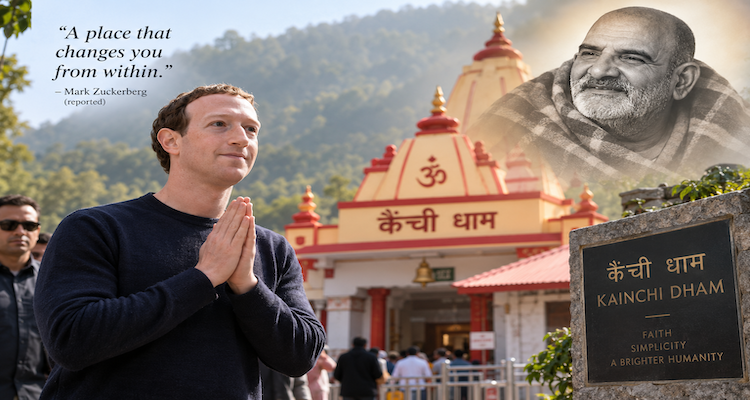
When Mark Zuckerberg spoke with Prime Minister Narendra Modi at Facebook headquarters in September 2015, he revealed a little-known episode from Facebook’s early years: during a difficult period for the company, Steve Jobs advised him to visit a temple in India that Jobs himself had visited.
Zuckerberg followed the advice. He said he traveled in India for almost a month and that seeing how people connected with one another reinforced his belief in what Facebook was trying to build.
The temple was subsequently identified as Kainchi Dham, the Himalayan ashram associated with Neem Karoli Baba, also known as Maharaj-ji. Contemporary reporting placed Zuckerberg’s visit there in 2008.
But one important detail is often lost in the retelling: Zuckerberg did not meet Neem Karoli Baba. Baba had died in 1973, years before Zuckerberg’s visit—and before Steve Jobs reached the ashram in 1974. What connects the two technology founders to Kainchi Dham is therefore less a story of a guru personally advising Silicon Valley and more a story about how an idea, a place and a spiritual tradition traveled from one generation of technology leaders to another.
Key Takeaways
- Zuckerberg’s Kainchi Dham journey took place during a difficult period in Facebook’s early development.
- Steve Jobs was the person who directed Zuckerberg toward the Indian temple.
- The temple was identified as Kainchi Dham, the ashram associated with Neem Karoli Baba.
- Jobs himself traveled to Kainchi in 1974 but arrived after Neem Karoli Baba had died.
- Zuckerberg said his Indian journey strengthened his belief in Facebook’s mission of connecting people.
- The deeper story is about purpose, intuition and service not a proven claim that spirituality created Silicon Valley’s biggest companies.
The Story Zuckerberg Told in 2015
Zuckerberg’s own account is the most important piece of evidence because it explains why he went.
At the September 27, 2015 town hall with Modi, Zuckerberg said Facebook had gone through a difficult period when some people believed the company should be sold. He went to Steve Jobs, whom he described as one of his mentors.
Jobs suggested that Zuckerberg visit a temple in India that Jobs had visited earlier in his own life. Zuckerberg said he followed the advice and spent almost a month traveling.
His description of the experience was strikingly practical rather than mystical. He said that seeing people and observing how they connected gave him a stronger sense of how much better the world could be if people had a greater ability to connect. He said that experience reinforced the importance of what Facebook was doing.
That distinction matters.
There is no need to claim that Zuckerberg received a supernatural message at Kainchi Dham, that Neem Karoli Baba personally guided Facebook, or that the visit somehow predicted the company’s future. Zuckerberg’s documented explanation is simpler: the journey helped him reconnect with the purpose he associated with Facebook.
Why Kainchi Dham Became Part of the Story
Zuckerberg did not name Kainchi Dham in his 2015 remarks. Contemporary reporting identified the temple as Kainchi Dham, near Nainital in Uttarakhand. Business Today reported that Zuckerberg traveled to the ashram during Facebook’s early years, while The Washington Post subsequently reported that he had visited Kainchi in 2008.
The connection is particularly interesting because Kainchi Dham is not primarily famous for technology.
The Uttarakhand government’s Kumaon regional website describes Kainchi Dham as a pilgrimage center on the Nainital–Almora road, around 17 kilometers from Nainital and 9 kilometers from Bhowali. The site is associated with Neem Karoli Maharaj.
India’s official tourism portal similarly describes the ashram as a spiritual destination dedicated to Neem Karoli Baba.
Its international reputation grew partly through Western seekers who became associated with Baba during the 1960s and early 1970s. Among them was Richard Alpert, the Harvard psychologist who later became known as Ram Dass.
That history helps explain why a small Himalayan ashram could eventually enter the personal histories of people connected with some of America’s most influential technology companies.
The Steve Jobs Connection Came First
The Zuckerberg story makes little sense without Steve Jobs.
In 1974, a young Jobs traveled to India with his friend Daniel Kottke while searching for spiritual understanding. His destination included Neem Karoli Baba’s ashram at Kainchi.
There was, however, a twist that has become central to the story: Neem Karoli Baba had already died in September 1973.
Jobs therefore never had the face-to-face encounter he had originally sought. Accounts of his journey, including material based on Walter Isaacson’s authorized biography, describe a seven-month period in India during which Jobs traveled, lived simply and explored Indian spiritual traditions.
The significance of India to Jobs should also be handled carefully.
It is tempting to draw a straight line from Kainchi Dham to Apple and say that Neem Karoli Baba “created” Apple’s philosophy. The evidence does not support such a simple causal claim.
Jobs’ spiritual development was shaped by several influences, including Zen Buddhism and his broader experiences in India. His later reflections, as recorded by Isaacson, emphasized intuition and the differences he perceived between Western and Indian approaches to life.
So Kainchi Dham is better understood as one part of Jobs’ larger intellectual and spiritual journey, rather than a single explanation for Apple’s success.
From Jobs’ Search to Zuckerberg’s Crisis
This is where the story becomes more interesting from a technology and business perspective.
Jobs did not tell Zuckerberg to copy Apple.
He did not tell him to adopt a particular management system or technology strategy.
He told him to return to a place that had been meaningful during Jobs’ own search for direction.
Zuckerberg then interpreted the journey through his own problem: what did Facebook actually exist to accomplish?
That makes the episode less about religion being imported into Silicon Valley and more about purpose being used as a decision-making tool.
A technology company can measure users, revenue, engagement and growth. But those measurements do not necessarily answer the question of why the company should exist.
Zuckerberg’s 2015 account suggests that this was the question he was wrestling with at the time.
His takeaway was expressed in the language of Facebook itself: connection.
That is an important detail because it prevents the story from becoming a generic tale about a billionaire seeking enlightenment. Zuckerberg did not describe Kainchi Dham as giving him a business formula. He described the journey as reinforcing his conviction about human connection.
What Neem Karoli Baba Actually Represented
Neem Karoli Baba’s significance cannot be reduced to his association with famous technology executives.
Accounts from his devotees emphasize a spiritual life centered on devotion, compassion and selfless service. The Ram Dass organization, drawing on Miracle of Love, describes selfless loving service as one of the central practices encouraged by Maharaj-ji.
Organizations carrying his tradition today similarly emphasize themes such as love, service, compassion and remembrance.
That provides a useful lens through which to understand the Silicon Valley connection but not proof of a direct business doctrine.
The striking contrast is that technology companies often think in terms of scale, optimization and networks, while the spiritual tradition associated with Kainchi emphasizes the individual act of serving and connecting with other people.
Zuckerberg’s own description of his experience happens to sit at that intersection: he said witnessing how people connected strengthened his sense of purpose.
The overlap is real. The claim that Neem Karoli Baba directly designed or predicted Facebook is not.
Why the Kainchi Dham Story Became So Powerful
The story gained unusual cultural power because it links two worlds that are normally discussed separately.
One is the world of Silicon Valley: startups, venture capital, software, global platforms and technological scale.
The other is a Himalayan spiritual center built around devotion, service and a teacher who died decades before Facebook existed.
The Washington Post’s 2015 reporting captured the unusual concentration of technology figures associated with Kainchi, including Jobs and Zuckerberg as well as other people connected to the technology and business world.
But the deeper appeal may be psychological.
Entrepreneurs are frequently expected to project certainty. They are supposed to know what they are building, why it matters and where the company is going.
The Kainchi story suggests something more complicated: even highly successful founders can reach moments when technical ability and business strategy do not answer the personal question of what should happen next?
For Jobs, that question took him to India.
For Zuckerberg, decades later, a difficult period at Facebook led him to follow Jobs’ advice.
The important connection is therefore not “Baba made technology successful.”
It is the transmission of a question about purpose.
What the Evidence Does and Does Not Show
Several versions of the Kainchi story have circulated online, and separating established facts from popular retellings is important.
Well documented: Zuckerberg said in 2015 that Steve Jobs advised him to visit an Indian temple that Jobs had visited. Zuckerberg also said he traveled for almost a month and that the experience reinforced his belief in Facebook’s mission of connecting people.
Strongly established by contemporary reporting: The temple was Kainchi Dham, and reporting placed Zuckerberg’s visit there in 2008.
Well documented: Steve Jobs traveled to India in 1974 seeking Neem Karoli Baba, but Baba had died in 1973 before Jobs arrived.
Not established: That Zuckerberg met Neem Karoli Baba. He could not have done so; Baba died decades earlier.
Not established: That Neem Karoli Baba directly instructed Zuckerberg to build Facebook or that his teachings caused Facebook’s commercial success.
Not established: That Apple’s or Facebook’s success can be scientifically or historically attributed to a visit to Kainchi Dham.
This distinction does not make the story less interesting. It makes it more credible.
The Larger Silicon Valley Lesson
The most revealing part of the Kainchi Dham story may have nothing to do with whether one accepts its spiritual dimension.
It shows how founders sometimes search outside their immediate professional environment when confronting questions of meaning.
Zuckerberg did not need another Silicon Valley meeting to be told how to build software. Jobs’ advice instead pointed him toward a place associated with reflection, spiritual searching and a different understanding of human connection.
And the advice was unusually personal: go somewhere that helped me reconsider what I was doing.
That is different from claiming that a Himalayan pilgrimage produces better entrepreneurs.
There is no evidence for that broader proposition.
What the story does demonstrate is that the personal histories of technology founders can contain influences that are easy to overlook when their careers are reduced to products, valuations and corporate milestones.
The mythology of Silicon Valley often presents innovation as a purely technological phenomenon. The Kainchi story complicates that picture.
It suggests that, for at least two of its most recognizable figures, questions of identity, purpose, intuition and spirituality existed alongside engineering and business ambition.
Conclusion
Mark Zuckerberg’s journey to Kainchi Dham is often retold as a mysterious connection between Facebook, Steve Jobs and Neem Karoli Baba.
The documented version is more nuanced and arguably more compelling.
Zuckerberg went to India after Steve Jobs advised him to visit a temple that had mattered during Jobs’ own spiritual search. Contemporary reporting identified that temple as Kainchi Dham. Zuckerberg later said the experience reinforced his belief in Facebook’s mission of connecting people.
Neem Karoli Baba was at the center of the place’s spiritual identity, but neither Zuckerberg nor Jobs actually met him. Jobs arrived after Baba’s death, while Zuckerberg visited decades later.
What survived was not a direct guru-to-founder relationship but an idea passed from one technology leader to another: when the purpose of what you are building becomes unclear, step outside the machinery of the business and reconsider why you are building it in the first place.
That may be the most enduring connection between Kainchi Dham and Silicon Valley not that a mountain ashram produced technological success, but that two technology founders found reason to look beyond technology when thinking about what their work was for.
This content is published for informational or entertainment purposes. Facts, opinions, or references may evolve over time, and readers are encouraged to verify details from reliable sources.
Related News
- Kainchi Dham: How a Himalayan Ashram Became a Global Spiritual Landmark
- How Religious Architecture Continues to Shape Human Emotions Long After Belief Fades
- The New Search for Silence and Why It Is Becoming a Spiritual Movement
- How Constant Notifications Are Changing the Human Capacity for Prayer and Contemplation