










How Constant Notifications Are Changing the Human Capacity for Prayer and Contemplation
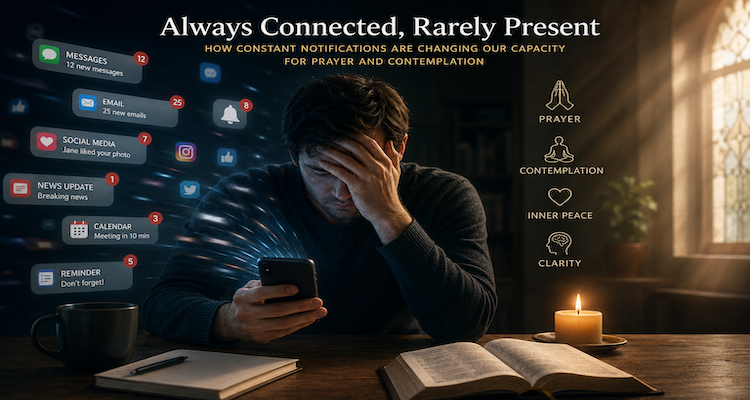
A prayer does not require a silent room. A person can pray on a crowded train, in a hospital corridor, or while walking through a city. But sustained prayer and contemplation do require something less visible: the ability to remain with one object of attention when nothing is demanding an immediate response.
That ability is increasingly being exercised against a digital environment designed around interruption.
A notification is small a vibration, sound, banner or icon but research suggests that its attentional effect can occur even when a person never picks up the phone. In a controlled experiment, researchers found that receiving a mobile-phone notification disrupted performance on an attention-demanding task even when participants did not interact with the device. The researchers suggested that notifications can trigger task-irrelevant thoughts and mind wandering.
That finding does not prove that smartphones are making people less capable of prayer. There is not enough direct longitudinal research to make that claim. But it raises a more useful question: if prayer and contemplation depend partly on sustained attention, what happens when everyday life repeatedly trains attention to respond to interruption?
The answer may be less about religion versus technology than about what kind of attention modern digital environments are encouraging people to practice.
Key Takeaways
- Notifications can interrupt attention even when people do not physically check their phones.
- Direct evidence that notifications reduce the human capacity for prayer remains limited.
- Prayer itself has been studied as an activity involving attention, cognition and mental regulation.
- Contemplative practices depend on repeatedly returning attention after distraction rather than eliminating every distracting thought.
- Turning off nonessential notifications can create better conditions for uninterrupted prayer without requiring rejection of technology.
- The deeper issue may be whether people still control when their attention becomes available to the outside world.
The overlooked problem is not the phone, but the interruption
The most obvious form of digital distraction is active phone use: opening a message, scrolling through a social platform or responding to an email.
Notifications are different.
They can interrupt without being opened.
In a 2015 experiment published in the Journal of Experimental Psychology: Human Perception and Performance, researchers found that participants performed worse on an attention-demanding task after receiving cellphone notifications, despite not directly interacting with their phones. The researchers proposed that notifications could generate task-irrelevant thoughts that competed with the task at hand.
Later research has also examined the cognitive effects of notification sounds and found slower responses when smartphone notifications accompanied demanding tasks. Other work has linked notification exposure with changes in measures associated with cognitive control.
The significance for contemplation is straightforward but should not be overstated.
If an incoming alert can redirect attention during a laboratory task, it is reasonable to consider whether repeated alerts make sustained periods of prayer more difficult. It is not reasonable to claim that science has demonstrated that notifications permanently damage someone’s spiritual capacity.
Those are very different statements.
Prayer is itself an attentional activity
Prayer is too diverse to reduce to a single psychological mechanism.
For some people it involves spoken words. For others it may involve silence, repetition, scripture, meditation, confession, gratitude, petition or an attempt to remain consciously present before God. Different religious traditions also understand prayer in profoundly different ways.
Yet psychological research suggests that attention is relevant to at least some forms of prayer.
A study published in Religion, Brain & Behavior examined prayer, contemplation and a control activity in two experiments. Among participants with high levels of religiosity, those who prayed about a personal concern subsequently showed improved performance on certain attention-related tasks. A second experiment suggested that prayer could influence attention toward information related to the concern being prayed about.
The researchers did not establish a supernatural mechanism. Their work examined cognitive processes associated with prayer.
That distinction matters.
Prayer can be meaningful as a religious practice without science being able to determine whether or how a divine response occurs. At the same time, cognitive research can investigate what happens to attention, memory, emotion and perception during prayer without reducing the religious meaning of the practice to brain activity.
This makes the notification question more interesting.
If prayer can involve deliberately directing attention toward a concern, text, person, belief or perceived relationship with the divine, then an environment that repeatedly pulls attention elsewhere may create friction with the practice.
Contemplation depends on returning, not never becoming distracted
There is another important correction to the popular idea of concentration.
Contemplation does not necessarily require a perfectly empty mind.
Meditative traditions often teach practitioners to notice distraction and return attention to the chosen object. Research on meditation has similarly investigated focused attention, executive attention and related forms of attentional control.
Studies have found evidence that certain forms of meditation can improve aspects of attention, although results vary according to the practice, population, study design and amount of training.
This suggests a useful way to think about prayer.
The problem is not necessarily that a person’s mind wanders during prayer. Mind wandering is part of ordinary human cognition. The more consequential question is what happens when the external environment repeatedly gives that wandering a new destination.
A person sitting quietly may notice a thought, acknowledge it and return to prayer.
A person interrupted by a notification receives a new external stimulus. The message may concern work, family, money, news, entertainment or something trivial. The mind now has another item to evaluate.
The interruption therefore changes the conditions under which attention has to be recovered.
Notifications can turn attention into a standing obligation
Modern notifications do more than deliver information. They create the expectation that information may arrive at any moment.
That expectation can become part of the mental environment even when the phone remains untouched.
Research summarized by the American Psychological Association has reported that participants experienced more inattention and hyperactivity during periods when smartphone notifications were enabled compared with periods when notifications were disabled. Other experimental work has investigated notification batching and found that grouping notifications rather than delivering them continuously can improve reported attention, stress and perceived productivity.
The practical lesson is broader than “phones are bad.”
Different notifications have different purposes.
A call from a family member may be important. A security alert may require immediate action. A workplace message may matter during working hours. A social-media reaction generally has a different level of urgency.
Treating every alert as equally worthy of immediate attention effectively gives every application a claim on the same cognitive resource.
Prayer can expose the absurdity of that arrangement.
A person may deliberately set aside ten, twenty or thirty minutes to attend to something considered spiritually significant, only to allow dozens of unrelated systems to retain permission to interrupt.
The issue is not technology itself. It is the default allocation of attention.
What constant interruption may be changing
It would be premature to say that notifications are “shrinking” the human attention span or permanently reducing the capacity for contemplation. The scientific literature does not justify such a simple conclusion.
A more defensible interpretation is that frequent interruptions can make sustained attention harder in particular circumstances.
That distinction is important because attention is trainable and context-dependent.
People can work deeply despite having smartphones. They can read books, meditate, pray and engage in long conversations. They can also become accustomed to checking devices frequently.
The same person may therefore experience very different attentional conditions depending on how the digital environment is configured.
This leads to a more useful question than whether technology has ruined attention:
Who decides when your attention is available?
If an application can produce an audible signal whenever it wants, it has effectively been given a mechanism for competing for a person’s attention. Turning that mechanism off changes the environment before it changes the individual.
That is a surprisingly important distinction.
The smartphone does not have to leave the room
For someone who wants deeper prayer or contemplation, the solution does not necessarily require abandoning a smartphone.
A more proportionate approach is to separate accessibility from availability.
A phone can remain available for emergencies while nonessential interruptions are removed. Depending on the device, this can involve notification summaries, scheduled focus modes, silent settings, app-specific notification controls or simply keeping the device out of sight.
The principle is simple: not every message deserves immediate access to consciousness.
A practical experiment could be deliberately modest:
- Choose a defined period for prayer or contemplation.
- Silence nonessential notifications before beginning.
- Keep emergency contacts or genuinely necessary alerts available if required.
- Put the phone outside the immediate field of view when possible.
- When attention wanders, return to the prayer rather than treating distraction as failure.
- Afterward, notice whether the period felt different from prayer conducted with notifications active.
The final step is especially useful because it turns the practice into observation rather than ideology.
The goal is not to prove that technology is harmful. It is to discover which conditions help a particular person remain attentive.
What the research still cannot tell us
There is a significant gap between research on smartphone notifications and research on spiritual practice.
Scientists have studied notification-related distraction, attention, cognitive control and mindfulness. Researchers have also studied prayer and its relationship with attention and cognition.
But those bodies of research should not be combined into a conclusion that has never actually been tested.
There is not currently strong evidence demonstrating that years of smartphone notifications cause a measurable decline in a person’s capacity for prayer.
Nor is there evidence that turning off notifications will automatically produce deeper faith, more meaningful prayer or spiritual transformation.
Religious experience contains dimensions that laboratory attention tasks cannot fully measure.
A person may also pray effectively despite considerable distraction, while another person may sit in complete silence and remain mentally restless.
The evidence therefore supports a narrower and arguably more useful claim: digital interruptions can interfere with the attentional conditions in which some forms of prayer and contemplation take place.
What happens beyond that depends on the person, the practice and the meaning they attach to it.
Reclaiming attention is also a spiritual decision
The deeper significance of notification culture may therefore have less to do with smartphones than with agency.
Contemplation asks a person to remain with something without demanding constant novelty. Notifications encourage the opposite rhythm: something arrives, attention moves, something else arrives, attention moves again.
Neither rhythm is inherently appropriate for every situation.
But a life dominated by the second rhythm leaves little room for practices whose value emerges slowly.
Prayer is one such practice. So are reading, reflection, silence, conversation and sustained thought.
The question is not whether technology should disappear from these parts of life. It is whether technology should automatically be allowed to interrupt them.
For someone who considers prayer important, protecting a period of uninterrupted attention is not necessarily an act of technological rejection. It can be an intentional act of prioritization.
A notification asks, “What has arrived?”
Contemplation asks, “What deserves my attention?”
Those questions are not always compatible. The ability to distinguish between them may become one of the quiet skills worth preserving in an always-connected world.
Conclusion
There is no scientific basis for declaring that notifications have permanently weakened humanity’s capacity for prayer. The evidence is more precise: smartphone alerts can disrupt attention, and prayer and contemplation can involve sustained, deliberately directed attention.
That makes the conflict less mysterious.
A notification does not need to destroy concentration to compete with contemplation. It only needs to arrive at the moment attention has begun to settle.
The practical response is therefore not to fear technology, but to establish boundaries around attention. Silence can be scheduled. Notifications can be filtered. Phones can remain available without remaining continually demanding.
In a culture where almost everything can ask for attention, choosing what is allowed to interrupt may itself become a form of discipline.
And for people who pray, that discipline may be less about escaping the digital world than about deciding, for a little while, that something else matters more.
This content is published for informational or entertainment purposes. Facts, opinions, or references may evolve over time, and readers are encouraged to verify details from reliable sources.
Related News
- Why Mark Zuckerberg Visited Kainchi Dham: The Neem Karoli Baba Connection Behind a Silicon Valley Story
- Kainchi Dham: How a Himalayan Ashram Became a Global Spiritual Landmark
- How Religious Architecture Continues to Shape Human Emotions Long After Belief Fades
- The New Search for Silence and Why It Is Becoming a Spiritual Movement