










The Electricity Demand Nobody Expected: Why “Small” Devices Are Becoming a Big Energy Story
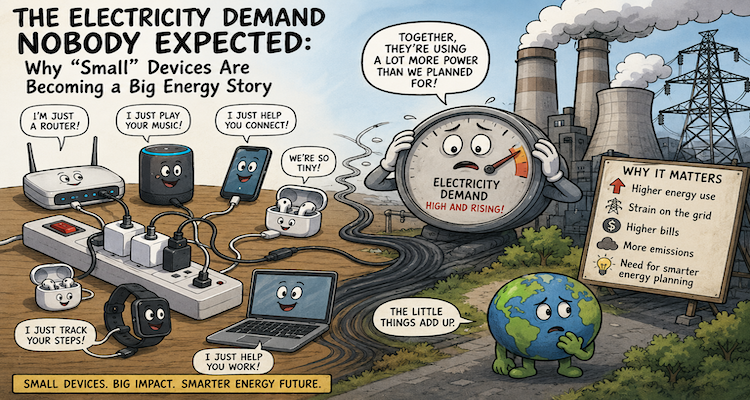
A smartphone charger, smart speaker, Wi-Fi router, security camera or connected thermostat hardly looks like an energy problem. One device may draw only a few watts, and some spend most of their lives in low-power or standby states.
The bigger issue is scale.
Electricity demand is increasingly being shaped by a much larger collection of digital and connected equipment operating continuously in homes, offices and businesses. At the same time, data centres, electric vehicles, air conditioning and industrial electrification are pushing power demand higher from the other end of the spectrum. The result is a more complicated electricity story: not simply a world of enormous new loads, but an expanding ecosystem of devices that are small individually and consequential collectively.
The distinction matters. Current global electricity growth cannot be blamed on smartphones or smart-home gadgets alone. The latest International Energy Agency (IEA) data show that buildings, industry, transport and data centres are all contributing to rising demand. But the history of connected devices offers an important warning: efficiency gains at the device level can be overwhelmed when billions of devices are connected, powered and used more frequently.
Key Takeaways
- A single connected gadget usually uses little electricity, but billions of always-connected devices can create a meaningful aggregate load.
- Standby and network connectivity can consume electricity even when a device is not performing its main function.
- Data centres and large electrified technologies remain much bigger electricity stories than individual consumer gadgets.
- Efficiency improvements matter because connected-device growth can otherwise offset some savings achieved by more efficient hardware.
- The electricity system increasingly has to manage both huge new loads and millions of smaller, distributed ones.
- Consumers can reduce unnecessary consumption by eliminating idle equipment and choosing devices with efficient standby and networking behavior.
The electricity problem hiding in plain sight
For decades, electricity demand was relatively easy to visualize.
A refrigerator ran continuously. A washing machine consumed power when switched on. A television was turned on for a few hours. Lighting represented another identifiable category of consumption.
Digitalisation changed that pattern.
Many devices no longer have a simple “on” and “off” state. A smart television may remain connected to a network. A voice assistant waits for commands. A security camera continuously communicates with a cloud service. A router remains active around the clock. A smart appliance can maintain a connection even when its main function is not running.
The IEA identified this phenomenon more than a decade ago in its research on networked devices. Its 2014 report More Data, Less Energy warned that the growing population of network-enabled equipment could become an important electricity issue because devices can consume energy simply to maintain connectivity. The report estimated that networked devices consumed more than 600 TWh globally in 2013 and found that, for some devices, maintaining a network connection could account for a large share of energy consumption.
That historical figure should not be treated as a current estimate. Technology, device efficiency and usage patterns have changed substantially since then. But the underlying principle remains relevant: connectivity creates an additional energy requirement that did not exist in the same form for many older appliances.
Why “small” does not necessarily mean insignificant
Imagine a device consuming only a few watts.
That sounds trivial.
Now change the question from How much does this device use? to How many such devices are operating?
A connected device can remain active for thousands of hours a year. Multiply that by several devices in a household, then millions of households, offices, shops and industrial sites.
This is where the arithmetic becomes more interesting than the individual specification sheet.
The same principle applies to computing equipment. A single sensor, network appliance or small computer may have modest electricity requirements. But a digital system can contain thousands or millions of such components.
This does not mean every small device is an important source of electricity demand. It means that scale, operating time and connectivity can matter as much as the wattage of an individual product.
That is why energy efficiency cannot be judged only by asking whether a particular gadget uses less electricity than its predecessor.
The more useful question is:
How much electricity does the entire installed population of these devices consume over its lifetime?
The much bigger story is happening at both ends
There is a danger in focusing too heavily on gadgets.
The current electricity-demand picture is dominated by a combination of much larger forces.
The IEA’s Global Energy Review 2026 reports that global electricity demand increased by about 3% in 2025, following 4.4% growth in 2024. The agency says the buildings sector accounted for nearly 45% of the increase in global electricity demand in 2025, with appliances, air conditioners and heat pumps among the contributors. Data-centre electricity consumption also increased by about 17%, although its approximately 70 TWh increase was much smaller than the roughly 800 TWh increase in total global electricity demand that year.
That comparison is important.
It prevents a common mistake: assuming that AI, data centres or consumer electronics explain all of the world’s rising electricity demand.
They do not.
The electricity system is being reshaped by several simultaneous trends.
The IEA’s 2026 electricity outlook expects global electricity demand to grow at an average annual rate of about 3.6% between 2026 and 2030, adding roughly 1,100 TWh of demand each year on average. The agency identifies industry, electric vehicles, space cooling and data centres among the major drivers.
Small connected devices therefore belong to a much larger story about the electrification and digitalisation of everyday life.
AI makes the distinction even more important
Artificial intelligence has introduced a particularly visible electricity debate.
The physical AI workload may appear to begin with something small: a person typing a question into a phone or computer.
But the electricity-intensive computing generally happens elsewhere.
AI models are trained and deployed primarily in data centres, where servers, networking equipment, cooling systems and other infrastructure consume electricity. The IEA estimates that global data-centre electricity consumption was about 415 TWh in 2024, roughly 1.5% of global electricity consumption. Its base case projects that data-centre consumption could reach around 945 TWh by 2030.
That creates an interesting disconnect between what users see and what the electricity system sees.
A person may hold a small smartphone while using an AI service. The phone itself is not necessarily the main electricity burden associated with the computation. The demanding work can take place in remote infrastructure.
And even there, efficiency is improving.
The IEA’s 2026 analysis says energy use per AI task has fallen substantially as hardware and software have improved. But it also warns that newer applications including video generation, reasoning and agentic tasks can require far more energy than simple text generation.
So efficiency and demand can move in opposite directions at the same time.
Each task can become cheaper in energy terms while the number and complexity of tasks increase.
The rebound problem: efficiency does not automatically mean less electricity
This is one of the most important ideas for understanding the technology-energy relationship.
Suppose a device becomes twice as efficient.
If people continue using it in exactly the same way, electricity consumption should fall.
But if efficiency makes the technology cheaper to operate, people may use it more or manufacturers may put the technology into many more products.
The total electricity requirement can therefore decline, remain stable or increase depending on how adoption and usage change.
The IEA has repeatedly highlighted this broader challenge in its work on digitalisation and energy: policymakers need to consider the energy impact of growing numbers of smart household and consumer devices rather than looking only at efficiency improvements in individual products.
This is particularly relevant to connected technology because connectivity itself can encourage more equipment to remain operational.
A conventional light switch did not need a software update.
A smart light may.
A conventional appliance did not need a cloud connection.
A connected appliance might.
Those additional capabilities can provide genuine benefits, but they can also introduce new energy requirements.
The hidden cost of being connected
For consumers, the practical lesson is not that every smart device should be unplugged.
Connectivity can provide real benefits: automation, accessibility, monitoring, security, energy management and remote control.
The better question is whether the energy consumed by a connected feature produces enough value to justify its continuous operation.
A few simple habits can help:
- Eliminate unnecessary always-on equipment. Devices that are rarely used do not necessarily need to remain permanently connected.
- Pay attention to standby efficiency. A device that spends most of its life idle should be efficient in that state.
- Use power-management settings. Sleep modes can reduce unnecessary consumption without eliminating functionality.
- Avoid duplicate devices. Multiple always-connected gadgets performing overlapping functions create additional background demand.
- Look beyond the headline wattage. Annual energy use can be more informative than maximum power consumption.
- Keep networking equipment efficient. Routers and other communication equipment may operate continuously, making long-term efficiency relevant.
These measures are not going to solve global electricity-demand growth by themselves. Their value is cumulative.
Why grids are paying attention
The electricity system is increasingly dealing with a strange combination of demand patterns.
Some loads are enormous and concentrated such as data centres and industrial facilities.
Others are distributed across millions of homes and businesses.
Some operate continuously. Others are highly variable.
Some can be shifted. Others cannot.
The IEA’s 2026 electricity outlook emphasizes that rising electricity consumption will require greater flexibility in power systems. Data centres, electric vehicles, cooling and electrified industry can create new patterns of demand that grids must accommodate alongside conventional consumption.
This is where connected devices could eventually become more interesting than their electricity consumption alone suggests.
A connected device is potentially controllable.
A smart thermostat can respond to conditions. A managed appliance can potentially shift its operation. A battery-connected device can interact with the grid differently from a conventional appliance.
In other words, digital connectivity can create both an energy burden and an energy-management opportunity.
That distinction is easy to miss.
The real lesson is about scale
The phrase “small devices” can be misleading because it encourages a focus on individual gadgets.
The more important unit is the ecosystem.
A single connected sensor is small.
A city filled with connected sensors is different.
A single smart appliance is small.
Millions of them operating continuously represent something else entirely.
And neither should be considered in isolation from the much larger electricity loads emerging from AI, data centres, electric vehicles, cooling, heat pumps and industrial electrification.
The IEA’s latest outlook describes an electricity system entering a period of sustained demand growth after years in which electricity consumption in many advanced economies was relatively stagnant.
That makes efficiency at every level more valuable not because a smartphone charger is about to overwhelm the grid, but because the modern economy is accumulating electricity-consuming functions everywhere.
Conclusion
The unexpected electricity story is not that a handful of tiny gadgets suddenly became major power plants.
It is that digital technology has changed how electricity consumption is distributed, multiplied and embedded into everyday life.
The large loads deserve attention: data centres, industrial facilities, electric vehicles, air conditioning and other electrified systems are driving substantial demand growth. But millions or billions of smaller connected devices reveal another side of the transition one in which electricity becomes a background requirement for connectivity, sensing, computing and automation.
That makes the future energy question less about whether one device uses a lot of electricity and more about whether the entire digital ecosystem is being designed to use power intelligently.
The smallest device may not matter much on its own.
The millions of them operating together do.
The information presented in this article is based on publicly available sources, reports, and factual material available at the time of publication. While efforts are made to ensure accuracy, details may change as new information emerges. The content is provided for general informational purposes only, and readers are advised to verify facts independently where necessary.
Related News
- The Energy Paradox of Efficiency: Why Using Less Electricity Does Not Always Mean Using Less Energy
- Why Extreme Weather Is Turning Electricity Resilience Into an Everyday Consumer Issue
- Why Energy Independence Is Becoming a Household Decision, Not Just a National Strategy
- The Hidden Energy Cost of Keeping Everything Available Instantly