










The Energy Paradox of Efficiency: Why Using Less Electricity Does Not Always Mean Using Less Energy
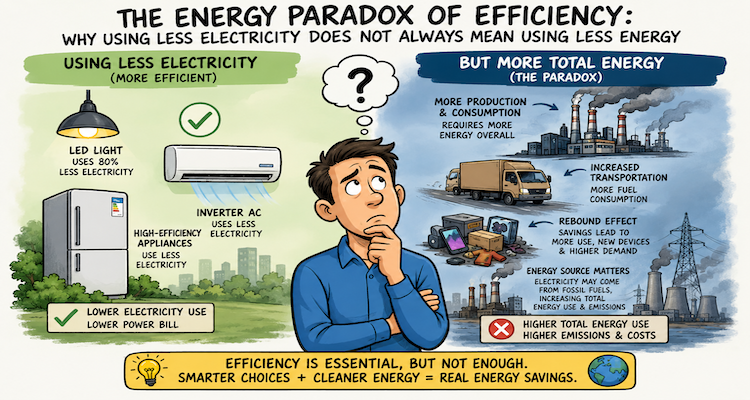
A more efficient device can use less electricity per task and still contribute to higher total energy demand. That sounds contradictory until electricity use, total energy use and the demand for energy services are separated.
An LED bulb is a straightforward efficiency success: it provides similar lighting with far less electricity than an incandescent bulb. But efficiency can also make an energy service cheaper to operate. People may use that service more, buy larger or more capable equipment, or spend the money saved on other energy-consuming activities. Economies can respond in similar ways.
This phenomenon is known as the rebound effect. It does not mean energy efficiency fails. In fact, efficiency remains one of the most important tools for limiting energy demand. The more important lesson is that measuring only the electricity consumed by an individual device can give an incomplete picture of what happens across the wider energy system.
Key Takeaways
- Efficiency can reduce energy required per task while increasing demand for the underlying service.
- The rebound effect can recover part of the energy savings, but its size varies greatly by technology and behavior.
- Electricity and total energy are different measures, especially when electricity replaces fuels such as gasoline or natural gas.
- AI illustrates the paradox: energy use per computational task is falling while overall data-centre electricity demand is rising.
- The best efficiency policies measure actual system-wide savings rather than assuming technical efficiency automatically becomes lower consumption.
- More energy services can sometimes represent improved welfare rather than an environmental failure.
Efficiency Changes the Cost of an Energy Service
The easiest way to understand the paradox is to stop thinking of efficiency as simply “using less.”
Efficiency changes the relationship between energy input and the service that energy provides.
Consider an air conditioner. If a newer model can provide the same cooling with less electricity, its technical efficiency has improved. If the household maintains the same temperature and operating hours, electricity consumption should fall.
But the lower operating cost also changes the economics of cooling.
A household that previously limited air-conditioning because of electricity costs may now run it for longer. A business may cool a larger area. A homeowner may choose a larger system with additional features. The amount of cooling delivered can therefore increase even while electricity consumption per unit of cooling falls.
The same principle can apply to transportation, heating, lighting, computing and industrial production.
Economists generally describe this response as the rebound effect: some of the energy savings expected from an efficiency improvement are offset by changes in behavior or economic activity.
That does not mean the technology has become less efficient. It means efficiency and total consumption are different questions.
Three Ways Efficiency Can Lead to More Energy Use
The rebound effect is broader than someone simply using an efficient appliance more frequently.
Direct rebound
The most intuitive form occurs when the improved service becomes cheaper.
A more fuel-efficient vehicle lowers the cost of driving each mile. Some drivers may respond by driving more.
A better-insulated home lowers the cost of maintaining a comfortable temperature. Some occupants may respond by keeping the home warmer in winter or cooler in summer.
A more efficient computer can make computationally intensive work cheaper, encouraging more computation.
Research reviewed by the U.S. Department of Energy describes this direct effect as increased demand for an energy service following a reduction in its operating cost.
Indirect rebound
The second mechanism is less visible.
Suppose an efficiency improvement saves a household $300 a year in energy costs. The household has not necessarily “saved” those dollars from the perspective of the entire economy. It may spend the money on something else.
That purchase could require energy to manufacture, transport, operate or dispose of.
The original efficiency improvement therefore remains real, but some of its potential energy savings can be offset elsewhere.
This is one reason researchers distinguish direct rebound from indirect and economy-wide effects.
Economy-wide effects
At a larger scale, efficiency can affect prices, production, investment and consumption.
If an industry becomes significantly more energy efficient, production may become cheaper. Lower costs can encourage greater output. Other industries may also respond to changing prices and demand.
These effects are difficult to measure because they extend beyond the original technology.
The IPCC therefore treats rebound as a system-level consideration rather than simply a household behavioral phenomenon. Its assessment notes that efficiency can produce more energy services while still reducing energy use per unit of service.
Why “Electricity” and “Energy” Are Not the Same Measurement
There is another source of confusion in discussions about efficiency: electricity itself is a form of energy, but it is also a secondary energy carrier.
Electricity can be generated from natural gas, coal, nuclear energy, hydroelectric power, wind, solar and other sources. The energy system therefore has different points at which consumption can be measured.
The U.S. Energy Information Administration, for example, distinguishes the energy used to generate electricity from the electricity ultimately delivered to consumers. In its 2018 U.S. energy-flow accounting, electricity generation consumed nearly 39 quadrillion Btu to provide about 13 quadrillion Btu of electricity for end use.
The exact numbers change with the generation mix and accounting method, but the principle remains important:
A kilowatt-hour at the wall socket does not tell the entire story of the energy system behind it.
This becomes especially important when one energy source is substituted for another.
Sometimes More Electricity Means Less Total Energy
Electric vehicles provide a useful example.
An electric vehicle consumes electricity, whereas a conventional vehicle consumes gasoline or diesel. Looking only at electricity would make the electric vehicle appear to be an additional energy consumer.
That is the wrong comparison.
The relevant question is how much energy is required to provide the same transportation service.
The IEA reports that the most efficient mid-size electric cars can use around half the primary energy of comparable internal-combustion vehicles.
The same logic applies to heat pumps.
A heat pump consumes electricity, while a conventional heating system may burn natural gas or another fuel directly. Electricity consumption can therefore rise while the total energy required to provide heating falls.
This distinction is becoming increasingly important as economies electrify transportation, heating and industrial processes.
Rising electricity demand does not automatically mean worsening energy efficiency.
Sometimes it represents a shift toward a more efficient energy pathway.
The AI Example Makes the Paradox Easier to See
Artificial intelligence provides a particularly current illustration.
The energy required for an individual AI task can fall rapidly as chips, software, algorithms and models become more efficient. According to the IEA’s 2026 analysis, energy use per AI task has been declining extremely rapidly, while newer applications such as video generation, advanced reasoning and agentic systems can require substantially more energy than simple text generation.
At the same time, overall data-centre electricity consumption continues to rise.
The IEA estimates that global data centres consumed about 415 TWh of electricity in 2024, roughly 1.5% of global electricity consumption. Its 2025 analysis projected that data-centre electricity demand could reach around 945 TWh by 2030 in its base case.
The latest 2026 IEA analysis says data-centre electricity consumption rose 17% in 2025, while AI-focused data centres grew even faster. It also emphasizes that efficiency improvements are occurring alongside rapidly expanding use and increasingly energy-intensive applications.
This is the paradox in unusually clear form:
The energy required to perform one task can fall while the number, complexity and intensity of tasks increase enough to raise total electricity consumption.
That does not demonstrate that efficiency is ineffective. It demonstrates that efficiency per unit and total demand are separate variables.
More Energy Use Is Not Always a Failure
There is an important ethical and economic complication.
Suppose a low-income household has previously kept its home colder in winter because heating is expensive. An efficiency upgrade allows the household to maintain a comfortable temperature without a proportional increase in energy costs.
Energy consumption may not fall as much as an engineering model predicted.
From a narrow energy-saving perspective, that could be classified as rebound.
From a human-welfare perspective, however, the household is receiving a valuable service it previously could not afford.
The IPCC notes this distinction in its assessment of buildings, where increased energy-service consumption following efficiency improvements can sometimes represent improved well-being and access to modern energy services.
The IEA makes a similar point: rebound can sometimes reflect positive economic and social outcomes rather than simply being treated as a policy failure.
That distinction matters particularly in countries and communities where energy access remains constrained by income.
So, How Much Energy Does Efficiency Really Save?
There is no single rebound percentage that applies to every technology.
Estimates vary according to the service being measured, household or business behavior, income, technology, prices, geography, time period and research methodology.
A review of household energy services published in Energy Policy concluded that direct rebound effects in OECD households were generally below 30%, while subsequent research has emphasized the considerable variation between applications.
The IPCC similarly reports substantial variation in building-sector estimates and cautions that differences in definitions, datasets and methods affect the results.
This is why statements such as “efficiency saves 20%” can be misleading unless they specify what is being measured.
Is it:
- electricity consumed by the device?
- energy consumed by the household?
- energy required to provide a service?
- primary energy used by the wider system?
- greenhouse-gas emissions?
- energy use after behavioral responses?
- energy use after accounting for the entire economy?
Those measurements can produce different answers.
The Bigger Lesson for Technology and Business
For technology companies, utilities and policymakers, the practical implication is straightforward: do not evaluate efficiency only at the component level.
A processor that uses less electricity per calculation is valuable.
A data centre that delivers more computing with the same power is valuable.
An air conditioner that delivers more cooling per kilowatt-hour is valuable.
But decision-makers also need to ask what happens after the efficiency improvement changes the economics of the service.
For businesses, this can affect forecasts of infrastructure demand. A company may dramatically improve computing efficiency while simultaneously expanding the amount of computing it offers customers.
For utilities, an appliance becoming more efficient does not necessarily mean electricity demand for that category will disappear. Electrification can even increase electricity demand while reducing overall energy use.
For policymakers, the most useful objective is therefore not simply maximum efficiency. It is lower energy and emissions for the services society actually wants, while accounting for behavioral and economic responses.
The IEA’s recent work reinforces why this broader perspective matters. Efficiency measures have produced substantial energy savings across IEA countries, even as economic activity, travel and energy-service demand have continued to grow.
Efficiency Still Matters But It Cannot Work Alone
The rebound effect should not be used as an argument against efficiency.
That would confuse an important qualification with a rejection of the underlying technology.
Efficiency improvements can reduce energy requirements, lower operating costs, improve energy affordability, reduce infrastructure pressure and help limit emissions. The IEA continues to identify efficiency as a central component of managing rising energy demand.
The more useful conclusion is that efficiency should be combined with other measures when the objective is to reduce total energy demand or emissions.
Those can include cleaner electricity generation, better system design, demand management, building standards, public transportation, pricing mechanisms and policies that account for environmental costs.
The goal is not to prevent every increase in energy-service consumption. Nor is it realistic to assume that every efficiency improvement will translate one-for-one into lower total energy use.
The goal is to understand the complete chain:
efficiency → lower cost per service → changed behavior and demand → changed system energy use.
That chain is where the apparent paradox disappears.
Conclusion
Using less electricity for a task is a meaningful efficiency gain. It simply does not guarantee that society will use less energy overall.
People respond to lower costs. Businesses respond to lower production costs. Markets respond to changing prices. Technologies create new uses that were previously too expensive or impractical. And electrification can increase electricity consumption while reducing the total energy required to deliver transportation, heating or other services.
The important question, therefore, is not “Did this device use less electricity?”
It is “What happened to total energy use after the efficiency improvement changed the cost and availability of the service?”
That is the real energy paradox and understanding it is increasingly important as electrification, AI, data centres and increasingly efficient technologies reshape the world’s energy system.
The information presented in this article is based on publicly available sources, reports, and factual material available at the time of publication. While efforts are made to ensure accuracy, details may change as new information emerges. The content is provided for general informational purposes only, and readers are advised to verify facts independently where necessary.
Related News
- Why Extreme Weather Is Turning Electricity Resilience Into an Everyday Consumer Issue
- Why Energy Independence Is Becoming a Household Decision, Not Just a National Strategy
- The Hidden Energy Cost of Keeping Everything Available Instantly
- Why Cheap Electricity Could Become the Next Competitive Advantage for Cities