










Why Cheap Electricity Could Become the Next Competitive Advantage for Cities
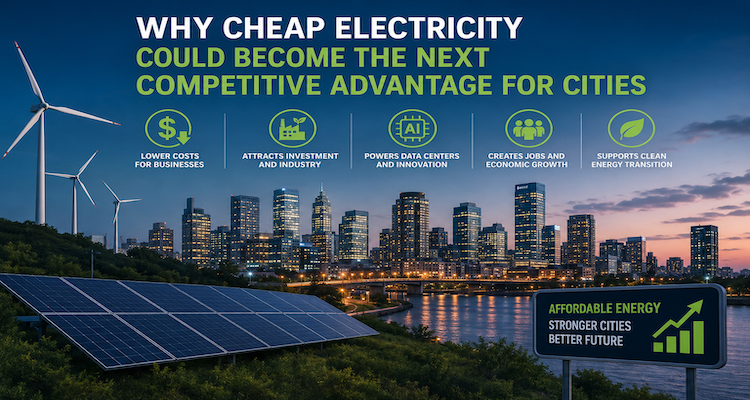
For decades, cities competed for businesses with familiar advantages: skilled workers, transport links, tax incentives, universities, broadband and access to major markets. Electricity was important, but often treated as background infrastructure.
That is changing.
The rapid expansion of data centres, artificial intelligence, electric vehicles, heat pumps, advanced manufacturing and other electricity-intensive activities is turning access to affordable power into a more visible economic advantage. The International Energy Agency expects global electricity demand to grow by an average 3.6% a year from 2026 through 2030 well above the previous decade’s pace with industry, cooling, electric vehicles and data centres among the major drivers.
For cities, however, the question is not simply who has the cheapest electricity. It is becoming a more complicated competition: Who can provide large amounts of electricity that are affordable, reliable, available when needed, connected to the grid, and increasingly low-carbon?
That distinction could shape where the next generation of factories, cloud infrastructure and AI computing capacity is built.
Key Takeaways
- Affordable electricity can lower operating costs for energy-intensive industries and make locations more attractive to investment.
- AI and data centres are making power availability a strategic factor in technology infrastructure decisions.
- Cheap power alone is insufficient if a city lacks grid capacity or cannot connect new facilities quickly.
- Europe continues to face a significant electricity-cost disadvantage for energy-intensive industries compared with the United States and China.
- Cities that expand reliable, affordable power without shifting infrastructure costs onto residents could gain a durable economic advantage.
- The emerging competition is increasingly about electricity systems not simply electricity prices.
Electricity Is Becoming an Economic Input Again
Electricity has always influenced industrial geography. Aluminium smelting, steelmaking, chemicals, paper production and other energy-intensive industries have historically gravitated toward locations where power was comparatively affordable and dependable.
What is different now is the number of economic activities becoming electricity-intensive.
Data centres are an obvious example. So are semiconductor manufacturing, electric-vehicle charging, building electrification, industrial heat pumps and parts of modern manufacturing.
The IEA describes the current transition as an “Age of Electricity,” with electricity consumption expected to reach about 33,600 terawatt-hours globally in 2030, compared with roughly 28,200 TWh in 2025.
That creates a strategic problem for cities.
A business deciding where to build a facility is not comparing electricity in isolation. It is comparing the total cost and reliability of operating there.
If two locations offer similar labour, logistics, connectivity and regulatory conditions, a persistent difference in electricity costs can materially change the economics of an energy-intensive project.
The effect is particularly important for facilities that consume power continuously rather than occasionally.
AI Is Making the Power Question Harder to Ignore
Artificial intelligence has brought electricity infrastructure into technology policy.
Training and operating large AI systems requires data-centre infrastructure, and data centres require substantial amounts of electricity for computing and cooling.
A 2025 update from Lawrence Berkeley National Laboratory estimates that U.S. data centres could account for 9.5% to 15.3% of total U.S. electricity consumption by 2030, with a midpoint estimate of 11.8%. The report uses a bottom-up model incorporating planned IT equipment, device energy use, cooling and facility characteristics.
The U.S. Department of Energy has likewise highlighted the expected growth in data-centre electricity consumption, linking it to AI expansion alongside manufacturing and broader electrification.
This changes the importance of location.
An AI company may be able to put software engineers almost anywhere with sufficient connectivity. A multi-hundred-megawatt data centre cannot be placed wherever land is available. It needs an electricity system capable of delivering the required power.
That makes the power network part of the technology stack.
The New Competitive Advantage Is Bigger Than a Low Power Bill
A city advertising inexpensive electricity may sound attractive, but the headline price can conceal the factors that determine whether a major project can actually operate.
For large industrial and technology customers, five characteristics increasingly matter:
| Factor | Why it matters |
|---|---|
| Price | Directly affects operating costs |
| Availability | Determines whether new facilities can obtain enough power |
| Reliability | Reduces the financial risk of outages and interruptions |
| Grid capacity | Determines how quickly large loads can connect |
| Carbon profile | Matters for corporate climate targets and regulation |
The distinction between price and availability is especially important.
A region can have abundant renewable resources and attractive wholesale electricity prices but still struggle to connect a new factory or data centre because the transmission network is constrained.
The IEA identifies grid capacity as an emerging bottleneck. Its 2026 analysis says more than 2,500 GW of renewable, storage and large-load projects including data centres are stalled in grid connection queues worldwide. It also estimates that grid planning and construction can take five to 15 years, while data centres can be built much faster.
That creates an unusual economic situation: a city can possess cheap electricity on paper without possessing cheap electricity in practice.
Europe’s Electricity Problem Shows Why It Matters
Europe provides a useful illustration of the competitiveness issue.
According to the IEA’s Electricity 2026 analysis, electricity prices paid by energy-intensive industries in the European Union remained more than twice U.S. levels on average in 2025 and nearly 50% above China’s.
The European Commission similarly says industrial electricity and gas prices remain substantially higher than those of major trading partners, posing a long-term competitiveness challenge for energy-intensive industries.
This does not mean every European city is economically uncompetitive, nor does it mean electricity price alone determines industrial investment.
But it illustrates an increasingly important principle: energy costs can become a structural feature of regional competitiveness rather than a temporary business expense.
That matters even more as companies electrify processes that previously depended on fossil fuels.
If electricity is expensive, electrification can become harder to justify economically. If electricity is affordable and reliable, the same transition can become a competitive opportunity.
The European Commission’s 2026 electricity policy agenda explicitly focuses on reducing system costs, improving flexibility and storage, addressing taxation differences and increasing the share of affordable domestic electricity.
Cities Will Compete for Power, but Also for Grid Capacity
The most interesting shift may be that local governments increasingly need to think beyond electricity generation.
Suppose a city has inexpensive wind or solar power nearby. That does not automatically mean a new data centre can connect there.
Transmission lines, substations, transformers and distribution networks may not have enough spare capacity.
The IEA estimates that meeting electricity demand through 2030 would require annual grid investment to rise by roughly 50% from today’s level of around $400 billion.
This creates an opportunity for cities willing to invest in infrastructure before companies arrive.
A city with:
- available industrial land,
- transmission capacity,
- modern substations,
- efficient permitting,
- reliable electricity,
- nearby generation,
- fibre connectivity,
- skilled workers, and
- predictable energy costs
could be considerably more attractive than a city that merely advertises a low electricity tariff.
In other words, the competitive advantage may belong to cities that can deliver power quickly, not merely cheaply.
Technology Companies Are Already Negotiating Around This Reality
Large technology companies are increasingly working directly with utilities and local authorities on the electricity infrastructure needed for data centres.
In February 2026, Google announced plans for a data centre in Pine Island, Minnesota, with Xcel Energy. The agreement includes 1,400 MW of additional wind capacity, 200 MW of solar and 300 MW of iron-air battery storage, alongside infrastructure commitments intended to avoid shifting the project’s costs onto local electricity customers.
Google has also publicly committed to paying for the power its data centres use and infrastructure costs directly driven by its growth under its Ratepayer Protection Pledge.
Microsoft has adopted a similar approach in its own infrastructure expansion. The company says it purchases electricity from local utilities while also using long-term contracts and power-purchase agreements to support additional carbon-free electricity. It reported that in 2025 it met its goal of matching 100% of its electricity consumption with renewable energy.
These examples are important because they show that the competition is moving beyond conventional electricity purchasing.
Large technology customers can become participants in the development of local energy systems.
The Risk: Cheap Power Can Become Expensive for Residents
There is a crucial political and economic caveat.
A city cannot simply welcome enormous electricity consumers and assume that everyone benefits.
Large data centres and industrial facilities can require new transmission lines, substations, generation capacity and other infrastructure. If those costs are spread across ordinary households and small businesses, the economic benefit of attracting investment can become politically difficult to defend.
That is why the structure of infrastructure agreements matters.
Google’s Minnesota announcement explicitly addresses the question of who pays for additional infrastructure, while Microsoft’s Community-First AI Infrastructure initiative says the company will cover its electricity and share of infrastructure costs associated with its facilities.
The broader lesson for cities is straightforward: attracting electricity-intensive investment is most defensible when the new infrastructure strengthens the system without unfairly transferring its costs to existing customers.
Cheap Electricity Could Also Change Where AI Gets Built
The conventional technology map has often been dominated by talent, venture capital, universities and proximity to customers.
Those factors will remain important.
But AI infrastructure introduces another constraint: physical energy.
The IEA estimates that grid constraints could delay around 20% of global data-centre capacity planned for construction through 2030.
That means future AI infrastructure may increasingly be shaped by a combination of computing economics and energy geography.
A region with abundant power and grid capacity could become attractive even if it is not an established technology centre.
This does not mean Silicon Valley-style technology ecosystems suddenly become irrelevant. Software companies still need engineers, investors, customers and networks.
Instead, the industry could become more geographically divided: talent and corporate headquarters may cluster in major technology cities while some of the physical computing infrastructure supporting AI grows in places with better power economics.
That is a potentially important change in the geography of the digital economy.
What Cities Should Measure
If electricity is becoming a competitive asset, city governments need a more sophisticated scorecard than “average electricity price.”
A useful investment-readiness assessment would ask:
How much additional electricity can the local grid provide?
Not just how much electricity is generated today, but how much new demand can actually be connected.
How long does a major connection take?
A cheap power contract is of limited value if a company must wait years for transmission or substation upgrades.
Who pays for the infrastructure?
The answer can determine whether a project creates broad economic value or increases pressure on existing ratepayers.
How stable are future electricity costs?
Companies making billion-dollar investments need visibility into long-term operating expenses.
Is the electricity supply sufficiently low-carbon?
For companies with emissions targets, access to clean power can be commercially important alongside its environmental value.
Can the city scale?
One data centre or factory may be manageable. A cluster of them could transform the local electricity system.
That last question may become particularly important as AI infrastructure expands.
The Cities That Win May Be the Ones That Plan for Power Early
The emerging electricity competition is not simply a race to produce the cheapest kilowatt-hour.
It is a race to create an electricity system that businesses can trust.
That requires generation, transmission, storage, flexibility, efficient regulation and enough capacity to accommodate new demand. It also requires mechanisms that ensure new industrial loads pay an appropriate share of the infrastructure they trigger.
For cities, this creates a different kind of economic-development strategy.
Instead of asking only, How do we attract the next technology company?, policymakers may increasingly need to ask, Can our electricity system support the next technology industry?
The answer could influence where factories are built, where cloud infrastructure expands and where AI computing capacity becomes economically viable.
Conclusion
Cheap electricity is unlikely to replace talent, infrastructure, universities or market access as a determinant of urban competitiveness. But as more of the economy becomes electricity-dependent, its importance is rising.
The strongest advantage will probably not belong to the city with the lowest advertised electricity price. It will belong to places that can combine affordable power, reliable supply, available grid capacity, rapid connections and credible long-term energy planning.
That is a much harder advantage to build—but also one that may be considerably more durable.
The next generation of economic competition may therefore be decided partly by something cities have traditionally taken for granted: whether they can deliver enough electricity, at the right price, at the right time, without compromising the reliability or affordability of the system around it.
The information presented in this article is based on publicly available sources, reports, and factual material available at the time of publication. While efforts are made to ensure accuracy, details may change as new information emerges. The content is provided for general informational purposes only, and readers are advised to verify facts independently where necessary.
Related News
- The Energy Paradox of Efficiency: Why Using Less Electricity Does Not Always Mean Using Less Energy
- Why Extreme Weather Is Turning Electricity Resilience Into an Everyday Consumer Issue
- Why Energy Independence Is Becoming a Household Decision, Not Just a National Strategy
- The Hidden Energy Cost of Keeping Everything Available Instantly