








The Growing Appeal of Doing Things Alone Is More Complicated Than It Looks
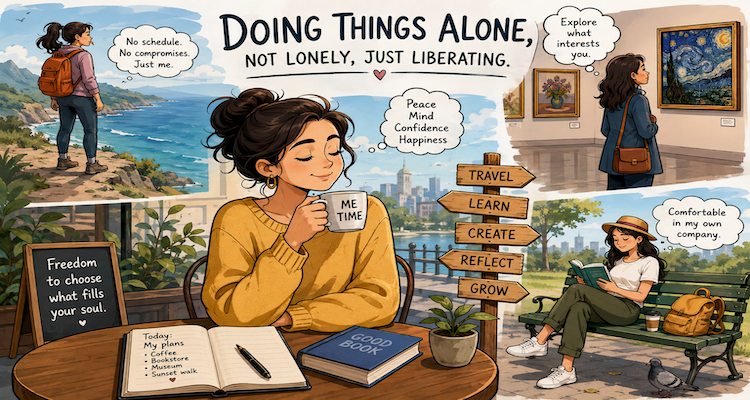
There is a noticeable difference between being alone because you want to be and being alone because you have no meaningful alternative. That distinction is becoming increasingly important as more people choose to eat alone, travel alone, work independently, spend evenings without company, or simply protect time in which nobody expects anything from them.
Psychological research has long shown that people differ substantially in how much solitude they prefer. More recent work suggests that the value of being alone cannot be understood simply by counting hours spent away from other people. Whether solitude is chosen, how it feels, and what happens during that time can matter as much as the amount of time itself.
That makes the growing appeal of doing things alone less a story about people becoming antisocial and more a story about autonomy, social expectations, personal boundaries and the changing meaning of solitude.
Key Takeaways
- Enjoying solitude is different from experiencing loneliness or unwanted social isolation.
- Research suggests people vary naturally in how strongly they prefer spending time alone.
- Chosen solitude can support autonomy, lower stress and create space for self-directed activities.
- More time alone does not automatically produce better well-being; its effects depend partly on context and motivation.
- There is no established universal number of hours that everyone should spend alone.
- Healthy solitude works best as part of a life that still contains meaningful social connection.
Why Doing Things Alone Can Feel So Appealing
Doing something alone removes a layer of social negotiation.
A person eating alone does not have to coordinate schedules. Someone watching a film alone does not need to agree on what to watch. A traveler can change plans without consulting anyone. A person spending a quiet afternoon alone can follow an impulse without explaining it.
These may sound like small conveniences, but they point toward something deeper: control over one’s own time.
Researchers studying solitude have increasingly distinguished between solitude that is freely chosen and solitude that is imposed. A 2023 study published in Scientific Reports, involving 178 adults who recorded their experiences over 21 days, found no evidence for a universal “optimal” balance between solitary and social time. Instead, the researchers found that the effects of solitude varied depending on circumstances and motivation.
On days when participants spent more time alone, they reported greater autonomy satisfaction and less stress in some measures, while also reporting greater loneliness and lower day satisfaction in others. Importantly, feeling that the solitude was choiceful reduced some of its negative associations.
The finding matters because it challenges a simple assumption: that more social interaction is always better, or that more solitude is always better.
Neither is necessarily true.
Solitude Is Not the Same as Loneliness
The words are often used interchangeably, but they describe different experiences.
Solitude refers broadly to being alone. It can be intentional, enjoyable or simply neutral.
Loneliness, by contrast, concerns an unwanted gap between the social connection a person wants and what they feel they have.
Someone can spend Saturday afternoon alone in a café, enjoy reading, and feel perfectly content. Another person can spend the same afternoon alone and desperately wish somebody would call.
The physical circumstances are similar. The psychological experience is not.
Research into individual differences in preference for solitude has found that people’s desire to spend time alone varies independently of the simple introvert-extrovert distinction. Jerry M. Burger’s 1995 research developed a measure of preference for solitude and found that this preference predicted how much time people spent alone, including beyond what could be explained by introversion-extraversion alone.
That helps explain why two people can receive the same invitation and respond completely differently.
One may think, I really need a night to myself.
The other may think, I’m glad someone invited me.
Neither response is inherently healthier.
The Psychological Value of Having Choice
One of the strongest themes emerging from solitude research is autonomy.
Being alone can create a temporary environment in which a person controls what they do, when they do it and whether they interact with anyone.
The 2023 Scientific Reports study found that greater amounts of solitude were associated with greater autonomy satisfaction in several analyses. The researchers also found that the motivation behind solitude influenced its relationship with well-being.
This suggests that the question “How much time should I spend alone?” may be less useful than:
“What am I getting from the time I spend alone?”
An hour spent alone pursuing something personally meaningful is psychologically different from an hour spent withdrawing because social interaction feels impossible.
That distinction also explains why the same behavior can have opposite meanings.
Choosing to cancel plans because you need rest can be healthy boundary-setting.
Repeatedly avoiding everyone because social interaction feels threatening or exhausting may point to a different problem.
The behavior looks similar from the outside. The motivation is not.
Why Solo Activities Can Feel Liberating
There is another practical reason solo activities can become attractive: they allow people to experience activities without constantly managing another person’s expectations.
Consider ordinary situations:
- Going to a restaurant without coordinating schedules.
- Taking a walk at whatever pace feels comfortable.
- Visiting a museum and spending as long as desired in one room.
- Traveling according to a personal itinerary.
- Reading or watching something without negotiating a choice.
- Working on a hobby without interruption.
- Spending an evening without having to perform a particular social role.
The attraction is not necessarily rejection of other people.
It can simply be the pleasure of temporarily having fewer obligations to other people.
Research supports the idea that people can have a genuine positive orientation toward solitude rather than merely tolerating it. Earlier work examining solitary activities found that enjoyment and frequency of solitary activity were more strongly related to a desire for aloneness than to simply having little interest in other people.
That is an important distinction.
A person who enjoys solitude may not be socially disconnected at all.
They may simply enjoy switching between connection and independence.
The Overlooked Problem: Solitude Can Also Become Isolation
Celebrating solitude without acknowledging its risks would produce an incomplete picture.
The U.S. Surgeon General’s office has emphasized that social connection plays an important role in individual and community health, while loneliness and social isolation can have serious consequences. Its advisory treats social connection as a significant public-health concern.
This does not mean that spending an evening alone is dangerous.
It means that chosen solitude should not be confused with chronic social disconnection.
A person can enjoy being alone while maintaining strong relationships.
Conversely, someone can say they prefer being alone while gradually losing relationships they actually value.
That is why frequency alone is a poor measure of whether solitude is healthy.
The more useful questions are:
- Do you choose the solitude?
- Do you enjoy or benefit from it?
- Can you reconnect with people when you want to?
- Are important relationships still being maintained?
- Does being alone leave you restored, or increasingly disconnected?
- Are you avoiding people because you genuinely want solitude or because interaction has become difficult?
These questions tell us considerably more than counting the number of hours spent alone.
There May Be No Perfect “Balance”
It is tempting to turn the research into a formula: spend a certain number of hours alone and a certain number with other people.
The evidence does not justify that.
The 2023 Scientific Reports study specifically tested whether there was a measurable “right” balance between solitude and social interaction and did not find evidence for a universal tipping point. The researchers concluded that balance may be better understood through the quality and circumstances of solitary and social experiences rather than a fixed number of hours.
That is arguably the most useful finding for everyday life.
Someone with a demanding social job may need considerable quiet time to recover.
Someone working remotely and living alone may need more deliberate social contact.
A parent may value an uninterrupted hour alone more intensely than someone whose daily routine already contains substantial personal freedom.
The same quantity of solitude can therefore have very different meanings for different people.
A New Way to Think About “Doing Things Alone”
The growing appeal of solo activities may be better understood as a shift in how people think about independence.
Doing things alone can provide opportunities to discover what a person actually likes when there is no group preference to accommodate.
It can also expose whether an activity is genuinely enjoyable or merely enjoyable because it provides social approval.
That makes solo experiences potentially useful forms of self-knowledge.
But independence becomes less valuable when it turns into an inability or unwillingness to connect.
Research on “aloneliness”—the negative feeling associated with not getting enough desired time alone—has further complicated the traditional assumption that being alone is inherently a problem. Researchers developed and validated measures examining people’s desire for more solitude and found that insufficient solitude can itself be associated with negative experiences.
The implication is striking: people can experience a version of loneliness from too little solitude, just as they can experience loneliness from too little social connection.
Human well-being may therefore involve navigating two different needs rather than choosing one side.
What Healthy Solitude Might Look Like
There is no universal prescription, but a useful distinction is between restorative solitude and defensive withdrawal.
Restorative solitude tends to leave a person feeling refreshed, focused, peaceful or more in control of their time.
Defensive withdrawal may be driven by fear, resentment, persistent social difficulties or a belief that connection is no longer worth pursuing.
The distinction is not always obvious, and the two can overlap.
Research published in 2024 involving 9,000 adults found associations between preference for solitude, social isolation and poorer mental-health measures, while also noting important limitations, including its cross-sectional design and the possibility of sampling bias. The researchers concluded that preference for solitude did not protect socially isolated participants from poorer mental-health outcomes.
That study should not be interpreted as evidence that enjoying solitude causes poor mental health. Its design cannot establish causation.
But it reinforces an important warning:
Calling isolation a personal preference does not necessarily make isolation beneficial.
The Appeal May Be Less About Being Alone Than Being Free
The most interesting part of the solo-life trend may therefore be hiding in plain sight.
People may not necessarily be searching for fewer relationships. They may be searching for more control over when and how they participate in them.
That is a different cultural shift.
The appeal of a solo meal may be independence rather than loneliness. A solo trip may be about flexibility rather than avoiding people. An evening alone may be recovery rather than withdrawal.
At the same time, meaningful relationships remain important. The U.S. Surgeon General’s framework emphasizes that social connection contributes to individual and societal well-being, making connection something that should not be treated as the opposite of personal independence.
The healthier question may therefore not be whether someone is becoming “too independent.”
It is whether their independence gives them more freedom to connect on their own terms, or gradually makes meaningful connection harder.
Conclusion
The growing appeal of doing things alone does not necessarily signal a society becoming less social.
It may reflect something more ordinary and more human: the desire for autonomy, quiet, flexibility and experiences that do not require negotiation.
Research increasingly suggests that solitude has no universal psychological effect. Chosen solitude can provide benefits such as greater autonomy and lower stress, while unwanted or excessive disconnection can be associated with loneliness and poorer well-being.
The useful distinction is therefore not alone versus together.
It is chosen versus unwanted, restorative versus draining, and independent versus disconnected.
For many people, doing things alone may be valuable precisely because it makes social connection a choice rather than a constant obligation. And that may be the more meaningful form of independence: being comfortable enough alone to enjoy your own company, without losing the ability to enjoy someone else’s.
This content is published for informational or entertainment purposes. Facts, opinions, or references may evolve over time, and readers are encouraged to verify details from reliable sources.