










The Classroom Attention Problem Nobody Measures: What Students Do Between Lessons
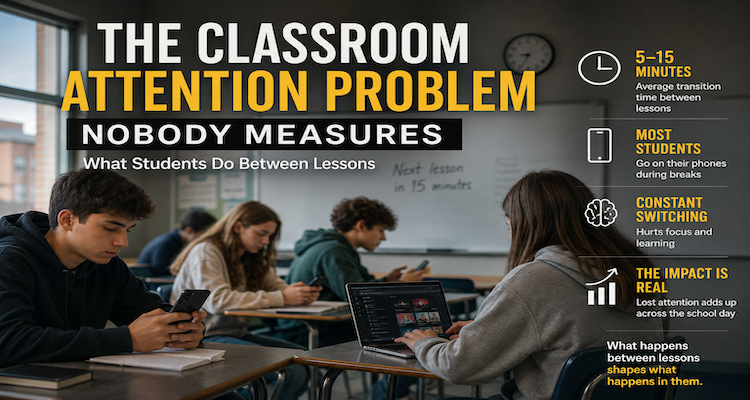
A school can record attendance, grades, test scores and even moments of classroom engagement. Yet there is a less visible part of the school day that can quietly shape all four: the minutes between lessons.
Students are moving between subjects, packing away materials, opening laptops, checking messages, talking with classmates, waiting for instructions, changing rooms or simply trying to mentally switch from one task to another. These moments are usually treated as administration rather than learning time.
Research on classroom management has long recognized transitions as a source of lost instructional time. The American Psychological Association has cited research estimating that a typical school day can involve more than 30 transitions and that managing them can consume a meaningful share of class time. More recent research continues to examine how reducing transition time can increase academic engagement.
The overlooked question is therefore not simply whether students are attentive during a lesson. It is whether the transition into that lesson leaves them ready to pay attention.
Key Takeaways
- Classroom transitions can consume instructional time while receiving far less attention than grades or formal lesson activities.
- Moving from one subject to another requires students to change tasks, environments, materials and mental focus.
- Research suggests that shorter, better-managed transitions can increase opportunities for academic engagement.
- A brief break is not necessarily wasted time; appropriately designed breaks can help sustain attention.
- Schools need to distinguish genuine disengagement from the normal cognitive demands of switching between activities.
- Measuring transitions could reveal an overlooked part of the learning environment without turning every student movement into a performance metric.
The Missing Measurement Between the Bell and the Lesson
Education has become increasingly comfortable with measurement.
Schools track attendance. Teachers assess assignments. Students take quizzes and standardized tests. Digital learning platforms can record log-ins, completion rates and interactions.
But there is a basic unit of school time that is harder to classify: the transition.
When mathematics ends and history begins, what exactly counts as learning time?
A student may take 40 seconds to close a workbook, put away a calculator, retrieve a laptop and open the next assignment. Another student may already be ready. A third may still be discussing the previous lesson with a classmate.
From the outside, all three are simply “between lessons.”
That distinction matters because attention is not a switch that automatically flips when a teacher begins speaking.
The U.S. Institute of Education Sciences notes that transition time between activities can disrupt students’ attention and recommends considering whether classroom environments and routines are contributing to disengagement.
The issue, then, is not that every second between lessons is harmful. It is that schools can lose visibility into what happens during those seconds.
A Transition Is More Than Moving From One Activity to Another
Changing lessons requires several things at once.
Students may have to:
- stop processing the previous subject;
- remember what they need for the next activity;
- physically reorganize their workspace;
- interpret new instructions;
- move between rooms or learning platforms;
- shift from individual work to group work;
- and redirect their attention toward a different teacher or task.
That makes transitions a small but important intersection of time management, classroom design and cognitive attention.
Research on classroom transitions has specifically linked the amount of time spent moving between activities with the amount of time available for academic engagement. A 2008 study involving high-school biology teachers found that providing feedback on transition time reduced the time spent transitioning and was accompanied by increases in student academic engagement.
A later study similarly described transition time as inversely related to time available for productive learning activities.
That does not mean every transition should be made as short as possible.
A rushed transition can create its own problems. Students need time to collect materials, ask questions, move safely and mentally disengage from demanding work. The goal is not zero transition time. It is intentional transition time.
The Attention Problem Is Not Simply About Distraction
The language around student attention often focuses on distraction: phones, social media, websites, conversations and other competing stimuli.
Those things can matter. But attention research suggests a broader problem.
A review of mind-wandering research in education noted that early observational studies found attention breaks during lectures, while also warning that visible signs such as looking away are imperfect measures of whether a student is actually paying attention. A student can look away and still be listening; conversely, staring directly at a teacher does not prove that meaningful processing is occurring.
That distinction is crucial.
If a student spends 90 seconds looking out of a window while waiting for the next activity, labeling the behavior “off-task” may tell educators very little.
The more useful question is what happens afterward.
Does the student begin the next activity quickly? Do they understand the instructions? Do they participate? Do they need repeated prompts?
In other words, measuring visible behavior during a transition may be less informative than measuring the quality of the transition’s outcome.
The Case for Measuring the Transition, Not Policing It
There is a danger in turning this insight into another surveillance system.
A school could theoretically track how long every student takes to open a book, log into a computer or begin an assignment. But that could confuse efficiency with learning.
A better approach would be to treat transitions as a classroom-level design variable.
Teachers could periodically ask:
How long does it take this class to move from one meaningful learning activity to another?
And:
What happens during that interval?
The answers might reveal surprisingly ordinary causes:
- instructions are unclear;
- materials are stored too far away;
- students are waiting for devices to connect;
- the next activity has not been prepared;
- students do not know what “finished” means;
- classroom movement is poorly organized;
- or the previous activity was cognitively demanding and students need a genuine pause.
This changes the intervention.
Instead of telling students to “pay attention,” educators can examine whether the learning environment makes attention easier or harder.
Not Every Break Should Be Eliminated
There is another important complication: time away from direct instruction is not automatically lost learning time.
Research increasingly distinguishes between unstructured delay and purposeful breaks.
A 2025 study published in Frontiers in Psychology examined micro-breaks in university seminars involving 253 undergraduate students. Students experienced either a conventional 10-minute break halfway through a 90-minute seminar or 90-second breaks at 10-minute intervals. The researchers found higher average quiz performance in the micro-break condition and a slower pattern of decline across the session.
The finding is interesting, but it should not be turned into a universal rule for schools.
The study involved university students, a specific course structure and a particular break design. Its results do not establish that every primary or secondary classroom should introduce 90-second breaks every 10 minutes.
What it does demonstrate is more modest and arguably more useful: the relationship between time, attention and learning is more complicated than simply maximizing uninterrupted instruction.
A well-designed pause can serve a different function from an unmanaged transition.
What Students Do Between Lessons Can Be Diagnostic
The minutes between lessons may also provide information that formal assessments miss.
Suppose students consistently struggle to begin a particular class. The problem might not be motivation.
Perhaps the previous lesson regularly runs over time.
Perhaps students have to move across a large building.
Perhaps the next teacher expects materials that students cannot access quickly.
Perhaps the transition involves switching from paper to a digital platform that takes several minutes to load.
Or perhaps students simply need a short mental reset after a demanding activity.
The transition becomes a diagnostic window.
This is where technology could help but only if it is used carefully.
Learning-management systems could record when a class activity ends and when the next activity begins. Classroom observation tools could sample transition duration rather than continuously monitoring individual students. Teachers could compare transition patterns across different activities without creating permanent behavioral profiles.
The objective should be better classroom design, not better surveillance.
What Schools Could Measure Instead
A practical transition dashboard would not need dozens of metrics.
A small set could be enough:
| Measure | What it reveals |
|---|---|
| Transition duration | How much scheduled time is spent moving between activities |
| Ready-to-learn time | When most students can begin the next task |
| Repeated instructions | Whether expectations are clear |
| Waiting time | Whether students are waiting for teachers, materials or technology |
| Restart quality | Whether students begin the next task successfully |
| Student perception | Whether the transition feels like a useful break or frustrating delay |
The final measure is especially important.
Two five-minute periods can look identical on a timetable while feeling completely different to students.
One may be a useful pause that allows them to reset.
The other may be five minutes of confusion.
Why This Matters More in Digital Classrooms
Digital learning adds another layer to the transition problem.
A physical transition might mean moving from one classroom to another. A digital transition can mean switching websites, applications, browser tabs, accounts, files and instructions.
The movement is invisible, but the cognitive switching is real.
Research on online learning has also identified attention as a significant challenge, with students facing multiple sources of distraction in digital environments.
That means the modern classroom may have two transition problems at once: physical transitions between lessons and digital transitions between tasks.
A student who appears to be sitting quietly may actually be navigating several systems before learning has even started.
For educators, that suggests a useful design principle: reduce unnecessary switching where possible, while preserving purposeful changes in activity.
The Bigger Lesson: Attention Starts Before Instruction
The traditional classroom question is often:
“Are students paying attention?”
A better question may be:
“What conditions did we create for attention to begin?”
That reframing puts some responsibility on the environment rather than placing the entire burden on students.
The evidence does not justify claiming that transitions are the hidden cause of poor academic performance. Nor does it suggest that schools should measure every moment of student behavior.
It does suggest something more practical: transitions are consequential enough to deserve deliberate attention.
Research has repeatedly treated transition efficiency as part of classroom management and academic engagement, while newer work on micro-breaks suggests that strategically interrupting prolonged attention can sometimes support performance.
The important distinction is therefore not instruction versus break.
It is productive transition versus unmanaged transition.
Conclusion
The overlooked attention problem in classrooms may not begin when a teacher starts talking.
It may begin in the minute before that.
Students arrive at each lesson carrying the momentum, fatigue, information and distractions of whatever came immediately before. If schools measure only what happens once formal instruction begins, they see only part of the attention story.
The answer is not to turn every transition into another productivity contest. Students need breathing room, movement and moments when they are not being assessed.
But schools can ask a better question about the time they already have: Does the transition help students arrive ready to learn, or does it make attention harder to recover?
That is a small change in measurement. It could lead to a much bigger change in how classrooms are designed.
The information presented in this article is based on publicly available sources, reports, and factual material available at the time of publication. While efforts are made to ensure accuracy, details may change as new information emerges. The content is provided for general informational purposes only, and readers are advised to verify facts independently where necessary.