









Why Some Faces Become Creepy When You Cannot Read Their Expression
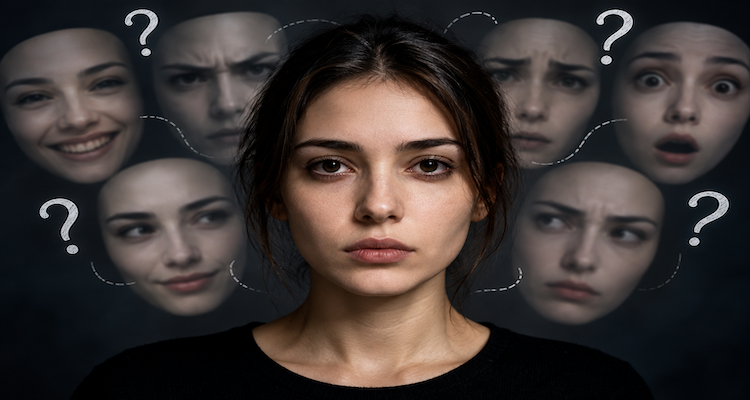
A face does not have to look frightening to make us uneasy.
Sometimes the unsettling feeling comes from something much subtler: we cannot tell what the person is feeling. Their mouth may be still, their eyes difficult to interpret, or different parts of the face may seem to send conflicting signals. Nothing is obviously wrong, yet the brain seems to hesitate.
That hesitation may be part of what makes the face feel “creepy.”
Humans are remarkably sensitive to faces because faces carry information about emotion, attention, intention and social behaviour. But reading a face is not simply a matter of matching a smile with happiness or a frown with anger. The brain combines small facial movements with context and prior expectations to work out what another person might be experiencing.
When those signals become weak, ambiguous or contradictory, uncertainty enters the process.
The brain wants to know what a face means
A face is a particularly important social signal. Research on face perception shows that several interacting brain systems help turn visual information into an interpretation of another person’s emotional state.
This process is not perfectly objective. The brain does not simply receive a facial expression and read its meaning like a label. Context can influence how an ambiguous expression is interpreted. Experiments have found that when facial expressions are difficult to recognize, surrounding circumstances can push observers toward different interpretations.
Imagine seeing someone with slightly widened eyes and an almost expressionless mouth.
Are they surprised?
Afraid?
Interested?
Uncomfortable?
Or simply tired?
The visual information is available, but its meaning is uncertain. Studies of facial-emotion ambiguity have found that people become less confident and can take longer to categorize expressions when emotional signals fall near the boundary between categories.
That creates an unusual social problem: we are looking at a face designed to communicate information, but the information is not arriving clearly.
Uncertainty can make an ordinary face feel unusual
The feeling of creepiness is not itself a single, well-defined scientific response. But research on faces and uncertainty offers a useful explanation for why ambiguity can become uncomfortable.
The amygdala, a brain region involved in emotional processing and attention, responds to facial information and appears to be sensitive not only to particular emotions but also to uncertainty surrounding emotional categories. One study combining behavioural experiments, brain imaging and recordings from individual neurons found evidence that the human amygdala represents both emotional intensity and categorical ambiguity.
That does not mean the amygdala simply detects “creepy faces.” The reality is more complicated.
A better way to think about it is that an ambiguous face can demand additional interpretation. If the brain cannot confidently determine whether a person is friendly, angry, frightened, amused or neutral, it has less certainty about how to respond.
And uncertainty matters particularly when another person is involved.
A clearly smiling stranger is relatively easy to interpret. A clearly angry stranger is also informative, even if unpleasant. But someone whose expression cannot be classified leaves the social situation unresolved.
The brain has to keep watching.
The problem gets stronger when facial signals disagree
Some of the strangest faces are not completely expressionless. They are faces in which different signals seem to conflict.
Consider a smile that does not seem to reach the eyes. Or eyes that appear tense while the mouth looks cheerful. Or a face that resembles a familiar human expression but is just slightly “off.”
These situations are difficult because facial emotion is normally interpreted from combinations of cues rather than from one feature alone.
Research on ambiguous smiles, for example, has found that people can respond differently when the mouth suggests happiness but the eyes provide less compatible information. This kind of mismatch can make the expression harder to interpret.
The effect is especially interesting because our brains are constantly making predictions about what should go together.
If one part of the face says happy while another suggests something else, the prediction does not resolve cleanly.
The result may not be conscious thought such as, “Those facial cues are inconsistent.” Instead, it can arrive as a much simpler reaction:
Something feels wrong.
Why “creepy” is not the same as “scary”
Creepiness and fear are related, but they are not identical.
A frightening face may provide a relatively clear signal: danger. A creepy face can do the opposite. It may leave us uncertain about whether danger exists at all.
This distinction helps explain why some people or characters seem eerie without looking conventionally threatening.
Research into the uncanny valley provides a useful parallel. Humanlike characters can become unsettling when their appearance is sufficiently familiar to invite comparison with real people but contains inconsistencies that make the comparison fail. However, the evidence does not show that ambiguity alone universally causes creepiness. Studies have produced different results depending on the kind of ambiguity and the characteristics of the stimulus.
So the popular idea that “the brain hates things that are almost human” is too simple.
A more defensible explanation is that familiarity, perceptual mismatch, uncertainty and difficulty interpreting social signals can interact.
That interaction is particularly powerful with faces because faces matter so much to us.
Context can change the face we think we see
An important part of this story is that the face does not exist in isolation.
The same ambiguous expression can look different depending on what is happening around it. If someone is standing beside a crying friend, we may interpret their neutral expression as concerned. If the same person is standing silently in a dark doorway, we may perceive the expression very differently.
Experimental research has demonstrated that context can bias the recognition of subtle facial emotions. When people were placed in a threatening experimental context, weak emotional signals were more likely to be interpreted in a threat-related direction.
This is one reason a face can seem perfectly normal in one situation and strangely unsettling in another.
The brain is not asking only, “What expression is this?”
It is also asking, “Given what is happening here, what could this expression mean?”
Your brain may prefer an imperfect answer to no answer
There is another intriguing possibility.
When emotional information is ambiguous, observers do not necessarily remain completely neutral. Research has found that ambiguous facial expressions can be subject to interpretation biases, with some circumstances encouraging more negative interpretations.
This makes evolutionary sense without requiring us to imagine that the brain is running a simple ancient “danger detector.”
In a social situation, uncertainty has a cost. Misreading a harmless person as threatening can be uncomfortable, but failing to notice genuine hostility could be more consequential. As a result, attention may be drawn toward unusual or uncertain social signals.
That does not mean humans are programmed to assume that ambiguous people are dangerous. Individual differences, experience, context and emotional state all matter. Someone who is anxious, for instance, may interpret ambiguous social signals more negatively than someone who is not anxious.
The important point is that an unreadable face gives the brain a problem to solve.
And sometimes the subjective experience of that unresolved problem is creepiness.
The strange power of an unreadable face
We often think of facial expressions as a language. But unlike spoken language, facial communication rarely comes with a neat dictionary.
A smile can mean happiness, politeness, embarrassment, nervousness or irony. A blank expression can mean calmness, concentration, fatigue, sadness or simply nothing in particular.
Most of the time, context helps us resolve these possibilities almost automatically.
When it does not, the face can become strangely compelling.
We look longer. We search the eyes. We inspect the mouth. We compare the expression with the situation. We try to decide what the person might be thinking.
That is why the creepiest face is not necessarily the ugliest, most distorted or most frightening one.
Sometimes it is the face that looks completely human but refuses to tell us what is happening behind it.
And when a face stops giving us a reliable emotional answer, the brain may replace certainty with vigilance.
The result is a peculiar sensation that is difficult to describe but immediately recognizable:
I don’t know what this person is feeling and I don’t know why that makes me uncomfortable.
This content is published for informational or entertainment purposes. Facts, opinions, or references may evolve over time, and readers are encouraged to verify details from reliable sources.