







The Emotional Power of Places That Refuse to Change
Some places seem to become more powerful precisely because they do not keep up with the world around them. A neighborhood shop with the same sign, a railway station whose platforms still look familiar, an old cinema, a family home, a quiet street, or a café that has somehow survived decades of redevelopment can produce an unexpectedly strong emotional response.
The feeling is often described simply as nostalgia. But nostalgia does not fully explain what happens. Research on place attachment shows that people can develop enduring emotional and cognitive bonds with particular environments. A place can become intertwined with identity, relationships, routines and memories, so returning to it is sometimes less like visiting a location and more like encountering a preserved part of one’s own life.
That helps explain a curious modern experience: when almost everything around us changes, an unchanged place can feel disproportionately meaningful. Its physical continuity gives something else continuity too the story we tell ourselves about who we were, who we became and what has remained recognizable along the way.
Key Takeaways
- Unchanged places can preserve routines and memories that have become part of personal identity.
- Place attachment combines emotional, cognitive and behavioral relationships with particular environments.
- Nostalgia is closely connected with social belonging, meaning and a sense of continuity across time.
- Familiar physical surroundings can make returning to the past feel more tangible than simply remembering it.
- Change can increase the emotional value of places that remain recognizable.
- Preserving meaningful places can matter culturally because places carry memories as well as buildings.
Why an Unchanged Place Can Feel So Different
A place is never only its physical structure.
Environmental psychology distinguishes between physical space and place: a location becomes a place partly through the meanings, experiences and relationships people associate with it. Researchers studying place attachment describe the relationship as involving the person, psychological processes and characteristics of the place itself.
That distinction matters.
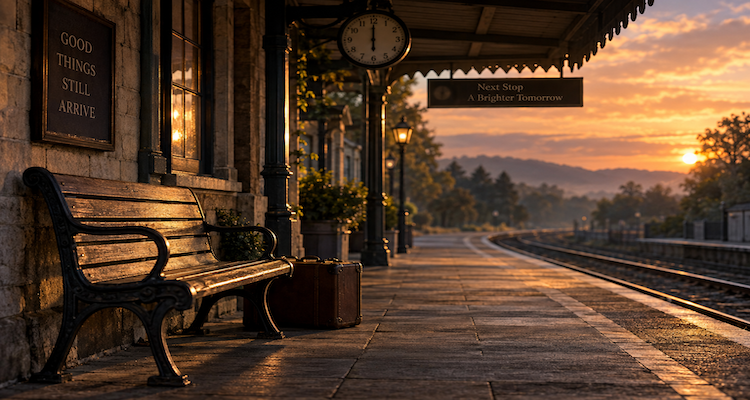
A bench in a park is an object. But the same bench can become the bench where someone used to sit with a parent. A railway platform can become the platform from which someone left home for university. A restaurant can become the place where a family celebrated birthdays. A street can become the physical background against which an entire childhood unfolded.
The emotional response therefore does not necessarily come from architecture alone.
It comes from the accumulated meaning attached to architecture.
Research reviewing decades of work on place attachment has found that people continue to form strong relationships with places despite increasing mobility and globalization.
This suggests something important about familiar environments: their emotional value can survive long after their original practical purpose has faded.
When the World Changes Around a Place
The emotional effect becomes particularly noticeable when the surrounding environment has changed.
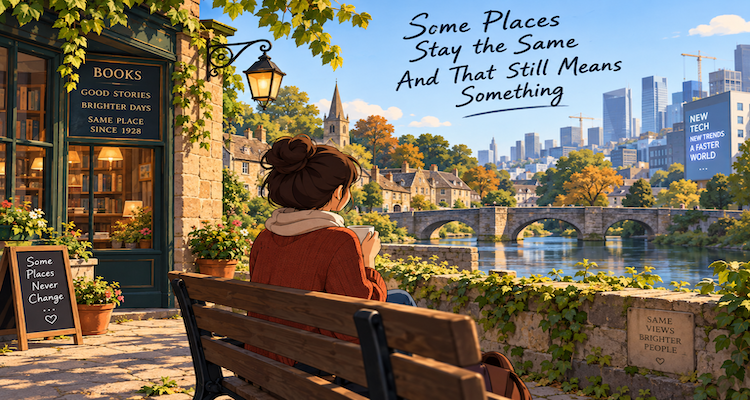
Imagine returning to a town after twenty years. The roads are wider. Buildings have been demolished. New apartment blocks have appeared. Shops have different names. Technology has changed how people communicate and travel.
Then, unexpectedly, one old bookstore remains.
Its shelves look familiar. Its doorway is in the same position. Perhaps the smell of paper is unchanged.
The reaction can be surprisingly strong.
The bookstore has become a point of continuity inside an environment dominated by change.
This is one reason an old place can trigger memories that seem much larger than the physical object itself. The location provides a concrete cue for experiences that otherwise exist only in memory.
Research into place memory has specifically examined the relationship between places, attachment, identity and collective memory. Places can become repositories of personal and social meaning rather than merely physical settings.
In that sense, an unchanged place can function almost like a landmark in time.
Nostalgia Is More Than Missing the Past
Nostalgia is often treated as a simple longing for earlier times. Psychological research presents a more complicated picture.
Research published in Psychological Science found that nostalgia can increase people’s sense of meaning in life, with social connectedness helping explain that relationship.
Later research has similarly described nostalgia as a predominantly positive but bittersweet emotion associated with social connectedness and self-continuity the feeling that one’s present self remains connected to one’s past self.
That concept of self-continuity is particularly relevant to unchanged places.
A photograph can remind someone of childhood. A song can bring back a relationship. But a physical place can recreate several elements at once: the visual surroundings, spatial arrangement, sounds, smells, movement patterns and familiar routes.
The place has not merely preserved a memory.
It has preserved some of the conditions under which the memory was created.
The People Inside the Place Matter Too
The emotional power of an old location is rarely about bricks and walls alone.
Usually, other people are embedded in the memory.
A school may remind someone of friends. A market may recall a parent who used to shop there. A house may evoke grandparents. A railway station may represent departures and reunions.
This is consistent with research describing nostalgia as a strongly social emotion. Studies have found that nostalgic reflection can strengthen feelings of social connectedness and motivate relationship-oriented goals.
That helps explain why an ordinary place can become emotionally extraordinary.
The emotional object may appear to be the building, but the memory attached to it may actually concern people, relationships and a particular period of life.
Why Familiarity Can Feel Comforting
There is another dimension to unchanged places: predictability.
Modern life often requires people to navigate unfamiliar environments, changing technologies, new workplaces, new neighborhoods and shifting social routines. A familiar environment requires less interpretation.
You know where the entrance is.
You know what the street looks like.
You remember where the light falls in the afternoon.
You may even remember the route without consciously thinking about it.
Research on residential place attachment has examined how attachment to familiar environments can relate to people’s ability to cope with unfamiliar environments, including research involving older adults.
This does not mean every familiar place is automatically comforting, nor does it establish that old buildings have universal psychological benefits. People’s relationships with places are highly individual.
But familiarity can be part of why returning to a known environment feels different from entering an unfamiliar one.
The Paradox of Change: The More the World Changes, the More the Old Place Matters
There is an interesting paradox here.
An unchanged place may seem ordinary when everything around it is also familiar.
Its emotional significance can become much clearer after the surrounding world has changed.
The old cinema becomes meaningful after the other cinemas disappear.
The traditional market becomes memorable after modern retail replaces much of the old shopping district.
The family house becomes emotionally charged after relatives move away.
The railway station becomes a reminder of another era after travel becomes faster and more technologically mediated.
In each case, change creates contrast.
The unchanged object becomes evidence that a particular period has not completely disappeared.
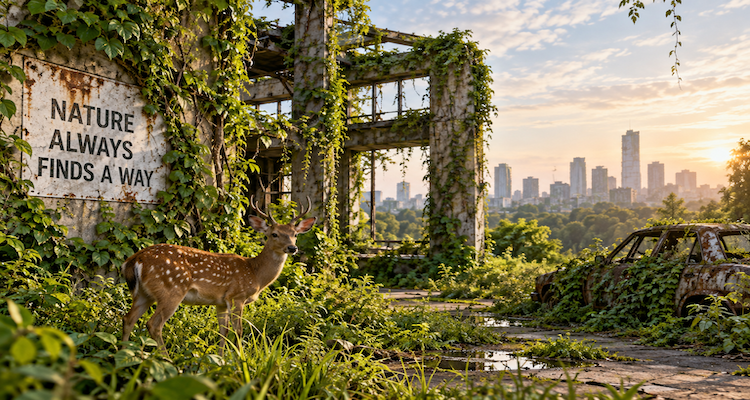
This is also why preservation debates are not only about architectural aesthetics. When communities protect historic buildings, streets or cultural landscapes, they may also be protecting physical settings through which collective memories and identities are expressed. Research on place attachment has increasingly considered these relationships between people, identity and environments.
An Old Place Does Not Have to Be Beautiful
Perhaps the most overlooked aspect of this phenomenon is that emotional importance does not necessarily correspond to architectural importance.
A grand historic building may have enormous cultural value while meaning very little to a particular individual.
Meanwhile, an unattractive roadside café may matter enormously to someone who spent years meeting a parent there.
This distinction is important.
Cultural significance and personal significance are not always the same thing.
A place can be historically ordinary but psychologically extraordinary.
That is why nostalgia cannot be understood entirely through heritage lists, architectural styles or property values. Some of the places that matter most to individuals would never appear in a conventional heritage inventory.
Their significance exists in memory.
When Preserving the Past Becomes Complicated
There is also a limit to romanticizing unchanged places.
Not every old building should remain untouched. Older environments can have accessibility problems, safety issues, inefficient infrastructure or uses that no longer serve communities well.
And attachment to a place can sometimes make people resistant to necessary change.
Research examining place attachment and environmental risk has found that strong attachment can have complicated consequences, including relationships with perceptions of risk and willingness to relocate.
So the lesson is not that everything old should be preserved.
It is that decisions about places should recognize that physical change can also have psychological and social consequences.
Demolishing a building removes more than material.
For some people, it removes a reference point in their personal history.
Why This Matters in an Age of Constant Change
The phenomenon has particular relevance at a time when environments can change quickly.
Digital services replace physical routines. Businesses move online. Neighborhoods are redeveloped. Familiar retail brands disappear. Traditional forms of communication become less common. People move between cities and countries more frequently.
Against this background, physical continuity can acquire a new emotional value.
Interestingly, recent research also suggests that nostalgia can operate through digital environments. A 2026 study involving two web-based experiments found that revisiting nostalgic social-media posts could enhance positive affect, self-regard and meaning in life under certain conditions, particularly among participants with lower self-continuity.
That finding offers an intriguing comparison.
Technology can preserve memories digitally, but a physical place preserves something different: the environment in which the memories originally happened.
A photograph shows what a place looked like.
Returning to the place allows a person to stand where the memory happened.
That distinction may help explain why an unchanged street can sometimes evoke more than hundreds of old photographs.
The Future of Places May Depend on What We Choose to Remember
There is no universal formula for deciding which places deserve preservation.
Some places matter because of architecture. Others because of history. Others because of cultural significance. And some matter because thousands of ordinary people quietly built memories there.
Research on place attachment continues to show that the relationship between people and environments is multidimensional, involving emotional, cognitive and behavioral elements rather than a single feeling.
That makes the disappearance of familiar places more complicated than a simple argument between old and new.
The question is not whether cities, neighborhoods and buildings should change.
They must.
The more useful question is whether change can occur without erasing every physical connection to the past.
Sometimes a community does not need an entire old world preserved.
It may need only a few recognizable places through which people can still locate themselves in that world.
Conclusion
The strange emotional power of an unchanged place comes partly from a simple fact: our memories change as we do, but the physical world around those memories can sometimes remain remarkably stable.
That stability gives memory somewhere to land.
An old doorway, street corner, shop or railway platform may appear insignificant to a stranger. To someone who has lived part of their life there, it can represent relationships, routines, identity and a version of the self that might otherwise feel increasingly distant.
Research on nostalgia and place attachment helps explain why these encounters can feel so powerful. Nostalgia can reinforce social connectedness, meaning and continuity between past and present, while attachment gives particular environments a lasting role in personal and collective identity.
Perhaps that is why an unchanged place can feel almost like a quiet conversation with the past.
It does not stop time.
It simply gives us a recognizable place from which to remember how far we have travelled.
This content is published for informational or entertainment purposes. Facts, opinions, or references may evolve over time, and readers are encouraged to verify details from reliable sources.