









The Photograph That Showed Something Nobody Remembered Being There
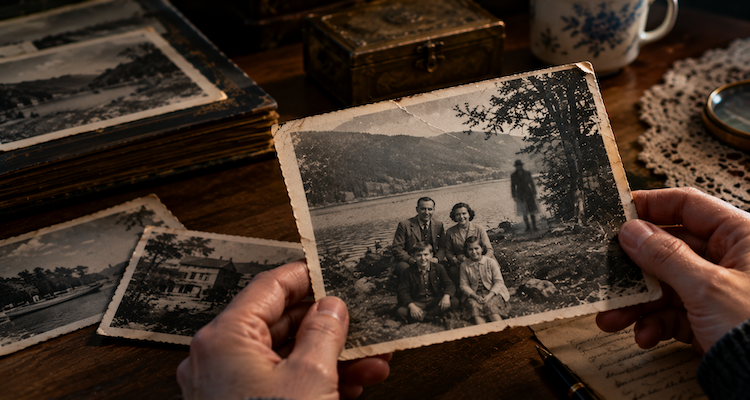
The photograph had been kept in a cardboard box for more than thirty years. Nobody knew exactly when it had been taken, although the house in the background suggested it was sometime in the late 1980s. The people in the picture were familiar: a family standing together outside their old home, dressed for an ordinary afternoon that had long since faded from memory.
Then someone noticed the figure in the doorway.
At first, it looked like a flaw in the photograph. The image was old, its edges yellowed, and a thin scratch ran across one corner. But the figure stood beyond the scratch, perfectly positioned between the dark wooden doorframe and the pale wall behind it.
It appeared to be a person.
Nobody remembered anyone standing there.
An Ordinary Photograph With One Unusual Detail
The discovery began during a routine attempt to organise old family belongings. Several albums had been forgotten in a cupboard, and the loose photographs inside had become mixed with birthday pictures, holiday snapshots and images of relatives whose names younger family members could barely recall.
The photograph showed six people standing in front of a house. Two adults stood at the back, while four children gathered in front of them. Everyone faced the camera. The sunlight was bright, and the shadows fell across the garden in the same direction.
Nothing about the scene seemed unusual.
The figure near the doorway changed that impression.
It was slightly taller than the children and appeared to wear dark clothing. Its face was difficult to distinguish, partly because the doorway was in shadow. One arm seemed to rest against the frame, as though the person had been watching the family while the photograph was taken.
The image offered no obvious explanation. There was no caption, no date written on the reverse, and no indication that another person had been present.
When the photograph was shown to the older members of the family, their reactions were surprisingly similar.
They recognised the house immediately. They remembered the garden, the front steps and even the tree growing beside the gate.
But they did not recognise the figure.
Memories That Refused to Match
The family began reconstructing the circumstances surrounding the photograph.
One relative remembered that the picture might have been taken during a summer gathering. Another thought it had been captured on a quiet weekend when only immediate family members were present. Neither recollection was certain enough to establish who had been there.
The doorway created another problem.
According to the family’s recollections, the house had usually been locked when everyone gathered outside. Yet the figure appeared to stand just inside the entrance, close enough to the camera that its outline remained distinct.
Could it have been another relative? A neighbour? Someone passing through the house at the moment the shutter was released?
Each possibility seemed reasonable, but none could be confirmed.
The family examined other photographs from roughly the same period. Several showed the same garden and the same entrance. In one, the doorway was open, revealing a dark interior. In another, it was closed.
No second image clearly established who might have been inside.
As the search continued, the original question became more complicated. The family was no longer asking only who the figure was. They were trying to determine whether the photograph captured a forgotten visitor, an ordinary optical effect or something introduced by the photograph’s age and condition.
The distinction mattered. An unexplained image is not necessarily evidence of an unexplained event.
What an Old Photograph Can Hide
There are several ordinary reasons why a photograph can contain a detail that nobody remembers.
A person may have entered the frame without attracting attention. Someone standing behind a window or inside a doorway may have been overlooked when the photograph was taken. Shadows, reflections, long exposure times and imperfections in the photographic material can also create shapes that resemble human figures.
Age introduces further uncertainty. Scratches, fading, chemical deterioration and damage to the original negative can alter details that were once clear.
Memory itself is not a perfect recording of the past. People retain some details while losing others, particularly when an event seemed unimportant at the time. A person who was present for only a few seconds might never have become part of anyone’s lasting recollection.
There is also a psychological effect worth considering. Once someone points out an unusual shape, other people may begin interpreting it in the same way. What first appeared to be a shadow can start looking unmistakably like a face or a body.
That does not mean the observer is deliberately imagining something. It means that human perception is influenced by expectation and context.
Without the original negative, additional photographs, reliable testimony or other independent evidence, the figure’s identity would remain uncertain.
The Detail That Made the Photograph Difficult to Forget
The family could have returned the photograph to its box and allowed the mystery to disappear with the other forgotten belongings.
Instead, the image acquired a new significance.
Every person who examined it seemed to notice something slightly different. Some focused on the figure’s apparent height. Others wondered why its face was so difficult to distinguish. A few questioned whether the shape was a person at all.
Yet the most unsettling feature remained unchanged: the figure occupied a recognisable part of a familiar house, surrounded by people who could identify almost everything else in the scene.
The family knew the building. They knew the people in the garden. They could recall the colour of the front door and the tree that had once stood beside it.
But they could not place the person in the doorway.
Perhaps the explanation was ordinary and had simply been lost over time. Perhaps the figure was a visitor whose brief appearance had never mattered enough to remember. Perhaps a technical flaw had transformed an unremarkable patch of darkness into something that resembled a human silhouette.
The photograph alone could not settle the question.
And that is what makes this kind of mystery so compelling. The image appears to offer evidence of a moment in the past, but the people who might explain that moment are unable to provide a complete account.
The photograph preserves what the camera recorded. It does not preserve everything that happened, everything people noticed or everything they later remembered.
Sometimes, the distance between those things is enough to create a mystery that lasts for decades.
The figure in the doorway may have had a perfectly ordinary explanation. But until that explanation can be established, the photograph leaves one question hanging in the shadows:
How much can a single image reveal about the past—and how much can it make us believe we have forgotten?
This content is published for informational or entertainment purposes. Facts, opinions, or references may evolve over time, and readers are encouraged to verify details from reliable sources.