









Why Seeing Someone Behave Normally in the Wrong Place Feels So Unsettling
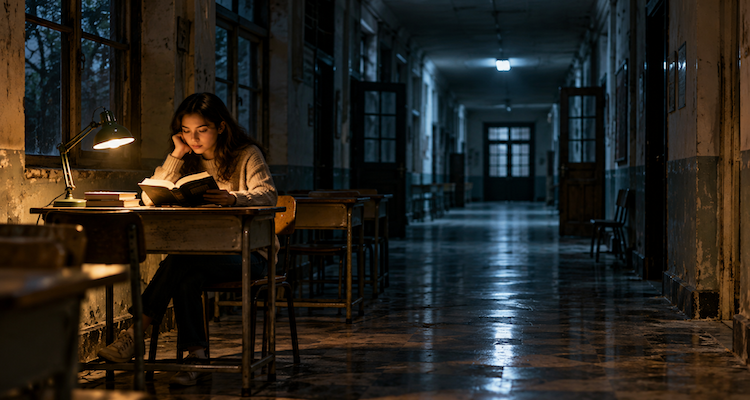
Imagine walking through an empty school after dark and seeing someone sitting calmly at a desk, reading a book. Nothing about their behaviour seems unusual. They are not whispering, hiding, or doing anything threatening. Yet something about the scene feels deeply wrong.
The same feeling can appear when you see a person standing motionless in an abandoned building, someone casually eating in a place associated with tragedy, or a familiar activity taking place somewhere it simply does not belong.
What makes these moments disturbing is not necessarily the person, the place, or the action itself. It is the unexpected combination of all three.
Our minds constantly use context to decide what is normal, what deserves attention, and what might signal danger. When a person behaves perfectly normally in an environment where that behaviour feels inappropriate, our expectations collide with what we see. The result can be an uncomfortable sensation that is difficult to explain.
The unsettling part is that nothing obviously frightening may be happening at all.
Key Takeaways
-
Context shapes perception: The same behaviour can feel ordinary in one location and disturbing in another.
-
Expectation violations attract attention: The brain notices when a scene does not match its predictions.
-
Emotional associations matter: Empty, abandoned, sacred, or dangerous places can influence how we interpret ordinary actions.
-
Ambiguity can intensify discomfort: When we cannot explain why a situation feels wrong, we may keep searching for an explanation.
-
Unfamiliar does not automatically mean dangerous: An unsettling impression is a psychological response, not proof that something bad is happening.
1. The Brain Expects People to Match Their Surroundings
We rarely experience a person as a completely separate object. We interpret their behaviour alongside the room they occupy, the sounds around them, the time of day, and what we believe should be happening there.
Someone reading quietly in a library attracts little attention. The same person reading a newspaper in the middle of an abandoned hospital corridor at midnight may create an entirely different impression.
The action has not changed. The setting has.
Research on context and emotion perception shows that people use surrounding information to interpret what they see. Facial expressions, for example, can be perceived differently depending on the scene in which they appear.
Our minds build informal rules about places. Schools are associated with learning and activity. Hospitals suggest treatment and vulnerability. Abandoned buildings suggest neglect, uncertainty, or possible danger.
When someone’s behaviour does not fit these expectations, the entire scene becomes harder to interpret.
The discomfort may arise before we can explain precisely what seems wrong.
2. The Uncanny Feeling Comes From a Mismatch
There is a particular kind of uneasiness that emerges when something looks familiar but does not fit its surroundings.
Psychologists often discuss the uncanny in connection with experiences that disrupt our expectations of what is familiar, human, or socially appropriate. Research has explored how mismatches between appearance and behaviour can contribute to this effect, although the uncanny is not limited to people behaving in unusual places.
Watering plants is ordinary. The person may look entirely normal. Yet the scene raises questions that have no immediate answers.
Why are they here? Who takes care of the plants? Do they know the building is abandoned? Is the place really empty?
The mind tries to connect the details into a coherent explanation. When the details do not readily fit together, the situation can feel strange even without an obvious threat.
This is one reason subtle eeriness can be more powerful than an openly frightening scene. A visible threat gives us something concrete to respond to. An unexplained mismatch leaves us uncertain about what we are experiencing.
3. Ordinary Behaviour Can Make a Strange Scene Even Stranger
We might expect someone in a disturbing environment to look frightened, behave cautiously, or acknowledge that something is unusual.
When they do none of these things, the contrast becomes more noticeable.
Imagine entering an empty railway station late at night. The lights are dim, the platforms are deserted, and the building feels unusually quiet. Then you notice a person sitting on a bench, eating a sandwich as if they were waiting for an ordinary afternoon train.
Their calmness creates a contradiction.
You perceive the environment as unusual, but the person appears to perceive nothing unusual at all.
This difference in interpretation can be more unsettling than the location itself. You begin wondering whether the person knows something you do not, whether you have misunderstood the situation, or whether there is a perfectly ordinary explanation you have overlooked.
Importantly, the person’s behaviour does not establish any of these possibilities. They may simply have a reason to be there.
The discomfort comes partly from the gap between your interpretation and theirs.
4. Silence and Empty Spaces Change the Meaning of Behaviour
Some places become unsettling because they lack the activity we normally associate with them.
A school without students, a shopping centre without shoppers, or an office without workers can feel strangely unfamiliar even when the physical surroundings remain unchanged.
When a person appears in such a place, their presence becomes unusually prominent.
In a crowded café, someone sitting quietly is barely noticeable. In an empty café after closing time, the same person may become the centre of your attention.
The difference is not necessarily the person’s appearance or behaviour. It is the absence of the ordinary background that would usually make them seem unremarkable.
Silence can intensify this effect. Without conversations, movement, or familiar background noise, small details become easier to notice. A chair scraping across the floor or a person turning a page may seem disproportionately significant.
The setting also invites interpretation. Why is this place empty? Is it closed? Is the person supposed to be there?
These questions may arise automatically, but they do not mean the environment is dangerous. They reflect the difficulty of interpreting a situation that differs from our usual experience.
5. Why the Mind Keeps Searching for an Explanation
Unexplained situations often hold our attention because we want to understand them.
When an event contradicts our expectations, we may examine it more closely, look for missing information, or revise our initial interpretation. Research into expectation violations has investigated how unexpected physical and social events engage attention and cognitive processing.
In an eerie setting, this search for meaning can become particularly noticeable.
You might initially think that a person looks out of place. Then you notice that they are behaving normally. Instead of resolving the uncertainty, this observation creates another question: why does the situation feel wrong if nothing unusual is happening?
The more you search for an explanation, the more details you may notice.
A corridor seems longer than expected. A light appears too bright. The person’s lack of concern becomes increasingly conspicuous.
Some of these details may genuinely be unusual, while others may simply receive more attention because you are already uncomfortable.
This does not mean the mind is inventing the entire experience. It means that perception involves interpretation, not just the passive recording of visual information.
Context, expectations, and prior experiences all influence how a scene is understood.
6. Why the Same Scene Does Not Disturb Everyone Equally
Not everyone finds the same situations unsettling.
A caretaker entering an abandoned building may regard the space as familiar and manageable. A visitor who has never been inside may interpret it as mysterious or threatening.
Previous experiences, cultural associations, familiarity with a location, and the information available to an observer can all influence the meaning assigned to a scene.
Movies and horror stories can also shape expectations. Someone accustomed to films in which an apparently ordinary person appears in an empty building may associate that combination with danger, even when the real-life situation has a harmless explanation.
Another person may see the same scene as peaceful, unusual, or completely unremarkable.
There is no single location or behaviour that universally produces eeriness. The feeling depends on the relationship between the scene and the observer’s expectations.
This distinction matters because discomfort is not evidence of wrongdoing. A person behaving normally in an unexpected place is not necessarily suspicious, dangerous, or connected to anything mysterious.
Sometimes the explanation is as simple as someone being in a place where you did not expect to find them.
Conclusion: Sometimes the Setting Is What Feels Wrong
Seeing someone behave normally in the wrong place can be unsettling because our understanding of behaviour depends heavily on context.
We expect people, actions, and environments to fit together in familiar ways. When they do not, our minds work to resolve the contradiction. An ordinary action can suddenly feel strange, and an otherwise empty space can become charged with meaning.
The most unsettling part may be the absence of anything clearly frightening. There is no obvious threat to identify, no strange behaviour to explain, and no immediate reason for alarm. There is simply a scene that refuses to feel quite right.
Understanding this response offers a useful reminder: something can feel wrong without actually being wrong.
The feeling is real, but the story we attach to it may not be.
This content is published for informational or entertainment purposes. Facts, opinions, or references may evolve over time, and readers are encouraged to verify details from reliable sources.