






Why Some Empty Places Feel Like They Are Waiting for Someone
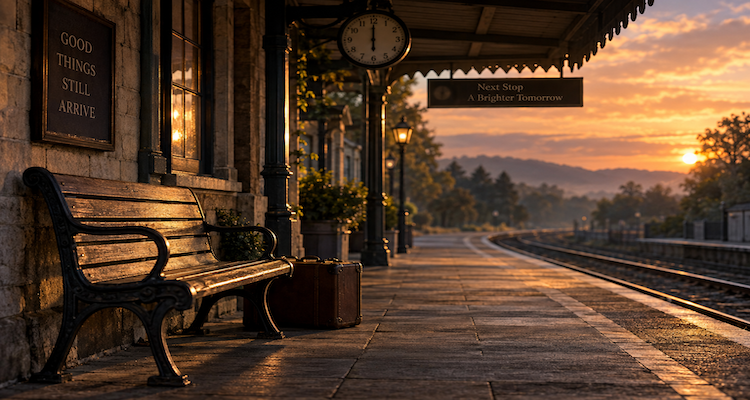
An empty railway platform just before dawn, a hotel corridor with every light switched on, a deserted school after sunset, or a restaurant with chairs neatly arranged but no customers can produce a surprisingly specific feeling: the place seems as though someone should be there.
The sensation is stranger than ordinary loneliness. The room may be completely ordinary, yet it can feel unfinished as if an expected person has stepped away for a moment and might return at any time.
Psychology offers a useful explanation. Places are not perceived as collections of walls, doors, furniture and lighting alone. People interpret environments through expectations built from memory, experience and context. When a familiar environment contains the physical signals associated with human activity but lacks the people normally associated with them, the mismatch can make the setting feel unusual, ambiguous or even unsettling.
Research into environmental psychology and visual perception suggests that the feeling is not evidence that a place possesses a hidden presence. Instead, it reveals something about how strongly the human mind predicts what should be happening around us.
Key Takeaways
- Empty places can feel unsettling when their physical arrangement implies human activity but the expected people are absent.
- Human perception relies heavily on contextual expectations about what objects and environments should contain.
- Research on uncanny places shows that deviations from familiar spatial patterns can increase feelings of uncanniness.
- Social presence can make public spaces feel more normal while having a different effect in private environments.
- Memories and emotional attachment can make particular places feel psychologically occupied even when nobody is physically present.
- The sensation of a place “waiting” is best understood as a perception shaped by expectation, context and meaning rather than evidence of a supernatural presence.
The Mind Does Not See a Place as an Empty Container
Walking into a classroom, café, hospital waiting room or railway station involves more than recognizing its physical structure.
The brain has learned what these places normally contain and what usually happens inside them. A classroom suggests students and teachers. A café suggests customers and staff. A railway platform suggests passengers, announcements and trains.
These expectations are partly learned through repeated experience.
Research on visual perception has shown that contextual expectations influence how people interpret scenes. The visual system does not process every element of an environment in isolation; knowledge about a setting helps guide attention toward things that are expected to occur there.
That creates an important consequence.
When the physical environment remains recognizable but an expected component disappears, the mind can register the discrepancy before a person consciously identifies what feels wrong.
A deserted shopping centre at midnight therefore does not necessarily feel strange because it is objectively dangerous. Its emptiness conflicts with the social activity normally associated with the setting.
The same empty space at another time of day may feel completely ordinary.
Why an Empty Chair Can Feel More Significant Than an Empty Wall
Furniture can make this effect particularly powerful.
A vacant room contains relatively little information about what happened immediately before. But a chair pulled away from a table, a cup left beside a computer, a coat hanging beside a door or a hospital bed prepared but unoccupied can suggest an absent person.
These objects function as clues.
They imply an activity, and activity implies an actor.
This is closely related to the idea of environmental affordances: physical features of a setting suggest possible actions. A bench affords sitting. A desk affords working. A dining table affords eating and social interaction.
Recent environmental-psychology research continues to investigate how physical features of places support meaningful experiences and attachment. Research published in the Journal of Environmental Psychology in 2026, for example, found that features such as places to sit, views, spatial definition and points of focus could contribute to meaningful experiences in people’s favourite urban places.
The important point is that a place communicates possibilities.
A room containing a bed, lamp and bedside table communicates something different from an empty concrete chamber. The first tells us what normally happens there.
When the expected activity is missing, the environment can feel as though it has been paused.
That may be one reason certain empty places seem to be “waiting.”
The Uncanny Begins When Familiarity Stops Working
Psychologists studying uncanny environments have found evidence that unusual physical configurations can make places feel disturbing.
A 2022 study published in the Journal of Environmental Psychology investigated whether the “uncanny valley” phenomenon could apply to physical places. The researchers found that structural deviations from familiar environments were associated with greater uncanniness.
The deviations included unusual proportions, displaced features, missing features and excessive repetition.
The study also examined social presence.
In large public environments, the presence of people could reduce uncanniness, while in private rooms the effect could move in the opposite direction. The researchers concluded that the psychological response depended partly on whether human presence was expected in that particular environment.
This distinction matters.
A deserted shopping mall may feel strange because people are expected there. A completely empty bedroom does not create exactly the same contradiction.
In fact, seeing an unexpected person in a private bedroom could make the room feel more unusual than seeing nobody there.
The brain is therefore responding not simply to “empty” or “occupied,” but to whether the situation makes sense.
The Feeling of “Someone Was Just Here”
There is another layer to the experience: time.
Some environments appear to contain traces of recent human activity.
A warm cup of tea, an open notebook, a computer displaying an unfinished document, freshly arranged chairs or a door left ajar can imply that somebody has recently occupied the space.
The mind naturally constructs a possible sequence:
Someone was here.
They were doing something.
They left.
They may come back.
Nothing supernatural is required for that narrative to emerge.
Human perception is strongly influenced by contextual expectations, and research has demonstrated that people can be more likely to notice or interpret information that fits the surrounding context.
This means an apparently ordinary object can become psychologically significant when it completes a plausible story about an absent person.
The room begins to feel less empty because the observer mentally supplies the missing human presence.
Why Familiar Places Can Feel More Haunted by Absence
The paradox becomes stronger when the place matters personally.
A childhood home, an old school, a former workplace or a family gathering place can carry memories that remain psychologically active long after circumstances change.
This is the territory of place attachment: the emotional and cognitive relationship people develop with particular environments.
Research has treated place attachment as more than simple preference. It can involve personal memories, identity, social relationships and the physical characteristics of a location.
Recent research published in the Journal of Environmental Psychology found that recalling places people feel attached to can increase aspects of perceived meaning in life, including coherence, significance and purpose.
That helps explain why returning to a familiar place after a major change can feel unexpectedly powerful.
The building may look almost identical.
But the people, routines or relationships associated with it may have disappeared.
The result can be a peculiar sense that the physical place remains while the life that gave it meaning has moved elsewhere.
The building has not changed enough to become unfamiliar.
It has changed enough to become emotionally incomplete.
The Difference Between Absence and Presence
There is an important psychological distinction between feeling that someone is absent and actually experiencing a sensed presence.
Most people occasionally encounter situations in which an empty environment feels socially occupied in an imaginative or emotional sense. That does not mean they are literally perceiving another person.
A separate phenomenon known as “felt presence” involves experiencing an external presence without clear sensory evidence.
Research suggests that felt presence can occur in the general population, although it is relatively uncommon. A large population study reported that 1.6% of participants experienced a felt presence during the previous month.
That phenomenon is broader and psychologically different from simply finding an empty room eerie.
This distinction matters because unusual environmental feelings should not automatically be interpreted as paranormal experiences. A person can experience a powerful sense of absence, anticipation or atmosphere while remaining fully aware that nobody is physically there.
The emotional experience can be real without the supernatural explanation being established.
Why Night Changes the Meaning of Familiar Places
Lighting adds another variable.
During daylight, people receive abundant visual information about an environment. At night, shadows, darkness and restricted visibility reduce the amount of information available.
The 2022 research on uncanny physical places specifically discussed how reduced lighting and visual occlusion can contribute to mystery and uncertainty.
This helps explain why a familiar location can feel different after dark.
The architecture has not necessarily changed. The information available to the observer has.
A corridor that looks routine at 2 p.m. can appear ambiguous at 2 a.m. The brain has fewer details with which to confirm that everything is normal.
When uncertainty combines with an environment that already implies human activity, the resulting experience can become unusually vivid.
The empty corridor seems not merely empty.
It seems expectant.
The Places We Design May Be Shaping These Feelings
The psychology has implications beyond eerie photographs and abandoned buildings.
Architects, urban planners, retailers, hospitality businesses and workplace designers all create environments that communicate expected behaviour.
A successful public space usually gives people cues about where to walk, sit, wait, meet or work. Human presence then reinforces those expectations.
Recent research into place attachment and environmental affordances is increasingly examining how physical characteristics can support meaningful relationships between people and places.
That suggests a broader principle: environments work partly because they make social activity legible.
A café feels like a café not only because of its tables and coffee machines, but because people use those objects in recognizable ways.
When the social layer disappears, the physical environment can suddenly become much more noticeable.
This may be why empty airports, hotels, offices and schools are so visually compelling. Their architecture remains, but their normal social script has temporarily vanished.
Why “Waiting” Is Such a Powerful Description
The word “waiting” is psychologically interesting because it assigns intention to an environment.
A room cannot literally wait.
Yet people routinely describe spaces using human qualities: welcoming, cold, hostile, comforting, oppressive, lively or lonely.
These descriptions are ways of translating a relationship between ourselves and the environment into emotional language.
When a place contains cues associated with a future or expected activity but lacks the people who normally perform it, “waiting” becomes a particularly natural metaphor.
A train platform appears to wait for passengers.
A theatre appears to wait for an audience.
A classroom appears to wait for students.
A restaurant appears to wait for customers.
The physical setting remains prepared for an event that is not happening.
That gap between preparation and activity may be the heart of the feeling.
The Larger Lesson: Places Carry Expectations
The most interesting thing about these environments may not be their emptiness at all.
It is the fact that we rarely experience places as neutral physical objects.
We bring memories, expectations, routines and assumptions with us.
Research on visual perception shows that context influences what people notice and how they interpret scenes. Environmental-psychology research shows that physical and social characteristics of places can influence attachment and emotional responses. Studies of uncanny environments demonstrate that deviations from familiar spatial and social patterns can make otherwise recognizable places feel strange.
Together, these findings suggest a useful way of understanding the mysterious atmosphere of an empty place.
The place is not necessarily communicating that someone is there.
It may be communicating that someone is supposed to be there.
And the human mind is remarkably good at noticing the difference.
Conclusion
Some places feel as though they are waiting because they contain more than physical objects. They contain expectations.
A chair implies a person. A classroom implies students. A railway platform implies passengers. A familiar home can imply relationships and routines that once filled it.
When those expected elements disappear, the environment can become psychologically louder.
The resulting sensation may feel eerie, nostalgic, lonely or strangely anticipatory. But the underlying mechanism can be surprisingly ordinary: perception is shaped by context, memory, familiarity and expectations about what a place should contain.
Perhaps that is why the most unsettling empty places are rarely completely empty.
They are full of evidence that life was supposed to be happening there.
This content is published for informational or entertainment purposes. Facts, opinions, or references may evolve over time, and readers are encouraged to verify details from reliable sources.