









Why Seeing Nature Take Back Human Spaces Feels So Powerful
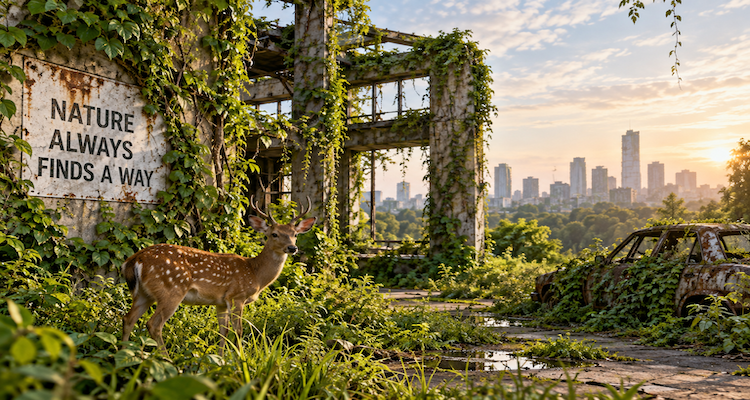
An abandoned railway station buried under vines, a house with trees growing through its roof, or a city street slowly disappearing beneath grass can produce a strange emotional reaction: fascination mixed with calm, sadness, unease and wonder.
The scene is more than an unusual photograph. It shows two systems operating at different speeds. Human construction represents planning, maintenance, ownership and permanence. Nature represents growth, decay, adaptation and change. When vegetation begins occupying a place designed entirely around human control, that contrast becomes visible.
There is also a scientific reason these scenes can feel restorative. Research on exposure to natural environments has linked contact with nature to changes in stress, mood and some aspects of cognitive functioning. But the abandoned-space phenomenon adds another layer: we are not simply looking at nature. We are watching nature interact with evidence of human absence.
Key Takeaways
- Abandoned places reveal ecological succession as plants gradually establish, compete and alter environments without routine human maintenance.
- Nature can attract attention without demanding the same sustained mental effort required by many urban and digital environments.
- Seeing vegetation overwhelm human structures creates a powerful contrast between permanence as humans imagine it and change as ecosystems experience it.
- Research supports links between nature exposure, stress reduction and aspects of cognitive restoration, although effects vary by setting and study design.
- Places such as Pripyat show that “nature taking over” is not instant destruction but a long, uneven ecological process.
- The emotional power of these scenes comes partly from seeing familiar human systems placed inside a much larger cycle of growth, decay and renewal.
When Human Maintenance Stops, Another Process Begins
A building does not become wild overnight.
Once mowing, pruning, cleaning, construction, traffic and other forms of disturbance stop, plants that were previously controlled can establish more freely. Seeds arrive through wind, animals and surrounding vegetation. Roots exploit cracks. Water enters places that maintenance once kept sealed. Shrubs and young trees eventually create shade, changing which species can survive beneath them.
Ecologists describe these changes through the broader concept of ecological succession: changes in the composition and structure of biological communities over time.
The process is not necessarily a march toward one predetermined “natural” endpoint. Soil conditions, climate, previous land use, available seeds, invasive species and continuing disturbance can all influence what develops.
Research on abandoned urban land shows why these places can become biologically interesting. A 2026 study of urban functional areas in Jinan, China, for example, documented 140 spontaneous plant species. The researchers found that these communities were strongly influenced by land use and the amount of habitat available, while most of the spontaneous flora consisted of herbaceous plants.
What looks chaotic to a person walking past an abandoned building can therefore represent a complex biological response to changing conditions.
Why the Contrast Feels So Different
A maintained garden tells us that someone is still controlling the environment.
An abandoned garden tells us that control has weakened.
That distinction matters psychologically.
Human environments are filled with signals of intention. Roads have lanes. Buildings have walls. Lawns are cut. Trees are planted in particular positions. Empty spaces are often expected to be redeveloped.
When those signals remain but maintenance disappears, the visual message becomes contradictory. The building says, “This place was designed.” The vegetation says, “The design is no longer controlling what happens here.”
That contradiction can make the scene unusually compelling.
It is one reason photographs of abandoned factories, railway lines, houses and amusement parks covered in vegetation often feel more evocative than photographs of untouched forests. A forest does not contradict our expectations. An office building with a tree growing through its floor does.
The viewer is seeing two timelines at once: the relatively short timeline of human construction and the slower, continuing timeline of ecological change.
Nature Does Not Need the Ruins to Be Dramatic
There is a temptation to describe abandoned places as evidence that nature is “winning” against humanity. That makes for a powerful phrase, but ecology is more complicated.
Plants are not consciously reclaiming buildings. They are responding to available resources and conditions.
A crack provides soil. A roof collects organic material. A wall creates a particular microclimate. Birds and insects move seeds. Water follows new paths. Species capable of surviving those conditions establish themselves.
The result can look like an intentional takeover even though no intention is involved.
That distinction actually makes the phenomenon more interesting.
The power of the image does not require nature to have a plan. It comes from watching biological processes continue after a human system has stopped maintaining the conditions it created.
What Science Says About Our Response to Nature
The emotional response also fits into a substantial body of environmental-psychology research.
One influential framework is Attention Restoration Theory, which proposes that natural environments can help restore forms of attention depleted by sustained mental demands. A 2016 systematic review found some evidence supporting this idea, although the researchers also emphasized substantial variation between studies and uncertainty about which aspects of attention are most affected.
A later systematic review examining 42 studies found evidence that exposure to natural environments can improve working memory and cognitive flexibility, with smaller and less reliable evidence concerning attentional control. The authors also noted methodological differences between studies and suggested that actual exposure to natural environments may have different effects from simulated exposure.
Stress is another part of the picture.
A 2020 systematic review examined 12 studies involving measures such as perceived stress, cortisol, blood pressure, heart-rate variability and other physiological indicators. The review reported an inverse relationship between nature exposure and several physiological measures of stress across the studies it assessed, while perceived stress was lower in most of the studies measuring it.
That does not mean every encounter with nature will produce the same response. Reviews of the broader evidence point to important differences involving the type and quality of green space, duration and frequency of exposure, and how exposure itself is measured.
Still, the evidence provides a useful backdrop for understanding why an overgrown space can feel different from a heavily engineered one.
The Strange Calm of “Soft Fascination”
One useful concept in the research is soft fascination.
Natural environments can hold attention through movement, texture, light, sound and changing patterns without necessarily demanding the same deliberate concentration required by tasks such as reading a report, navigating traffic or responding to notifications.
An overgrown abandoned building combines that quality with something visually familiar.
Leaves move through broken windows. Grass follows the outline of a former path. Moss spreads across concrete. Sunlight enters rooms that were once artificially lit.
There is enough change to attract attention, but often no obvious task to complete.
The viewer can simply observe.
That may help explain why photographs and videos of abandoned places surrounded by vegetation can feel absorbing even when nothing dramatic is happening.
Pripyat Shows What Long-Term Abandonment Looks Like
One of the clearest real-world examples is Pripyat, the Ukrainian city abandoned following the 1986 Chernobyl nuclear accident.
Pripyat is not an uncomplicated example of nature “returning.” Radiation remains an important environmental factor, and the area’s ecological history is unusual. Nevertheless, researchers have documented substantial changes in its vegetation after decades without ordinary urban maintenance.
A study of Pripyat’s urban forest published in Urban Forestry & Urban Greening examined 40 plots across different urban habitats. Researchers found extensive tree regeneration and evidence that species composition was already changing after more than two decades without normal maintenance. The researchers described a transition in which ecological factors increasingly shaped the urban forest instead of the original human choices that determined where trees were planted.
The wider Chernobyl exclusion zone provides another important lesson. Research has documented wildlife persistence and recolonization in an area where human access and activity were dramatically reduced, although radiation creates its own ecological effects and means the region should not be treated as a simple model of healthy wilderness. Recent research continues to examine how restrictions on human access affect mammal distributions.
The lesson is therefore not that removing humans automatically creates a healthier ecosystem.
It is that reducing particular forms of human disturbance can fundamentally change ecological conditions.
Abandoned Places Also Challenge the Idea of Permanence
Perhaps the deepest reason these images affect people is that architecture normally communicates permanence.
A concrete building looks solid. A railway line looks engineered to remain in place. A road appears to impose a permanent pattern on the landscape.
Vegetation growing through these structures quietly challenges that impression.
It reminds us that construction does not stop ecological processes. Buildings weather. Materials break down. Water moves through cracks. Plants reproduce. Animals occupy spaces. Soil accumulates.
The timescale is different from everyday human experience, which makes the process easy to overlook.
A person may see a building as something expected to last for generations. An ecosystem has no obligation to preserve that human intention.
That is why the image can feel simultaneously beautiful and unsettling.
There Is Beauty in Decay, but Decay Is Not Always Harmless
The attraction should not be confused with an argument for abandoning urban spaces.
Unmanaged vegetation can damage structures, obstruct drainage, create fire risks and conceal hazards. Some abandoned sites contain contaminated materials, unstable buildings or dangerous infrastructure. Invasive species can also dominate disturbed environments, meaning that spontaneous growth is not automatically synonymous with ecological improvement.
Research on abandoned urban properties has found that increased vegetation can sometimes bring greater canopy cover and plant richness, while also noting that non-native or overgrown vegetation can create ecological and management challenges.
This matters because the romantic image of “nature reclaiming a place” can hide a more complicated reality.
Ecological recovery is not the same thing as ecological perfection.
A neglected site can become valuable habitat, an ecological stepping stone, a visual record of history or a hazardous piece of land. Sometimes it can be several of these at once.
Why These Images Stay With Us
The strongest abandoned-place images rarely show nature destroying something in a dramatic instant.
Instead, they show a quiet transition.
A tree has grown beside a wall.
Roots have lifted pavement.
Grass has crossed a former boundary.
Vines have entered a window.
None of these events is spectacular on its own. Together, they reveal a change in who or rather what is shaping the space.
That may be the real source of their emotional force.
We are accustomed to seeing landscapes as products of human decisions. An abandoned place temporarily reverses that perspective. Human decisions remain visible, but their control becomes less obvious with every season.
The scene therefore becomes more than a picture of decay. It becomes a picture of time.
And unlike a conventional ruin, an overgrown ruin contains evidence not only of what has disappeared, but of what is still happening.
Conclusion
Seeing nature take back human spaces feels powerful because it compresses several ideas into one image: human ambition, abandonment, ecological succession, time and impermanence.
Science offers part of the explanation for why natural environments can feel restorative and engaging. Ecology explains how vegetation can establish and reorganize communities when disturbance and maintenance change. Psychology helps explain why natural patterns can capture attention without demanding the same effort as many human-made environments.
But the emotional response goes beyond any single scientific mechanism.
An overgrown building makes change visible.
It shows that the things humans construct may feel permanent while still being temporary participants in a much older biological process. The vines, roots and trees are not staging a victory over civilization. They are simply continuing to grow.
That quiet fact may be what makes the image so difficult to ignore.
This content is published for informational or entertainment purposes. Facts, opinions, or references may evolve over time, and readers are encouraged to verify details from reliable sources.