





How Convenience Is Quietly Changing What People Eat
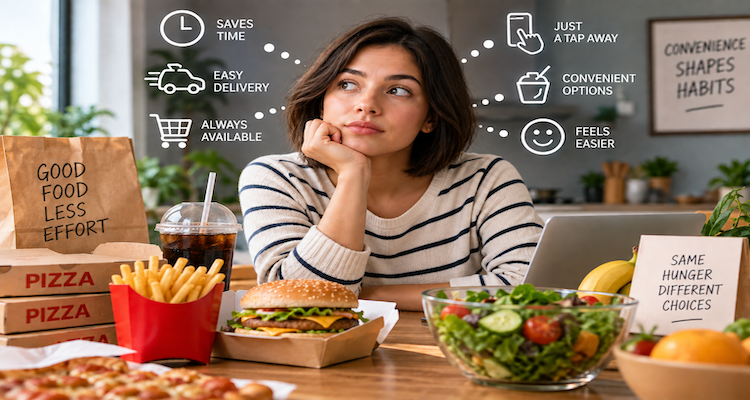
The modern food decision often begins before hunger does. It starts with a question that sounds harmless: What is easiest right now?
A ready meal that takes three minutes, groceries delivered to the door, a food-delivery app that remembers previous orders, a packaged snack within arm’s reach, or a restaurant meal that requires no shopping, chopping or washing up can remove several small obstacles from eating.
That convenience is not inherently unhealthy. In many situations, it can make eating easier, cheaper in time, and more manageable. But research increasingly suggests that convenience is more than a preference. It can shape the food environment in which choices are made, influencing what people notice, buy, prepare and eat. A 2024 systematic review of 243 studies found that convenience is commonly understood in terms of reducing the time, physical effort, mental effort or skills required to plan, obtain, prepare and consume food.
The important shift is therefore not simply from “healthy food” to “unhealthy food.” It is from deliberate food decisions toward frictionless ones.
Key Takeaways
- Convenience reduces the time, effort and planning required to turn food into a meal.
- Time scarcity has been associated with greater use of ready-made meals, fast food and other convenience foods.
- Food-delivery apps can change not only where people buy food, but also which choices they encounter first.
- Convenience does not automatically mean poor nutrition; meal kits and prepared foods can sometimes support better eating.
- The biggest influence may be the food environment surrounding a choice, not convenience alone.
- Small changes in how food is stocked, displayed and ordered can make convenient choices healthier.
Convenience Is More Than Saving Time
Convenience is often treated as if it means “fast.” Research suggests the concept is broader.
A food can be convenient because it requires little cooking, little cleaning, minimal planning, few ingredients, limited preparation skills or almost no travel. Delivery services can eliminate shopping and transportation. Ready-to-eat products can eliminate preparation altogether.
That matters because every step removed from the process changes the calculation consumers make.
Consider two dinners. One requires deciding what to cook, checking ingredients, shopping, preparing food and cleaning the kitchen. The other requires opening an app and tapping “reorder.”
The nutritional difference between those meals is only part of the story. The decision-making effort is different too.
A 2024 review in Appetite found that convenience has been studied across food planning, acquisition, preparation, storage, transport, consumption and clean-up not simply cooking time. The researchers also noted that convenience has often been measured through people’s perceptions rather than objective measures, showing how difficult it is to capture the concept precisely.
That distinction helps explain why convenience can quietly influence eating without a person consciously deciding to change their diet.
When Time Becomes an Ingredient in Food Choice
Time scarcity is one of the clearest mechanisms.
A long-standing review of food-choice research found that perceived lack of time has been associated with less home preparation and greater use of fast food and ready-prepared foods.
More recent evidence adds detail. A Norwegian cross-sectional study of 497 parents found associations between higher reported time scarcity and higher consumption of several categories of ultra-processed foods, including ultra-processed dinner products and fast foods. Because the study was cross-sectional, however, it cannot establish that time scarcity itself caused those eating patterns.
That limitation is important.
People who feel short on time may also differ in employment, household structure, income, cooking skills, family responsibilities and other factors that affect food choices. Convenience should therefore not be treated as a single explanation for dietary behavior.
Still, the pattern reveals something significant: when time becomes scarce, the cost of preparation becomes more important.
The food that requires fewer decisions and fewer steps can gain an advantage.
The Hidden Power of the Food Environment
Convenience also changes what is available at the precise moment a person becomes hungry.
A stocked freezer, a vending machine, a supermarket checkout, a delivery app or a kitchen cupboard can function as a decision environment. The easier option is physically or digitally closer to the consumer.
This is particularly visible in online food ordering.
Research using data from Australia, Canada, Mexico, the United Kingdom and the United States found that the share of adults reporting online food-delivery use increased between 2018 and 2021 in all five countries studied. The study covered more than 83,000 adults, although the data describe purchasing patterns rather than proving that delivery services caused changes in diet.
Once food ordering moves onto a screen, convenience takes another form: choice architecture.
The order in which restaurants and meals appear, the prominence of photographs, promotions, prices and recommendations can all affect what consumers see before making a decision.
A 2024 randomized experiment involving 4,008 UK participants tested different ways of presenting choices in a simulated food-delivery platform. Placing lower-carbon choices earlier in the menu reduced the average carbon footprint of selected meals and was also associated with higher nutritional value and fewer calories. This does not prove that every commercial delivery platform would produce the same result, but it demonstrates that the design of a digital food environment can influence choices.
Convenience, in other words, is no longer only about how quickly food arrives.
It can also determine what becomes easiest to choose.
Why “Convenient” Does Not Always Mean “Unhealthy”
There is a danger in turning convenience into a synonym for junk food.
That would oversimplify both the research and people’s lives.
A bag of frozen vegetables can be more convenient than fresh vegetables while still contributing useful nutrients. Pre-cut produce can remove preparation barriers. A simple meal kit can make home cooking possible for someone who would otherwise order dinner.
Research on meal kits illustrates this mixed picture. A recent scoping review identified 15 publications examining the nutritional content, safety and acceptability of meal-kit delivery services and concluded that the category has potential while also requiring better evidence and quality assessment.
Individual meal-kit research has also found trade-offs. An Australian review of selected commercial meal kits found that the meals were generally convenient and easy to prepare, but some had relatively high levels of salt and fat and could cost more than buying the same ingredients separately.
Convenience can therefore work in either direction.
The more useful question is not:
“Is convenient food bad?”
It is:
“What kind of food becomes easier because of convenience?”
That question produces a much more practical way of thinking about diet.
The Ultra-Processed Food Connection Needs Careful Interpretation
The relationship between convenience and ultra-processed foods deserves particular attention, but it should not be reduced to a simple cause-and-effect story.
Ultra-processed foods include a wide range of products, from packaged snacks and sugary drinks to instant noodles and ready-made meals. An umbrella review published in The BMJ found that greater exposure to ultra-processed foods was associated with numerous adverse health outcomes, particularly cardiometabolic outcomes, common mental disorders and mortality. However, the review also found that much of the evidence was of low or very low quality, meaning the strength of individual associations needs to be interpreted carefully.
There is also experimental evidence suggesting that the characteristics of highly processed foods may affect eating behavior. A small randomized crossover study involving 18 healthy adults examined processing level and food texture and measured energy intake under controlled conditions. Its small sample means the findings should not be generalized too broadly, but it provides one line of evidence for investigating how food structure can affect eating behavior.
The broader point is that convenience can intersect with processing, palatability, portioning, availability and marketing.
But none of these factors should be treated as interchangeable.
Digital Convenience Is Creating a New Food Environment
Food-delivery apps make the issue especially interesting because they combine several forms of convenience at once.
They remove travel. They reduce planning. They provide menus. They remember previous purchases. They can promote particular restaurants or products. And they can make food available far beyond the consumer’s immediate neighborhood.
A 2024 systematic mapping review of 43 studies concluded that online food-delivery platforms have become an important part of the food environment, with existing research examining promotion, retail, food composition, prices and labelling. The authors argued that nutrition policies have not always fully incorporated this digital environment.
More recent research illustrates the complexity. A 2026 study of 397 university students in Saudi Arabia found that price, food appearance and perceptions of what constitutes a healthy meal were among factors associated with food choices on delivery applications. The study was limited to a specific student population, so it should not be treated as representative of all consumers.
This is where convenience intersects with technology.
The phone does not merely make ordering easier. It can become the place where the food decision happens.
The Better Strategy May Be to Redesign Convenience
If convenience influences food choices, asking people simply to “make healthier choices” may miss an important part of the problem.
A more practical approach is to make healthier choices convenient too.
That can mean:
- keeping fruit, vegetables and other useful foods easy to reach;
- preparing basic ingredients in advance;
- using frozen or minimally processed ingredients when they save time;
- choosing simple meals rather than treating cooking as an all-or-nothing activity;
- making healthier options the first visible choices in digital menus;
- checking whether convenience products actually reduce preparation without creating unnecessary nutritional trade-offs.
The evidence from online choice-architecture research is particularly interesting because it suggests that the environment around a decision can matter. In the 2024 experiment, changing menu order influenced participants’ selections without removing their ability to choose other foods.
That offers a broader lesson: people do not necessarily need more willpower; sometimes they need better default environments.
What This Means for Everyday Eating
The quietest influence of convenience may be repetition.
A single ready meal or delivery order says very little about someone’s diet. The larger effect can emerge when the same frictionless choice becomes the default several times a week.
This is why looking at individual foods can miss the bigger picture.
Ask instead:
What happens when convenience repeatedly determines breakfast, lunch, snacks and dinner?
That question shifts attention from moral judgments about particular foods toward the structure of everyday life.
Work schedules, household responsibilities, cooking skills, food prices, access to shops, technology and the design of food services all shape the choices available to people. Convenience is one part of that system, but it can become a powerful one when time and attention are limited.
The answer is not to eliminate convenience. For many people, that would be unrealistic.
The more useful goal is to make the convenient choice a better choice more often.
Conclusion
Convenience is changing eating habits partly because it changes the cost of making a food decision.
When preparation, shopping, planning and cleaning become difficult, foods that remove those steps naturally become more attractive. Digital delivery platforms take that process further by placing food selection directly into the smartphone and shaping what consumers see when they order.
But convenience itself is not the enemy. It can help people cook, manage busy schedules and access useful foods. The important distinction is what kind of food is being made convenient.
That may be the most overlooked part of the modern food environment: people are not only choosing what to eat; they are choosing from systems designed around different levels of effort.
The healthier future of convenience may therefore depend less on asking consumers to resist convenience and more on designing everyday food environments in which good choices require less of it.
This article is intended for general awareness and educational purposes only. It should not be considered medical advice. Readers are encouraged to consult qualified healthcare professionals for personal health decisions.