



The Technology Behind Waiting Less Is Changing How People Experience Time
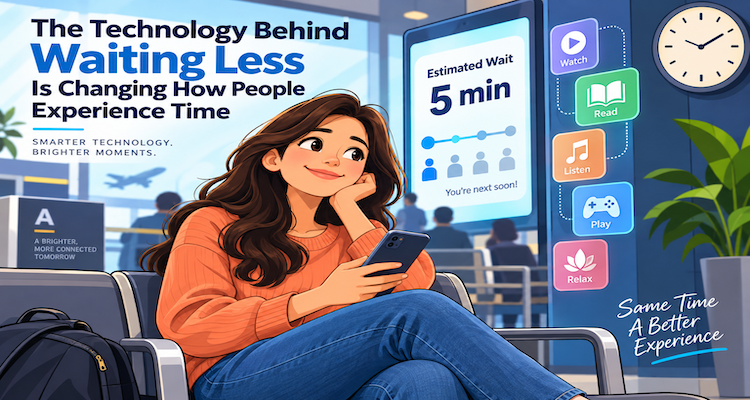
A waiting screen, a live delivery tracker, a self-checkout machine or a ride-hailing estimate can change an experience before the underlying delay has changed at all. The important technological shift is therefore not simply that companies can make queues shorter. Increasingly, digital systems can measure, predict, display, fill and reorganize waiting time.
Research on service technology has found that self-service systems can reduce actual waiting under the right operating conditions, but their effectiveness depends on factors such as processing speed, capacity and failure rates. Other research shows that technology can influence how long a wait feels, not merely how long it lasts.
That distinction is becoming increasingly important as everyday services move toward automated checkouts, real-time tracking, digital queues, AI customer service and app-based scheduling. People are not experiencing time only through clocks anymore. They are experiencing it through interfaces.
Key Takeaways
- Technology can reduce actual waiting, but poorly designed systems can simply move the frustration somewhere else.
- Real-time information gives people greater visibility and can reduce uncertainty about how long a wait will last.
- Interactive technology can make waiting feel less burdensome by giving people something to do or control.
- A predicted wait changes expectations, making the difference between expected and actual waiting particularly important.
- Automation works best when speed, reliability and user control improve together rather than when technology merely replaces human service.
- The next evolution of queue management may focus as much on the experience of waiting as on eliminating the wait itself.
The Difference Between Waiting Less and Feeling Less Time
A five-minute wait measured by a clock is always five minutes. The experience of those five minutes can be very different.
Consider two situations. In the first, a customer sees a blank screen saying that a service representative will be available “soon.” In the second, the customer sees that there are three people ahead and an estimated wait of four minutes.
The underlying duration may be similar, but the second situation provides information and a degree of predictability.
Research has repeatedly shown that perceived waiting time and expectations matter to satisfaction. A study of emergency-department patients, for example, found that perceptions of waiting and the quality of information provided were associated with satisfaction, while actual waiting time itself was not a significant predictor in that study.
This does not mean that actual waiting time is irrelevant. Long delays still matter. Rather, it demonstrates that the psychological experience of waiting cannot be understood from the clock alone.
That is where technology has gained an unusual role: it can change the information surrounding the wait.
The Smartphone Turned Waiting Into an Informational Experience
Older queues often gave people little information. You knew you were waiting, but not necessarily how much longer you would wait.
Digital services increasingly expose information that was previously hidden.
A transport application can show the location of an approaching vehicle. A delivery platform can display progress. A digital appointment system can provide an estimated time. A customer-service interface can show that a request has moved from one stage to another.
Real-time information does not guarantee that the service itself is reliable. Research into public transport waiting has found that the value of real-time information depends partly on the reliability of the underlying service and the credibility of the information.
This creates an important principle for digital service design:
Information is useful only when people can reasonably trust it.
An inaccurate countdown can be worse than no countdown because it creates an expectation that the system subsequently violates.
Predictability Can Be Almost as Important as Speed
One of the more interesting developments in waiting research concerns expectations.
A 2023 study in the Journal of Retailing examined how customers respond when actual waiting is shorter or longer than expected. Across three studies, the researchers found that waiting shorter than expected could produce a substantial increase in satisfaction, while modestly longer waits did not have an equally large negative effect. However, when waiting became substantially longer than expected, dissatisfaction increased sharply. The study also found that the source of the expectation mattered.
That finding has direct implications for digital services.
Suppose an application says:
Estimated wait: 8 minutes
If the service arrives in six minutes, the customer has effectively received a small positive surprise.
If the service arrives in 20 minutes, however, the original estimate becomes part of the problem.
Technology therefore does more than measure time. It establishes a contract about time.
Every ETA, countdown and queue position creates an expectation against which the eventual experience can be judged.
Interactive Technology Can Make Waiting Feel Different
Another technological change is that waiting no longer necessarily means doing nothing.
Self-checkout machines allow customers to participate in the transaction. Ride-hailing applications provide movement information. Online services can allow users to monitor progress. Digital customer-service systems can provide status updates while a request is being processed.
Research on self-service technology has found that the experience of using such systems can influence both satisfaction with the technology and perceptions of waiting. More interactive systems can have different effects from simpler self-service technologies.
A 2021 study of mobile ride-sharing applications similarly found that greater mobile interactivity could increase tolerance of perceived waiting time, partly through cognitive absorption the degree to which users become engaged with the interaction.
This suggests a subtle distinction.
Technology does not necessarily make the minutes disappear. Instead, it can make the person less exclusively focused on the passage of those minutes.
That is a very different mechanism from simply increasing processing speed.
The “Time Filler” Is Becoming Part of Service Design
Digital interfaces increasingly occupy the space between an action and its completion.
Progress animations, status messages, interactive maps, queue information and other interface elements can provide something to process while the underlying system works.
Research on chatbot handovers has explored this idea directly. A 2020 human-computer interaction study examined the use of queue information and “time fillers” during transfers from chatbots to human representatives, finding evidence that transparency and activities during the wait can improve the subjective waiting experience. The study was small, with 28 participants, so its findings should not be generalized to every digital service.
More recent research is examining similar mechanisms in other digital waiting situations. A 2026 Scientific Reports study involving online ride-hailing drivers investigated how progress information and entertainment features affected perceived waiting time and emotional experience.
The broader lesson is not that every waiting screen needs entertainment.
It is that the interface surrounding a delay can become part of the service itself.
But Technology Can Also Make Waiting More Visible
There is a paradox here.
The same technology that reduces uncertainty can make people monitor the clock more closely.
A customer who previously had no information might simply wait. A customer watching a countdown may check every few seconds whether the estimate has changed.
The promise of transparency can therefore create a new form of attention.
A September 2026 review in the European Management Journal argues that modern digital services have changed the forms of waiting without eliminating waiting itself. Its framework considers not only elapsed time, but also the experiential, social and psychological dimensions of waiting, including uncertainty, agency and the way information shapes the experience.
This is an important shift in thinking.
The technological goal should not necessarily be:
“How do we make people wait zero minutes?”
In many services, that is economically or technically unrealistic.
A more useful question can be:
“How do we make unavoidable waiting predictable, understandable and reasonably controllable?”
Faster Technology Can Still Produce Longer Queues
There is another limitation that businesses sometimes overlook: automation does not automatically improve the entire system.
Research examining self-service technology in hotel check-in found that actual waiting times depended on several interacting factors, including customer demand, available resources, processing speed and technology failure rates. Faster or more reliable self-service can help, but slow processing and failures can create additional delays, particularly during periods of high demand.
This is why replacing a human process with a digital interface is not the same as solving a queue.
A badly designed automated process can simply create a digital queue instead of a physical one.
The customer may still be waiting, only now beside a spinning icon rather than behind another person.
The Business Value of Better Waiting
For companies, this matters because waiting affects more than convenience.
Waiting can influence satisfaction, service evaluations and willingness to use a particular service. Research into self-service technologies has consequently examined not only productivity but also customer perceptions of waiting and the broader service experience.
This creates several practical areas for businesses to consider:
- Accuracy: Is the estimated waiting time credible?
- Visibility: Can customers understand what is happening?
- Agency: Can customers change, cancel or reschedule the request?
- Reliability: Does automation actually work during periods of high demand?
- Progress: Can customers see meaningful evidence that their request is moving forward?
- Fallbacks: What happens when the automated process fails?
- Accessibility: Can people who struggle with digital interfaces still obtain the service?
These questions are increasingly important because digital queue systems can distribute inconvenience differently among users.
A fast digital route may benefit people who are comfortable with technology while creating additional friction for those who prefer or require human assistance.
Technology therefore changes not only how long people wait, but potentially who waits, how they wait and what choices they have while waiting.
The Next Competitive Advantage May Be Better Time Design
For decades, service businesses have generally treated waiting as an operational problem.
Reduce the queue. Add capacity. Increase processing speed.
Those objectives remain important. But digital technology makes another approach possible: designing the experience around the unavoidable parts of the queue.
A service can tell people what is happening. It can provide credible estimates. It can offer useful interaction. It can give users control over their next step. And it can make failure visible instead of leaving customers wondering whether the system has stopped working.
That does not make a 20-minute delay equivalent to a two-minute delay.
It does, however, recognize that human beings experience time through expectations, attention, uncertainty and control as well as through minutes and seconds.
The strongest digital services will therefore not necessarily be those that promise that nobody will ever wait.
They may be the ones that understand what waiting feels like and design the technology accordingly.
Conclusion
Technology is changing the experience of time by attacking waiting from two directions at once.
The first is operational: automation, self-service and digital processes can reduce the amount of time required to complete a task when they are fast, reliable and properly integrated into the wider service system.
The second is experiential: information, interaction, progress indicators and credible estimates can change how people understand and respond to the time that remains.
That distinction matters because eliminating every wait is unrealistic. Designing a better wait is not.
As more everyday services become digital, the competition may increasingly move beyond who can process a request fastest. It may also involve who can make the unavoidable minutes feel predictable, transparent and worth tolerating.
The clock has not changed. The technology around it has.
The information presented in this article is based on publicly available sources, reports, and factual material available at the time of publication. While efforts are made to ensure accuracy, details may change as new information emerges. The content is provided for general informational purposes only, and readers are advised to verify facts independently where necessary.