







Why Certain Sounds Feel Wrong Even When Nothing Is Wrong
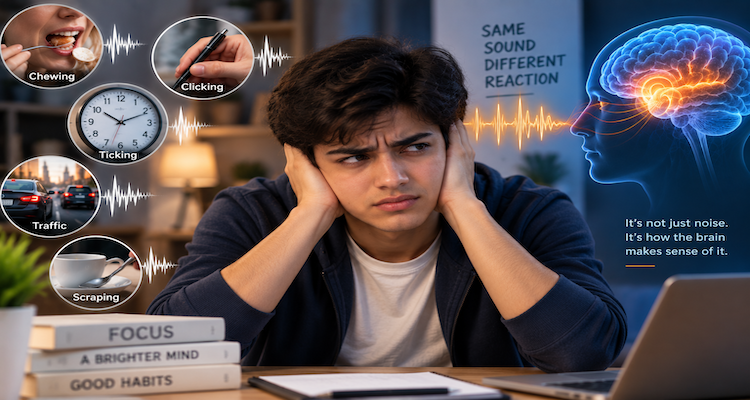
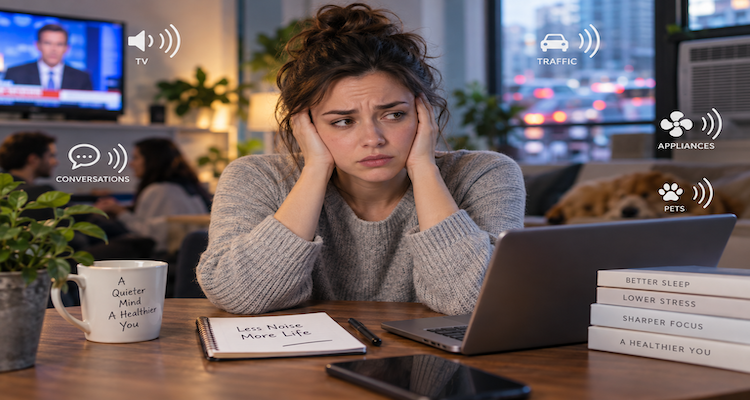
A spoon scraping a plate. Someone chewing nearby. Repeated pen clicking. A particular ringtone. None of these sounds is necessarily loud, dangerous, or objectively unpleasant and yet, for some people, they can produce an immediate feeling of irritation, disgust, anxiety, or even a powerful urge to escape.
That reaction is not always about the sound’s volume. Neuroscience research increasingly suggests that the brain can assign unusually strong emotional significance to particular sounds, linking auditory perception with systems involved in attention, emotion, bodily responses, and learned associations. This helps explain why two people can hear exactly the same sound and experience it very differently.
One of the clearest examples is misophonia, a condition involving decreased tolerance to specific sounds or sound-associated cues. It is different from simply finding noise annoying, and it is also different from hyperacusis, in which sounds can seem excessively loud or physically painful. Researchers are still working out exactly how these conditions develop and how they should be distinguished clinically.
Key Takeaways
- Some sound reactions are driven more by emotional significance than by loudness.
- Misophonia can make specific everyday sounds trigger intense, involuntary emotional responses.
- Hyperacusis differs because ordinary sounds may seem excessively loud or physically uncomfortable.
- Brain-imaging studies connect sound intolerance with networks involved in salience, emotion and sensory processing.
- A sound’s context, meaning and source can influence how strongly a person reacts to it.
- Persistent or painful sound sensitivity can warrant professional assessment rather than simple avoidance.
The Sound Is Not Always the Problem
Human hearing does more than measure acoustic energy. The brain continuously decides which sounds deserve attention.
A sudden alarm, a baby’s cry or a nearby crash can rapidly capture attention because the nervous system treats certain acoustic patterns as important. This ability is useful: ignoring every sound equally would make it harder to detect potential threats or respond to changes in the environment.
But the same principle can produce very different experiences when a normally harmless sound becomes strongly associated with an emotional response.
Research into misophonia provides an especially interesting example. A 2022 international expert consensus defined misophonia as decreased tolerance to specific sounds or their associated stimuli. The response is not simply a matter of the sound being objectively louder than other sounds.
That distinction matters.
A person with misophonia might react intensely to a relatively quiet chewing or breathing sound while remaining comfortable around much louder environmental noise. The important variable may therefore be the particular sound pattern and what it represents to the listener, rather than volume alone.
Why the Brain Can Turn an Ordinary Sound Into a Powerful Signal
One influential line of research points toward the brain’s salience network systems involved in detecting and prioritizing information that deserves attention.
In a widely cited fMRI study, researchers found that people with misophonia showed unusually strong responses in the anterior insular cortex when exposed to their trigger sounds. The anterior insula is involved in processing internal bodily states and emotionally relevant information. The study also reported altered connectivity between this region and areas involved in emotional processing and regulation.
The significance is not that scientists have found a single “misophonia center” in the brain. They have not.
Instead, the findings support a more complicated picture: a sound can become unusually important because auditory processing interacts with systems that determine relevance, emotion and bodily response.
That may help explain why the reaction can feel automatic. The person may intellectually understand that the sound is harmless while still experiencing an immediate physiological or emotional response.
Context Can Change the Reaction
One of the most revealing features of sound intolerance is that the same acoustic signal may not produce the same reaction in every situation.
Research and clinical models of misophonia have emphasized that reactions can depend on factors such as who produces the sound, the surrounding circumstances and the meaning attached to it. This contrasts with hyperacusis, where the physical intensity of sound is more central to the problem.
Consider two versions of the same sound: a repetitive tapping noise made accidentally in a quiet room, and the same tapping produced by someone in a situation where the listener already expects irritation.
The acoustic waveform may be similar. The psychological significance may not be.
This is one reason it is misleading to describe every unpleasant response to sound as simply “sensitive hearing.”
Misophonia and Hyperacusis Are Not the Same Thing
Several forms of reduced sound tolerance can look similar from the outside but involve different experiences.
| Condition | Typical experience |
|---|---|
| Misophonia | Specific sounds trigger strong emotional reactions such as anger, disgust or distress. |
| Hyperacusis | Sounds may seem excessively loud, uncomfortable or painful. |
| Phonophobia | Fear or anxiety is associated with sound; the term is also used differently in neurology, particularly around migraine. |
| General noise sensitivity | A broader feeling of being overwhelmed, annoyed or uncomfortable in noisy environments. |
A clinical review published in the American Journal of Audiology emphasized that terminology and assessment methods remain inconsistent across the field. The authors also stressed the importance of distinguishing these conditions when evaluating decreased sound tolerance.
That uncertainty is important. Not every person who dislikes chewing sounds has misophonia, and not every person who finds ordinary sounds uncomfortable has hyperacusis.
New Brain Research Is Making the Picture More Complicated
The neuroscience has continued to develop.
A 2025 study published in Hearing Research used resting-state fMRI to investigate differences in intrinsic brain connectivity associated with misophonia, including cases with and without hyperacusis. The researchers identified connectivity patterns involving cortical and subcortical networks, while emphasizing the need for further work to establish how these findings relate to the conditions themselves.
Another recent study examined brain responses to emotionally valenced sounds in groups with misophonia, hyperacusis, both conditions, and controls. The researchers reported both overlapping and distinct neural patterns, including differences involving salience, sensory and frontal-control networks. Because this is an evolving research area, these findings should be interpreted as evidence about possible neural mechanisms rather than a complete explanation of why sound intolerance develops.
This distinction is crucial.
Brain-imaging research can reveal associations between symptoms and neural activity. It does not automatically establish that a particular brain difference caused the condition.
Why the Reaction Can Feel Physical
Sound intolerance is not necessarily an intellectual judgment such as, “I don’t like that noise.”
Studies of misophonia have reported physiological responses alongside emotional reactions. In the earlier fMRI research, trigger sounds were associated with increased heart rate and changes in skin conductance among participants with misophonia.
This helps explain an experience that can otherwise seem difficult to describe: the sound may provoke tension before a person has consciously decided that it is irritating.
The brain’s response to a salient stimulus can involve attention, emotion and autonomic physiology at the same time.
That does not mean every unpleasant reaction is a neurological disorder. It does mean that, for people with clinically significant sound intolerance, simply being told to “ignore it” may overlook the complexity of the response.
Why Avoiding Every Trigger May Not Be the Answer
For people experiencing persistent sound sensitivity, avoidance can seem like the most obvious solution. But complete avoidance is not always recommended.
The NHS notes that people with hyperacusis may become more sensitive to noise if they avoid sound completely or use ear protection continuously. Its guidance recommends seeking professional advice when ordinary sounds become excessively loud or painful and notes that treatment can depend on the underlying cause.
This does not mean someone should deliberately expose themselves to painful noise.
Rather, it highlights the importance of understanding what type of sound intolerance is actually present before deciding how to manage it.
A person experiencing persistent, disruptive or painful sound sensitivity may benefit from assessment by an appropriate healthcare professional, particularly if symptoms appear suddenly, interfere substantially with daily life, or occur alongside hearing problems, tinnitus, migraine or other symptoms.
The Larger Lesson: Hearing Is Also About Meaning
The most interesting part of sound sensitivity may be what it reveals about ordinary hearing.
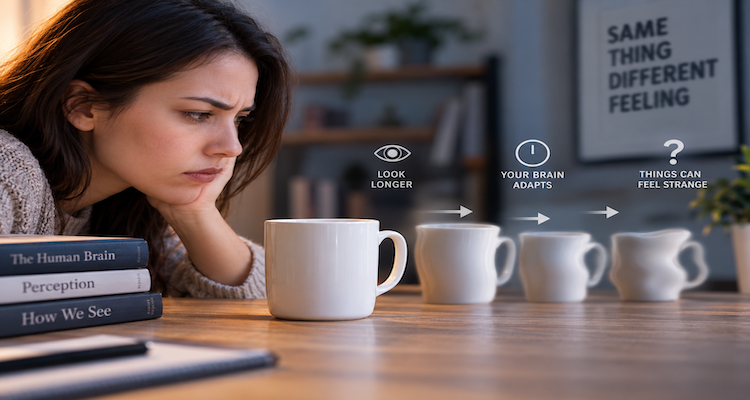
We tend to imagine hearing as a straightforward process: sound enters the ear, the brain identifies it, and we react. In reality, perception is more interactive. The brain evaluates sensory information in relation to attention, context, previous associations and emotional relevance.
Misophonia provides an unusually clear window into that process.
The irritating sound is real. The emotional response is real. But the intensity of the reaction cannot necessarily be explained by the sound’s physical properties alone. Research increasingly points toward interactions between auditory processing, salience, emotion, bodily awareness and other neural systems.
That is why the same noise can be meaningless background information for one person and almost impossible to ignore for another.
Conclusion
Sometimes a sound feels wrong even when nothing is objectively wrong with the sound itself.
The difference can lie in how the brain assigns significance to what the ears detect. In misophonia, particular everyday sounds can become powerful emotional triggers; in hyperacusis, ordinary sounds may instead be experienced as excessively loud or painful. These conditions overlap in some people, but research suggests they should not simply be treated as different names for the same problem.
The emerging neuroscience does not yet provide one complete explanation. What it does show is that sound perception is inseparable from the brain systems that decide what matters.
A sound is therefore never just a sound. For the brain, it can also be a signal of relevance, memory, emotion, expectation—or, in some circumstances, distress.
This content is published for informational or entertainment purposes. Facts, opinions, or references may evolve over time, and readers are encouraged to verify details from reliable sources.