








The Animals That Change Their Daily Routine When Humans Stop Watching
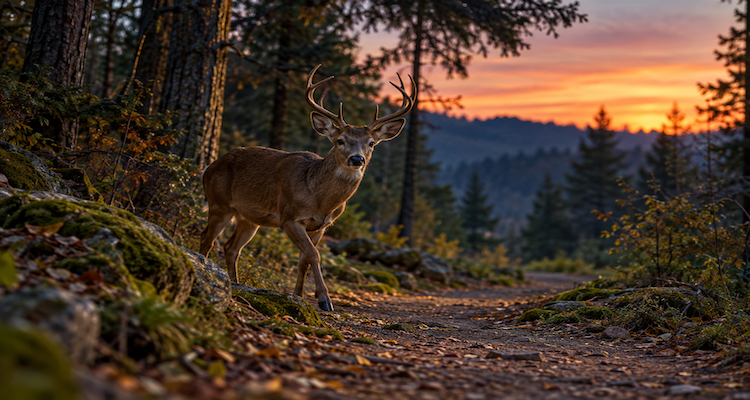
From deer navigating forest trails to predators moving through human-dominated landscapes, wildlife can follow a different daily schedule when human activity fades. Scientists are discovering how deeply our presence influences the lives of animals we rarely see.
Imagine a forest trail shortly after sunset. Throughout the afternoon, hikers have passed through, bicycles have rolled over the dirt, and conversations have echoed between the trees. Now the path is empty.
A deer emerges from the undergrowth. Farther away, a fox moves along the edge of the trail. Animals that remained concealed during the busiest hours may begin exploring spaces they avoided earlier.
It is tempting to imagine that nature has suddenly awakened. But something more complicated may be happening.
For some wild animals, the difference between day and night is not simply about sunlight. It is also about when humans are around.
Researchers have found that human disturbance can influence when animals feed, travel, rest, and interact with their surroundings. In some places, wildlife becomes more active at night to reduce encounters with people. Elsewhere, animals adjust their routes or become accustomed to predictable human activity.
These behavioural changes reveal an often-overlooked dimension of human influence on nature: we can alter the daily lives of animals without ever touching them.
Key Takeaways
-
Wildlife can adjust its daily activity patterns in response to human disturbance, even where people are not directly hunting animals.
-
A major scientific analysis found increased nocturnal activity among mammals exposed to human disturbance.
-
Deer, carnivores, and other mammals may change when or where they move to reduce encounters with people.
-
Reduced human activity does not produce the same response in every species or environment.
-
Camera traps, GPS tracking, and other monitoring technologies reveal wildlife behaviour that ordinary human observation often misses.
-
Understanding these hidden schedules can help conservationists design more effective wildlife protection strategies.
The Daily Schedule That Humans Rarely See
Most people experience wildlife through brief encounters. A bird appears on a balcony. A deer crosses a road. A fox passes through a park.
Those sightings offer only a narrow view of an animal’s life.
Wild animals make repeated decisions about when to search for food, where to rest, how to avoid predators, and which routes provide the safest passage through their habitats.
These decisions are influenced by environmental conditions, including temperature, daylight, food availability, competition, and predation risk.
Human activity adds another factor.
A woodland trail may provide an efficient route between feeding areas, but frequent hikers can make that route less attractive during daylight. An open field may contain abundant food, yet nearby vehicles or people may discourage some animals from entering it.
Rather than abandon the location completely, animals may shift their activity into quieter hours.
This creates a landscape in which humans and wildlife use the same places at different times.
The animals have not necessarily disappeared. Their schedules have changed.
When Human Activity Pushes Wildlife Into the Night
One of the clearest scientific findings about human disturbance concerns nocturnality: the proportion of an animal’s activity that occurs at night.
In a 2018 study published in Science, researchers led by Kaitlyn Gaynor examined 76 studies involving 62 mammal species across six continents.
Their analysis found that mammals were, on average, 1.36 times more nocturnal in response to human disturbance.
This does not mean that every animal became 36% more active at night. The figure describes an average relative change in nocturnality across the studies, with variation between species and circumstances.
Importantly, the researchers examined different forms of human disturbance, including activities that were not directly lethal to wildlife.
The findings suggest that animals may respond to people as a potential source of risk even when humans are simply moving through an environment.
Consider a mammal that normally divides its activity between daylight and darkness. In a disturbed habitat, it may concentrate more movement into nighttime hours.
Such a shift can help reduce encounters with people, but it may also introduce new challenges.
Nighttime temperatures, food availability, competition, and exposure to predators may differ from daytime conditions. A schedule that reduces one risk can increase another.
Avoiding humans is therefore not always equivalent to living under better conditions.
The Animals That Reorganise Their Lives Around People
Deer can adjust movement and habitat use in response to recreation, hunting pressure, and other human activities. In some environments, they make greater use of exposed areas when human disturbance is lower.

Foxes living near settlements can exploit human-altered habitats while adjusting their activity to local conditions. Some become more active during quiet nighttime periods, although urban foxes can also become accustomed to people.

Leopards and other large carnivores may alter movement or activity patterns in human-dominated landscapes. Their responses depend on factors such as prey availability, habitat cover, and local human behaviour.
These examples should not be interpreted as evidence that every individual animal follows the same pattern. Behaviour varies considerably between populations and environments.
What Happens When Humans Suddenly Disappear?
An unusual opportunity to examine this question emerged during the COVID-19 pandemic.
In 2020, restrictions on travel and movement reduced certain forms of human activity across many regions. Scientists began investigating how wildlife responded to these changes.
The period became widely known in research discussions as the anthropause.
It provided an opportunity to investigate how human mobility affects animal movement and behaviour.
A 2023 study published in Science, using GPS tracking data from terrestrial mammals, found that animal movement responses differed depending on the severity of human mobility restrictions and other conditions.
In areas with stricter lockdowns, mammals showed longer movements over some measured periods, suggesting that reduced human activity could make landscapes more permeable to wildlife.
However, the results were not uniform.
Some animals were affected by changes in food sources associated with human activity. Others experienced changes in recreational disturbance, vehicle traffic, or local habitat use.
The pandemic did not demonstrate that all wildlife thrives when humans disappear.
Instead, it revealed how varied and sometimes unexpected the relationships between animals and human activity can be.
The study tracked 2,300 individual mammals representing 43 species, comparing their movements during lockdowns with the same period in 2019.
Under strict lockdown conditions, the researchers recorded a 73% increase in a measure of longer-distance movement over ten days. This was not a 73% increase in the average distance travelled by every animal.
Wildlife did not simply reclaim the world. Some animals changed how they used it.
How Scientists Discover Behaviour That Happens Without Us
Studying wildlife creates an interesting challenge: the presence of an observer can influence the behaviour being observed.
To reduce this problem, researchers use technologies that collect information without requiring a person to stand nearby.
Camera traps capture images or videos when animals pass a sensor. By comparing detections across different hours and locations, researchers can estimate patterns of activity.
GPS collars record animal locations over time, allowing scientists to examine travel distances, habitat use, and movement around roads or settlements.
Acoustic monitoring records sounds in an environment, helping researchers investigate animal vocalisations and changes in soundscapes.
None of these methods is completely free of limitations. Camera-trap detections depend on placement and detection probability, while tracking collars may affect animals and require careful welfare considerations.
Nevertheless, these tools allow scientists to study patterns that would be difficult to detect through occasional sightings.
An animal rarely seen during the day may still be regularly using the same habitat after dark.
Does Changing Routine Help Animals Survive?
Changing activity patterns can provide an immediate advantage by reducing contact with a perceived threat.
But the longer-term consequences are more uncertain.
An animal adapted to feeding in daylight may face different conditions when it shifts into darkness. Visibility, temperature, predator encounters, and interactions with other species can all change.
There may also be consequences for ecosystems.
Predators and prey do not exist independently. Their activity schedules influence when they encounter each other. If one species changes its routine, the effects may extend to other animals sharing the habitat.
Researchers studying wildlife nocturnality have highlighted these potential ecological costs, including consequences for survival, reproduction, and species interactions.
An animal may be avoiding people while simultaneously losing access to its preferred feeding hours.
Why Quiet Spaces Matter More Than We Realise
Wildlife conservation often focuses on protecting physical habitats: forests, wetlands, grasslands, and migration corridors.
Yet protecting a location does not necessarily mean that animals can use it comfortably throughout the day.
A trail running through a protected forest may experience intense recreational activity during certain hours. Roads may become barriers when traffic is heavy but less restrictive when vehicles are scarce.
These patterns suggest that conservation planning can benefit from considering time as well as space.
Depending on the species and location, possible measures include limiting access during sensitive periods, maintaining undisturbed habitat refuges, reducing unnecessary nighttime disturbance, or adjusting recreation schedules.
Such decisions require local evidence. Restricting human activity without understanding the species involved may produce limited benefits or unintended consequences.
The broader principle is that wildlife needs more than land. Animals also need opportunities to use that land in ways compatible with their biological requirements.
Conclusion: The Natural World Has a Schedule We Rarely Witness
Return to the forest trail after sunset.
The hikers are gone. The sound of bicycles has faded. Somewhere beyond the trees, an animal begins moving through an area it avoided earlier.
It may not be responding to the absence of a particular observer. It may simply be responding to lower disturbance, reduced traffic, or a familiar period of relative safety.
That difference is scientifically important.
Animals are not necessarily waiting for humans to stop watching. But research shows that many adjust their behaviour according to the risks and opportunities associated with human activity.
Perhaps one of the most revealing things about wildlife is not what animals do when we see them, but what they must change because we are there.
This content is published for informational or entertainment purposes. Facts, opinions, or references may evolve over time, and readers are encouraged to verify details from reliable sources.