






Why Quiet Places Are Becoming Rare Refuges for Wildlife
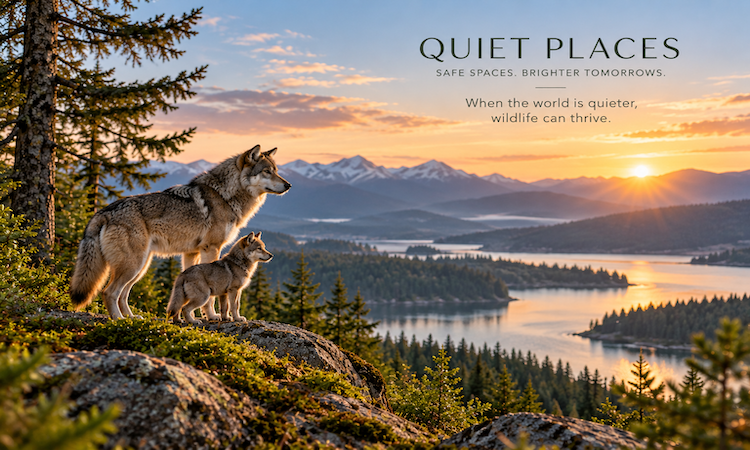
For wildlife, a quiet forest is not simply a peaceful landscape. It is a functioning communication system.
Birds use sound to attract mates and defend territories. Frogs call to reproduce. Bats listen for prey. Mammals detect approaching predators and other animals through sound. When roads, aircraft, machinery, recreation and other human activities introduce persistent noise, animals may have to change when, where or how they feed, communicate and move.
That makes the remaining quiet places increasingly important. They can provide wildlife with something that is becoming harder to find across human-dominated landscapes: periods and pockets where natural sounds remain relatively undisturbed.
The evidence does not mean every noisy environment becomes biologically damaged, nor that wildlife always avoids people. Responses vary considerably between species and circumstances. But research increasingly shows that human disturbance can alter animal behaviour and habitat use, including inside protected areas. The emerging conservation question is therefore not simply how much land remains protected, but how much of that land still provides sufficiently undisturbed conditions for wildlife.
Key Takeaways
- Natural quiet helps wildlife communicate, detect danger, find food and reproduce.
- Human noise can shrink the effective listening space available to animals.
- Even recreational activity that appears low-impact can change wildlife behaviour and habitat use.
- Remote landscapes can function as behavioural refuges for species sensitive to human activity.
- Protecting quiet does not necessarily mean excluding people; visitor management can reduce disturbance.
- Conservation planning increasingly needs to consider sound and human presence alongside habitat and land cover.
Quiet Is Part of Habitat
Habitat is usually described in physical terms: forests, wetlands, grasslands, rivers, mountains and coastlines. But for many animals, habitat also has an acoustic dimension.
The U.S. National Park Service notes that animals depend on sound for activities including finding suitable habitat, communicating, attracting mates, avoiding predators, protecting young and establishing territories.
Noise can interfere with those functions by masking naturally occurring sounds. An animal may still occupy the same physical landscape, but the information it can obtain from that landscape may have changed.
This distinction matters.
A road does not have to physically destroy a forest to influence animals living nearby. Its traffic noise can create an acoustic barrier around the road. Similarly, aircraft can temporarily change the sound environment over otherwise undeveloped areas.
Researchers have described this phenomenon as a form of habitat degradation because the disturbance changes how animals can use their surroundings.
The Invisible Footprint of Human Activity
Human influence on wildlife is often measured through visible infrastructure: buildings, roads, farms, mines and power lines.
Noise is different because its footprint can extend beyond the physical structure producing it.
The National Park Service’s research synthesis documents hundreds of wildlife studies examining responses to human-generated noise. Findings across species include changes in behaviour, communication, stress responses and habitat use, although the magnitude and significance of those effects vary.
One particularly important mechanism is masking. As background noise increases, the distance over which an animal can detect biologically important sounds can decrease.
For a predator, that can mean a smaller listening area for detecting prey. For a prey species, it can make approaching danger harder to detect. For a bird or frog, background noise can interfere with signals used for reproduction.
These are not necessarily permanent effects. Animals can sometimes adjust their behaviour or vocalizations. But adaptation itself can carry costs.
Some birds in noisy environments, for example, have been observed changing their vocal behaviour. Research has also documented responses to human noise among frogs, bats, mammals and marine animals.
The important point is not that every species responds identically. It is that sound can alter ecological relationships even when the underlying landscape appears unchanged.
Protected Areas Are Not Automatically Quiet
National parks, wildlife refuges and other protected areas are often imagined as places where wildlife can escape human pressure.
Protection can provide critical habitat, but legal protection does not automatically eliminate disturbance.
Visitors still hike, cycle, camp and travel through many protected landscapes. Aircraft may pass overhead. Roads can cross or border protected areas. Nearby development can introduce traffic and other persistent sounds.
Recent research makes this tension particularly clear.
A 2024 study of white-tailed deer in a protected area near Montreal found that deer reduced their spatial and temporal overlap with hikers. The animals were more active before the reserve opened to visitors and were detected more frequently farther from hiking trails, even when those locations offered less suitable habitat.
The finding does not mean hiking is inherently incompatible with conservation. Instead, it demonstrates why the location, timing, intensity and predictability of human activity matter.
A protected landscape can therefore contain wildlife refuges within it places or periods when human presence is sufficiently low for animals to use habitat differently.
Recreation Can Change Wildlife Without Leaving a Visible Mark
One of the most interesting developments in wildlife research is the growing attention to recreation.
People often distinguish between obviously disruptive activities and supposedly harmless ones. A hiker walking quietly through a forest, for example, may appear very different from a construction site or a highway.
Ecologically, however, animals respond to human presence rather than to our intentions.
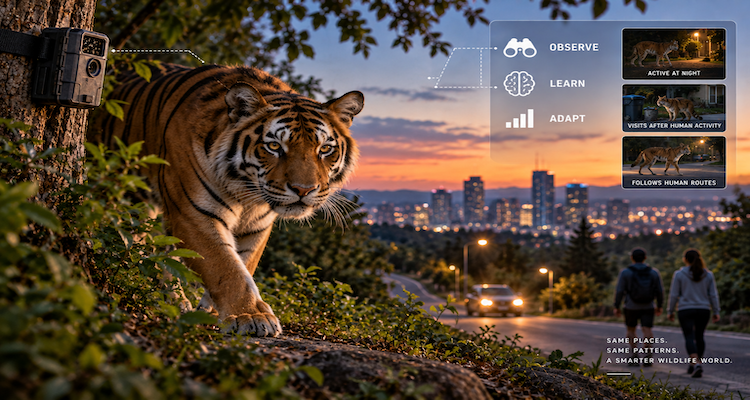
A 2023 study using camera traps during a partial COVID-19 closure of Glacier National Park found changes in the spatial and temporal behaviour of multiple mammal species when recreation was present. The researchers reported fewer detections, reduced site use and lower daytime activity across much of the 24-species assemblage studied.
The findings are significant because hiking is generally considered a relatively low-impact recreational activity compared with motorized development.
That does not make hiking environmentally destructive by definition. It does suggest that the cumulative effect of human presence deserves more careful consideration, particularly in places used by sensitive species.
Visitor management can therefore become a conservation tool. Limiting access to particularly sensitive areas, restricting activity during breeding periods, concentrating trails, controlling group sizes or directing visitors toward less sensitive locations can reduce disturbance while retaining opportunities for people to experience nature.
Remote Places May Be Doing More Work Than We Realize
Large, remote landscapes can act as spatial refuges for wildlife that is less tolerant of human activity.
A recent analysis published in Nature Ecology & Evolution found that mammal responses to increasing human activity differed among trophic groups and landscapes. The researchers highlighted remote landscapes as potential refuges for species that are filtered out as human modification increases, while also noting that these areas are increasingly exposed to recreation, tourism and other pressures.
This creates a conservation paradox.
The places people increasingly want to visit because they remain wild can be the same places wildlife needs precisely because they remain relatively undisturbed.
As nature-based tourism grows, managers face the challenge of preserving the ecological qualities that attract visitors in the first place.
The answer is not necessarily to make wilderness inaccessible. Tourism and protected areas can support conservation when they are carefully managed. The more important question is where human access is appropriate, when it should occur and how much disturbance a particular ecosystem can absorb.
Quiet Is More Than the Absence of Noise
It would be too narrow to treat quiet as simply a decibel measurement.
For wildlife, disturbance can involve human presence, movement, artificial light, vehicles, trails and repeated encounters as well as sound.
A forest can therefore be acoustically quiet but still heavily used by people. Conversely, an area may experience occasional loud events while remaining relatively undisturbed for long periods.
This is why conservation planning increasingly benefits from thinking in terms of disturbance regimes rather than isolated noise events.
Frequency matters. Duration matters. Timing matters. Predictability matters. Species sensitivity matters.
A sudden helicopter flight may produce a very different response from continuous background traffic. A trail used by hundreds of people each day may have a different ecological effect from an occasional hiker. A breeding season may also create a period when disturbance has greater consequences than it would at another time.
There is no universal threshold that determines when a landscape becomes unsuitable for wildlife.
Protecting Quiet Does Not Mean Removing People
Conservation sometimes becomes framed as a choice between people and nature.
The evidence suggests a more practical approach.
Protected areas can accommodate recreation while using visitor-management strategies to maintain ecological conditions. USGS and National Park Service guidance on recreation management emphasizes assessing visitor capacity, understanding wildlife impacts and designing management responses around the conditions an area is intended to maintain.
That can include seasonal closures, designated routes, limits on visitor numbers, education, zoning, restrictions on motorized access and careful monitoring.
Technology can also help.
Acoustic monitoring allows researchers and park managers to measure sound environments over time rather than relying only on occasional observations. Camera traps, GPS-based visitor data and automated sensors can help reveal where wildlife and people overlap and when animals change their behaviour.
The goal is not to make nature silent.
Natural ecosystems are full of sound. Wind, rain, insects, birds, amphibians and mammals form complex soundscapes. Conservation is about preserving those natural acoustic conditions sufficiently for wildlife to continue using sound as part of its ecological life.
Why the Remaining Quiet Places Matter
The significance of quiet becomes clearer when viewed alongside the broader transformation of landscapes.
Human activity has altered large portions of the planet, while protected areas face pressures from development, recreation, tourism and climate change. IUCN emphasizes that protected areas remain central to biodiversity conservation, but their effectiveness depends on how well they are managed and governed.
The European Environment Agency has similarly identified quiet areas as important components of Europe’s environmental soundscape and noted their potential value for both people and wildlife.
That makes quiet a useful conservation indicator.
A landscape that retains darkness, natural sound, low human presence and intact habitat may provide ecological opportunities that are difficult to reproduce elsewhere.
For some species, the value of such a place may not be obvious from a map. There may be no spectacular landmark, no famous animal and no dramatic conservation project.
There may simply be a stretch of forest where a bird can hear another bird.
A wetland where frogs can call without being masked by traffic.
A mountain valley where prey can detect a predator.
A remote coastline where marine animals can communicate without persistent mechanical noise.
Those conditions can be easy for humans to overlook precisely because they appear ordinary.
The Conservation Value of Leaving Some Places Quiet
The growing interest in quiet places points toward a broader shift in conservation thinking.
Protecting wildlife is not only about preserving enough land. It is also about preserving the conditions under which animals can actually use that land.
That means conservation plans may need to consider acoustic environments, visitor patterns and periods of human absence alongside vegetation, water, species populations and physical habitat.
It also means that responsible recreation should involve more than carrying out rubbish or staying on trails. In sensitive places, being a quieter visitor can itself be part of conservation.
For land managers, the lesson is equally practical: sometimes the most valuable intervention is not building something new, but deciding where and when not to add another source of disturbance.
Conclusion
Quiet places are becoming valuable refuges not because wildlife requires silence, but because natural sound and limited human disturbance are part of functioning ecosystems.
Research increasingly shows that human activity can change how animals communicate, forage, move and use habitat—even inside protected landscapes. At the same time, protected areas remain important places for people to experience nature, and tourism and recreation can contribute to conservation when they are managed responsibly.
The challenge is therefore not to create a world without people in nature. It is to recognize that some ecological benefits depend on giving wildlife room and sometimes simply giving it a chance to hear.
In an increasingly connected and busy world, a genuinely quiet landscape may be one of the least conspicuous forms of wildlife protection left.
This content is published for informational or entertainment purposes. Facts, opinions, or references may evolve over time, and readers are encouraged to verify details from reliable sources.