





What the Ganga on Shiva’s Head Really Represents in Hindu Tradition
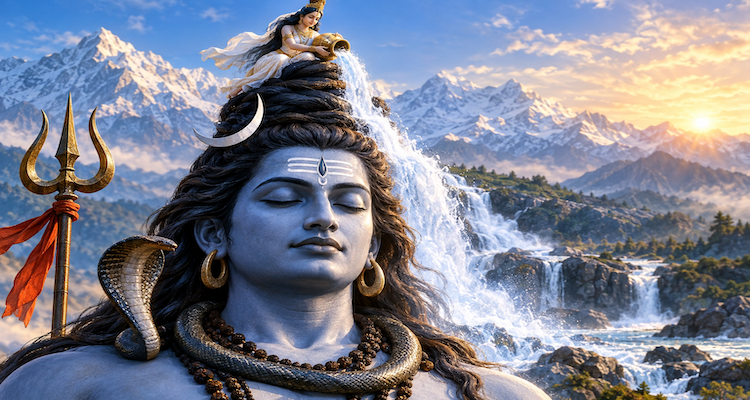
The image of the Ganga flowing from Shiva’s matted hair is one of the most recognizable symbols in Hindu religious art. It is often reduced to a simple story: the celestial river was falling to Earth with such force that Shiva caught it in his hair. But the tradition carries a much richer meaning.
In accounts found in the Ramayana, Mahabharata, and Bhagavata Purana, the descent of Ganga is connected with Bhagiratha’s extraordinary effort to redeem his ancestors. Shiva’s role is not merely that of a powerful deity preventing a disaster. He becomes the mediator through whom a force too immense for the Earth can become life-giving and accessible.
That is why Ganga in Shiva’s hair represents more than a river. It brings together ideas of divine power, restraint, purification, asceticism, compassion, and the relationship between the cosmic and human worlds.
Key Takeaways
- Ganga’s presence in Shiva’s hair symbolizes the controlled descent of an overwhelming divine force into the human world.
- The story links Ganga with Bhagiratha’s perseverance and the redemption of his ancestors.
- Shiva does not destroy Ganga’s power; he receives, contains, and redirects it.
- Ganga is simultaneously understood as a sacred river, a goddess, and a purifier in Hindu tradition.
- The symbol connects Shiva’s ascetic identity with his role as a protector and mediator.
- Hindu texts and artistic traditions preserve multiple layers of meaning rather than a single universally defined interpretation.
The Story Behind Ganga’s Descent
The best-known account begins with King Bhagiratha and his desire to secure the liberation of his ancestors, the sons of King Sagara.
In the Valmiki Ramayana, Bhagiratha undertakes severe austerities to bring Ganga from the celestial realm to Earth. The problem is that the force of her descent would be too great for the Earth to withstand. Brahma therefore directs Bhagiratha toward Shiva, who alone is described as capable of bearing the impact.
The Bhagavata Purana similarly describes Bhagiratha requesting Shiva to sustain the powerful waves of Ganga. Shiva agrees and holds the river upon his head. The same passage describes Ganga as having a sacred connection with Vishnu, whose feet are identified as the source of her purifying waters.
The Mahabharata also preserves the central episode: Ganga is to descend from heaven, Shiva receives her on his head, and Bhagiratha’s purpose is connected with the salvation of his forefathers.
These accounts are important because they show that the familiar image is not simply a later artistic invention. The association between Shiva, Ganga and Bhagiratha appears in multiple major Hindu textual traditions.
Why Does Shiva Catch Ganga in His Hair?
The physical image provides the first clue to its deeper symbolism.
Ganga is extraordinarily powerful. Her descent is not something the Earth can simply absorb. Shiva’s matted hair acts as a form of containment.
This creates a striking religious metaphor: power without restraint can become destructive, while power properly contained can become beneficial.
The story therefore does not portray Shiva as opposing Ganga. He does something subtler. He receives her force and makes her descent possible.
The Metropolitan Museum of Art describes the Gangavatarana tradition in similar terms, noting that Shiva catches the river in his hair to prevent the tremendous descent from destroying the Earth.
Seen this way, Shiva’s hair represents more than an unusual divine attribute. It becomes the medium through which cosmic energy is transformed into something the earthly world can receive.
Ganga and the Power of Shiva’s Asceticism
There is another important layer that can easily be missed.
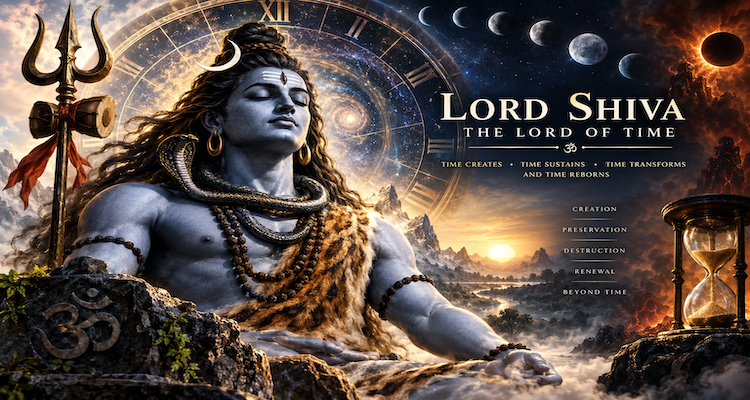
Shiva’s matted hair, or jata, is closely associated with his identity as an ascetic and yogic deity. Museums documenting Hindu iconography consistently identify Shiva through features such as matted locks, the crescent moon and the third eye.
The symbolism becomes especially interesting when Ganga enters those locks.
The river represents movement, fertility, purification and life. Shiva’s asceticism represents stillness, discipline, withdrawal and mastery.
The two images are almost opposites.
Yet Hindu iconography places them together.
That juxtaposition suggests an important principle: spiritual power is not necessarily about eliminating energy or desire; it can also mean learning how to contain and direct enormous forces.
The river moves. Shiva remains still.
Ganga descends. Shiva receives her.
The contrast is part of the meaning.
Bhagiratha’s Role Is Just as Important
It would be easy to remember the story as “Shiva saved the Earth from Ganga.”
But that leaves out Bhagiratha, whose determination drives the entire episode.
The Ramayana presents Bhagiratha undertaking prolonged austerities to accomplish the descent of Ganga. His motivation is not personal wealth or conquest but the redemption of his ancestors.
The Bhagavata Purana likewise describes Bhagiratha bringing Ganga to the place where the bodies of his forefathers lay.
This gives the story a second major theme: human effort working in relationship with divine power.
Bhagiratha cannot accomplish the task by himself.
Ganga possesses the necessary sacred power, but her descent is dangerous.
Shiva possesses the capacity to control that force, but Bhagiratha’s devotion and purpose set the process in motion.
The story therefore brings together three elements:
- Bhagiratha’s perseverance
- Ganga’s purifying power
- Shiva’s capacity to contain and direct that power
The result is not simply a miracle. It is a carefully structured relationship between human aspiration and divine forces.
Why Is Ganga Called a Goddess?
The Ganga is not treated merely as a geographical watercourse in Hindu religious tradition.
She is personified as Goddess Ganga, and the river is understood as sacred.
The Bhagavata Purana calls Ganga capable of delivering or purifying beings, while the Mahabharata repeatedly describes the river in intensely sacred terms and associates her with spiritual merit and liberation.
This explains why representations of Shiva frequently include a tiny female figure or flowing stream emerging from his matted locks.
The National Museum of Asian Art notes that Ganga is often represented in Shiva’s hair and describes her as an emblematic part of Shiva’s iconography, comparable in recognizability to his third eye and crescent moon.
In other words, the river is not merely near Shiva.
Her presence helps identify a particular conception of Shiva himself.
From Myth to Iconography
The story became deeply embedded in Indian artistic traditions.
The Metropolitan Museum of Art documents numerous representations of Shiva with his characteristic matted hair, while its discussion of the Ganga tradition explains that the river may appear as a small figure within Shiva’s locks.
A particularly important form is Shiva Gangadhara, meaning Shiva as the “Bearer of Ganga.”
In this iconography, Ganga can appear as a small figure or stream emerging from Shiva’s hair. The visual composition compresses an entire theological narrative into a single image: celestial water, Shiva’s power, the descent to Earth and the preservation of the world.
The Met’s collection includes a 1945 work explicitly titled Shiva Gangadhara, “Bearer of the Ganga,” illustrating this longstanding visual tradition.
The artistic tradition is therefore not merely decorative. It functions as visual storytelling.
A devotee who sees Ganga in Shiva’s hair can recognize the entire narrative without the story being written out.
The Deeper Symbolism: Power That Must Be Directed
Perhaps the most useful way to understand the image today is through the relationship between force and discipline.
Ganga is enormously powerful, but power alone is not the objective.
If her descent were uncontrolled, the Earth could not withstand it. Shiva’s role is to transform the character of that descent through containment.
This makes the image remarkably sophisticated.
The lesson is not simply “Shiva is powerful.”
It is closer to this:
Great power becomes constructive when it is received, controlled and directed appropriately.
That interpretation also fits Shiva’s broader iconography. His matted locks identify him as an ascetic; the crescent moon is another characteristic symbol; and his third eye represents another dimension of his extraordinary perception.
Ganga adds another dimension: Shiva is not only the solitary yogi but also a figure through whom a cosmic force reaches the world.
Why the Image Still Resonates
The Ganga-on-Shiva image has survived for centuries because it works on several levels simultaneously.
For a devotee, it can represent a sacred episode involving Ganga, Shiva and Bhagiratha.
For someone approaching the story historically, it is part of a long textual and artistic tradition.
For an observer of Hindu philosophy and symbolism, it presents a powerful contrast between movement and stillness, energy and restraint, divine power and human responsibility.
And for Indian art, it is one of the clearest examples of how a complicated theological narrative can be condensed into a recognizable visual symbol.
The story also resists being reduced to a single interpretation. Different Hindu texts and regional traditions emphasize different elements, and the symbolism developed through centuries of religious practice, storytelling and artistic representation. The existence of these variations is not a weakness of the tradition; it is part of how Hindu sacred narratives have been transmitted.
What Ganga on Shiva’s Head Represents
The most important detail in the image is therefore not simply that water is flowing from Shiva’s hair.
It is how that water gets there.
Ganga represents an immense sacred force descending toward the world. Shiva represents the capacity to receive that force without being overwhelmed by it and to make its movement beneficial rather than destructive.
Bhagiratha represents the human effort that seeks to bring the sacred into the earthly world.
Together, the three create a remarkably layered symbol: aspiration, divine power and disciplined transformation.
That is why the Ganga on Shiva’s head has remained far more than an artistic motif. It is a visual expression of a recurring idea in Hindu thought: immense forces require not rejection, but wisdom, discipline and right direction.
Conclusion
The Ganga flowing through Shiva’s matted hair represents the meeting of cosmic power and disciplined consciousness. In the traditions surrounding Bhagiratha’s quest, Shiva does not simply stop the river; he receives its overwhelming force and enables it to reach Earth.
That is what makes the image enduring. Ganga embodies sacred movement and purification, Bhagiratha embodies perseverance and purpose, while Shiva embodies the capacity to contain and direct extraordinary power. The image consequently tells a larger story than the descent of a river: it presents a Hindu vision in which powerful forces become beneficial when guided by restraint and spiritual purpose.
This content is published for informational or entertainment purposes. Facts, opinions, or references may evolve over time, and readers are encouraged to verify details from reliable sources.