






Why Shiva’s Mount Nandi Is More Than a Symbol of Strength
In Hindu imagery, Nandi is often introduced simply as the bull who serves as Shiva’s mount. But that description leaves out much of what makes Nandi significant. In Shaiva traditions, Nandi occupies several roles at once: vehicle, devotee, guardian and a central figure in the visual language of Shiva temples.
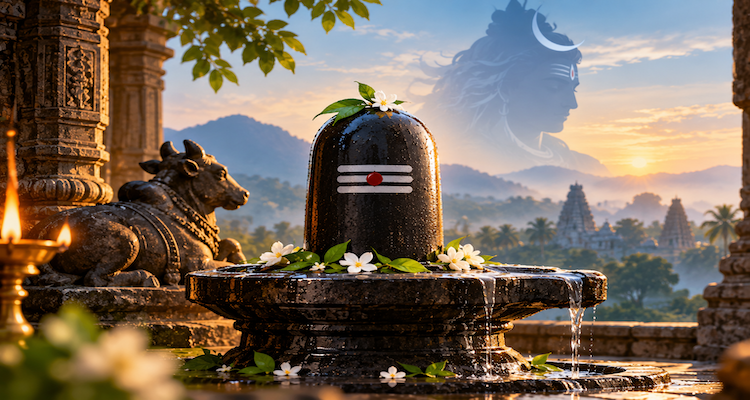
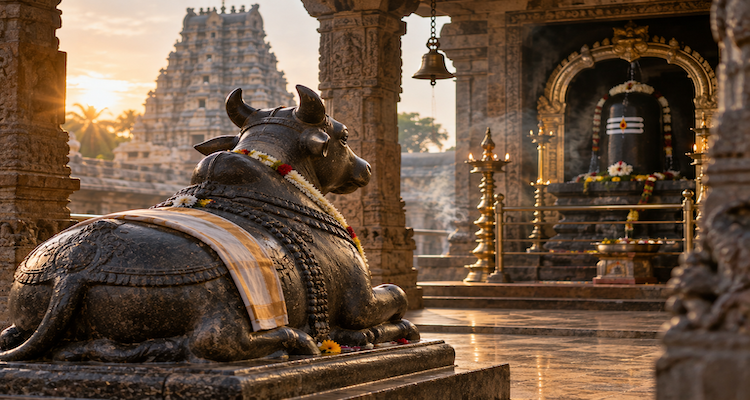
The distinction matters because Nandi is rarely presented as a decorative animal placed beside Shiva. In traditional temple settings, the bull is commonly positioned facing the Shiva linga, creating a visual relationship between devotee, deity and sacred space. The Metropolitan Museum of Art describes Nandi as Shiva’s principal devotee, while museum collections and architectural examples show how consistently the bull appears in association with Shiva worship.
Seen this way, Nandi represents more than physical strength. The figure connects power with devotion, discipline, attentiveness and service qualities that have helped make the image enduring across centuries and across different forms of Hindu art.
Key Takeaways
- Nandi functions in Shaiva traditions as Shiva’s vehicle, devotee and, in some traditions, guardian.
- His position facing the Shiva linga gives the temple image a devotional and architectural purpose.
- The bull’s physical strength is only one part of Nandi’s symbolism.
- Historical artworks show Nandi appearing consistently alongside Shiva and Parvati across South Asian traditions.
- Nandi’s attentive posture can be understood as an image of devotion directed toward the divine.
Nandi Is Shiva’s Vahana and More
The Sanskrit term vahana refers to the vehicle or mount associated with a deity. In Hindu iconography, these vehicles help identify divine figures and communicate aspects of their sacred identity. The Metropolitan Museum of Art notes that Shiva is associated with the bull, while Parvati is associated with the lion and Vishnu with Garuda.
Nandi therefore has an immediate iconographic function: when viewers encounter the bull in the appropriate religious setting, the association points toward Shiva.
Yet describing Nandi only as a vehicle misses an important distinction. Museum documentation also identifies Nandi as Shiva’s principal devotee. In depictions of Shiva and Parvati, Nandi may appear not simply as an animal carrying Shiva but as an attentive presence within the divine household.
That dual identity vehicle and devotee is one reason Nandi occupies such a distinctive place in Shaiva imagery.
The Meaning of the Bull’s Strength
The bull naturally evokes physical power, endurance and stability. Those associations make it easy to interpret Nandi as a straightforward symbol of strength.
But religious symbolism is rarely that simple.
Nandi’s significance emerges from the relationship between strength and restraint. The bull possesses considerable physical power, yet the traditional image is usually one of composure rather than aggression. Nandi is commonly shown seated or kneeling, often facing Shiva with an attentive posture.
This creates a more nuanced symbolic reading: strength does not necessarily have to be expressed through force. It can also appear as steadiness, discipline and controlled energy.
That interpretation should be understood as a reading of the iconography rather than as a single universally prescribed theological meaning. Different Shaiva traditions and communities may emphasize different aspects of Nandi.
Why Nandi Faces the Shiva Linga
One of the most significant features of Nandi’s placement becomes visible inside Shiva temples.
In a traditional Shiva temple arrangement, Nandi is frequently positioned opposite the sanctuary containing the Shiva linga. The British Museum, for example, describes a temple at Tiruchirappalli in which a crouching Nandi stands opposite the Shiva sanctuary.
A historical drawing of a Shiva temple compound in Rajasthan similarly places Nandi before the linga, identifying him as Shiva’s principal devotee.
The arrangement gives the visitor a visual lesson before any written explanation is necessary: Nandi’s attention is directed toward Shiva.
For devotees, this positioning can be understood as an expression of unwavering devotion. Nandi does not turn away from the deity. His gaze establishes a relationship between the worshipper, the sacred image and the divine presence within the temple.
The architecture therefore reinforces the symbolism.
Nandi as the Model Devotee
Perhaps the most meaningful dimension of Nandi is not strength but devotion.
In Shaiva traditions, Nandi is frequently associated with unwavering service to Shiva. The image of the bull facing his lord can therefore be read as a representation of concentrated attention.
This is especially interesting because Shiva himself is commonly portrayed as an ascetic and yogic figure. The pairing creates a visual contrast: Shiva represents the transcendent deity and yogic consciousness, while Nandi embodies the devoted presence oriented toward him.
The Metropolitan Museum has described Nandi in one tradition as a guardian of Shiva’s abode at Mount Kailash. Another museum record identifies him explicitly as Shiva’s principal devotee.
The different descriptions point to a broader pattern. Nandi’s role is not limited to transportation. He belongs to the sacred world surrounding Shiva.
Guardian of Shiva’s Sacred Space
Nandi is also associated with guardianship.
A late-19th-century artwork in the Metropolitan Museum’s collection depicts Nandi in anthropomorphic form as a guardian or door-keeper associated with Shiva’s abode on Mount Kailash. The same artwork also distinguishes this guardian figure from the bull form of Shiva’s mount.
This distinction is important.
“Nandi” can appear in more than one form within the broader tradition. There is the familiar sacred bull, but there are also representations of Nandi as an anthropomorphic attendant or guardian.
That helps explain why Nandi’s presence around Shiva temples can feel architectural as well as devotional. He can mark an approach toward sacred space while simultaneously directing attention toward the deity.
Nandi Across Centuries of Art
The durability of Nandi’s image can be seen in the historical record.
The Metropolitan Museum holds a late-19th-century Kalighat painting showing Shiva seated on Nandi, while another Pahari work from the 19th century depicts Shiva and Parvati with Nandi as Shiva’s vahana.
Earlier works show the same association beyond modern India. The Met’s collection includes a 14th-century sculpture from Java in which Parvati stands upon Shiva’s bull Nandi. The museum also holds a Champa sculpture from Vietnam, dated to the first half of the 10th century or earlier, depicting Shiva seated on Nandi.
These examples demonstrate that the Nandi-Shiva relationship has not been confined to one artistic period or one geographic region. The imagery traveled with Shaiva religious traditions and was interpreted through different artistic cultures.
The details changed. The central association remained recognizable.
Strength Without Aggression
Modern interpretations often reduce symbols to single words: the lion becomes courage, the eagle becomes freedom, and the bull becomes strength.
Nandi invites a more careful reading.
His strength is important, but the traditional visual language places that strength within a framework of devotion and stillness. A powerful animal is shown in a posture of attentiveness. The result is not an image of uncontrolled force but of power placed in service of something higher.
That distinction gives Nandi contemporary relevance without requiring the ancient symbol to be turned into a modern motivational slogan.
The image can be read as a reminder that strength and restraint are not opposites. Physical power without direction can become destructive; disciplined strength can become service.
That is an interpretation rather than a single doctrinal definition, but it helps explain why Nandi remains such a recognizable and meaningful figure.
The Deeper Meaning of Nandi in a Shiva Temple
The next time a visitor encounters a Nandi statue in front of a Shiva shrine, the most useful question may not be, “Why is there a bull here?”
It may be: “What is Nandi looking toward?”
The answer directs attention toward Shiva.
That simple visual relationship is powerful because it turns architectural placement into religious communication. Nandi’s posture demonstrates attention, his association with Shiva demonstrates devotion, his role as vahana establishes identity, and his guardian associations connect him with sacred space.
The bull therefore functions on several levels simultaneously.
This layered symbolism is characteristic of religious art: an image can identify a deity, structure a ritual environment and communicate values without requiring a written explanation.
Why Nandi Still Matters
Nandi has survived not merely because the bull is an impressive symbol of strength, but because the figure carries several meanings at once.
He is Shiva’s vahana. He is a devoted attendant. In some traditions, he is a guardian. In temple architecture, he often creates a direct visual axis toward the Shiva linga. In art, he has appeared in India and across parts of South and Southeast Asia for centuries.
The deeper lesson lies in the combination.
Nandi’s physical strength is visible immediately. His discipline and devotion require a closer look.
That may be why the seated bull continues to command attention long after the first impression has passed. Nandi does not need to charge, roar or display force to communicate power. His stillness is part of the message.
In the sacred visual world of Shiva, strength is not represented only by what can be conquered. It can also be represented by the ability to remain steady, attentive and devoted.
For millions who encounter Nandi in temples and religious art, that combination gives the ancient bull a meaning that reaches well beyond the idea of strength alone.
Conclusion
Nandi’s importance in Shaiva tradition cannot be reduced to the role of Shiva’s mount. Historical artworks and temple arrangements show a figure associated simultaneously with Shiva’s vehicle, devotion and sacred space. His characteristic orientation toward Shiva makes him an enduring visual representation of focused devotion.
The bull’s strength remains part of the symbolism, but it is strength under discipline rather than strength for its own sake. That layered meaning helps explain why Nandi remains one of the most recognizable figures in the visual culture of Shiva.
This content is published for informational or entertainment purposes. Facts, opinions, or references may evolve over time, and readers are encouraged to verify details from reliable sources.