






Wildlife Is Learning Our Routines and Scientists Are Watching
A fox moving through a city after commuters have gone home. A wild animal avoiding a popular trail during busy hours but returning when people disappear. A raven changing its response when visitor numbers fluctuate. These are not isolated curiosities. Across different ecosystems, researchers are finding that human activity can become a predictable part of an animal’s environment.
The important scientific question, however, is more precise than whether animals are simply “learning our routines.” Wildlife does not necessarily understand a human schedule in the way people do. Instead, repeated patterns of traffic, recreation, noise, lighting, food availability and human presence can become environmental signals. Animals may respond by changing when they move, where they travel, and how they use human-dominated landscapes.
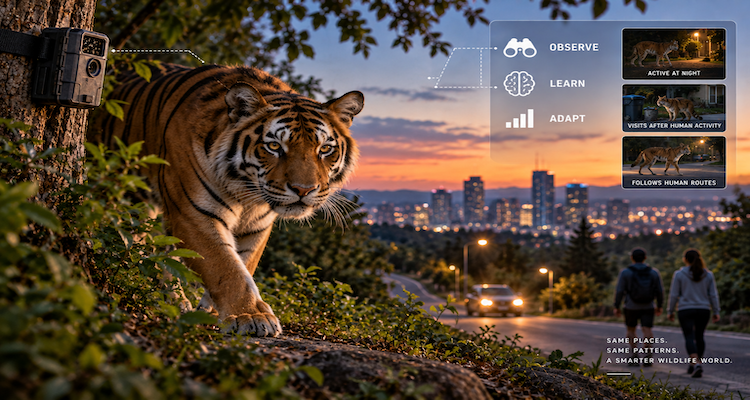
Recent research is giving scientists increasingly detailed ways to observe those changes. Camera traps, GPS tracking, automated image recognition and other monitoring technologies are turning millions of observations into behavioural time series. The result is a new view of human-wildlife coexistence: the struggle is not only over space. Increasingly, it is also over time.
Key Takeaways
- Wildlife can adjust activity times and movement patterns in response to predictable human presence.
- A 2024 global analysis found that many mammals became more nocturnal as human activity increased in developed landscapes.
- New research suggests urban foxes can organize movement around recurring human activity and environmental patterns.
- These behavioural shifts can carry costs, including altered sleep, energy use and interactions between predators and prey.
- Camera traps and AI are allowing scientists to analyse wildlife and human activity at scales that were previously difficult to manage.
- Behavioural adaptation does not mean every species benefits from living alongside people; responses vary substantially between species and habitats.
The Human Schedule Has Become Part of the Landscape
For wildlife living near people, a city or recreation area is not static.
A road becomes crowded at certain hours. A park fills with walkers in the afternoon. A trail may become relatively quiet after sunset. Restaurants and households generate food waste according to recurring patterns. Streetlights change the night environment. Weekend recreation can create a different disturbance pattern from weekdays.
Animals experience these changes as recurring conditions.
A 2021 ecological framework examining wildlife and urban infrastructure described cities as environments in which animals have to respond not only to physical structures but also to the timing of human movement. Commuting and leisure activity can create predictable periods of disturbance and opportunity, influencing when animals move through particular areas.
That does not mean a fox is checking the clock at 5 p.m.
Rather, natural selection, individual experience and behavioural flexibility can favour animals that respond appropriately to repeated environmental signals. An animal that encounters fewer people on a particular route at night may gradually use that route more frequently during those hours.
The distinction matters because behavioural adjustment is not necessarily the same thing as conscious learning.
Scientists can measure the pattern without claiming to know that an animal understands the human routine in human terms.
Wildlife Is Changing the Clock, Not Just the Map
One of the clearest findings in recent research is that animals can respond to human disturbance by changing the timing of their activity.
A 2024 study published in Nature Ecology & Evolution analysed camera-trap information covering 163 mammal species and 102 projects around the world. The researchers found substantial variation among species, but in more developed landscapes, increasing human activity was generally associated with greater nocturnality. Carnivores showed particularly strong responses.
This is an important distinction.
An animal does not necessarily have to abandon a useful habitat because humans are present. It may instead use the same landscape at different times.
That can create a kind of temporal refuge: a period when the animal can move, forage or cross an area while encountering fewer people.
But moving activity into the night is not automatically harmless.
Night-time conditions bring different temperatures, predators, prey, visibility and competition. Artificial light can further alter the ecological environment. The behavioural solution that helps an animal avoid people may therefore create a different set of challenges.
A 2024 Southeast Asian Study Shows Why Species Responses Differ
The pattern becomes more complicated when researchers look at entire wildlife communities rather than one species.
A 2024 Nature Communications study examined 10 tropical forest landscapes in Southeast Asia. Researchers found that human disturbance was associated with shifts in the timing of activity, but the direction and magnitude of those changes differed according to species characteristics.
Some rarer specialist species showed stronger movement toward nocturnal activity, while some medium-sized generalists became relatively more diurnal. Larger hunted species also showed stronger changes in activity timing.
That finding challenges the simple idea that “wildlife becomes nocturnal because of humans.”
There is no universal wildlife response.
Species differ in body size, diet, predators, hunting pressure, habitat requirements and tolerance of human activity. Two animals living in the same forest can therefore experience the same human disturbance very differently.
This matters for conservation because protecting habitat alone may not be enough if animals cannot safely use that habitat during the hours when they need it.
The Fox May Be One of the Best Urban Case Studies
Red foxes provide an especially interesting example because they have become highly successful in many human-dominated landscapes.
New research published in Animal Behaviour in 2026 examined wild red foxes exposed to novel food-related objects. Urban foxes particularly those in London were more likely to touch and explore the objects than rural foxes. Older urban foxes also displayed more exploratory and innovative behaviours. The study associated behavioural responses with long-term urban exposure, although it does not establish that urban foxes consciously understand human routines.
An even newer 2026 preprint provides a more direct connection to the question of routine.
Researchers tracking red foxes, raccoons and wild boar along an urbanisation gradient found that urban foxes aligned their movement behaviour with human activity and showed stronger day-night contrasts and more repeatable space use than rural foxes. Raccoons and wild boar showed different patterns.
Because that study is a preprint rather than a completed peer-reviewed publication, its findings should be treated as emerging evidence rather than settled scientific consensus.
Still, it illustrates where wildlife research is heading: scientists are no longer looking only at whether an animal is present. They are asking how repeatedly and predictably it moves through space and time.
Scientists Are Watching With Cameras, GPS and AI
The ability to study these patterns has changed dramatically.
Camera traps can operate continuously without researchers standing nearby. GPS tags can record animal movements across landscapes. Increasingly, machine-learning systems can process the enormous volumes of images generated by these devices.
A 2025 Scientific Reports study demonstrated a deep-learning approach using 1.3 million images from 91 camera traps covering 24 mammal species. The researchers reported an F1 score of 96.2% for their expert-model classification stage.
But high automated accuracy in one research system does not mean AI can simply replace ecological expertise.
Another 2025 study comparing AI classifiers with citizen-science classification found that errors could vary by species and lighting conditions, with particularly important consequences for rare or nocturnal animals. The authors emphasized the need to account for classification quality and uncertainty when drawing ecological conclusions.
That limitation is important.
If an algorithm misses more animals at night than during the day, researchers could mistakenly conclude that animals are changing their behaviour when part of the apparent change is actually a measurement problem.
Modern wildlife science therefore increasingly involves two questions:
What did the animals do?
And:
How confident are we that our technology measured it correctly?
The Technology Is Beginning to Watch Human Behaviour Too
The most interesting development may be the ability to measure both sides of the interaction.
Researchers can combine animal detections with measurements of people, vehicles and other human activity. A 2025 study in the Belgian Ardenne, for example, analysed more than 700,000 images from 19 cameras and used a convolutional neural network to identify people and other objects. The researchers highlighted the potential for automated monitoring to help understand visitor patterns and manage recreational pressure.
This creates a much richer dataset.
Instead of recording:
Fox detected at 22:14.
Researchers can increasingly ask:
- How many people were present nearby?
- How much vehicle activity occurred?
- Was the trail busy or quiet?
- Was the animal repeatedly using the location at similar times?
- Did the animal change its behaviour when human activity increased?
- Did the pattern persist across seasons?
That shift—from isolated sightings to long-term behavioural datasets—is changing what scientists can infer about human-wildlife interactions.
Sometimes Animals Avoid Us. Sometimes They Exploit Us.
Avoidance is only half the story.
Human environments can also provide food, shelter and other resources.
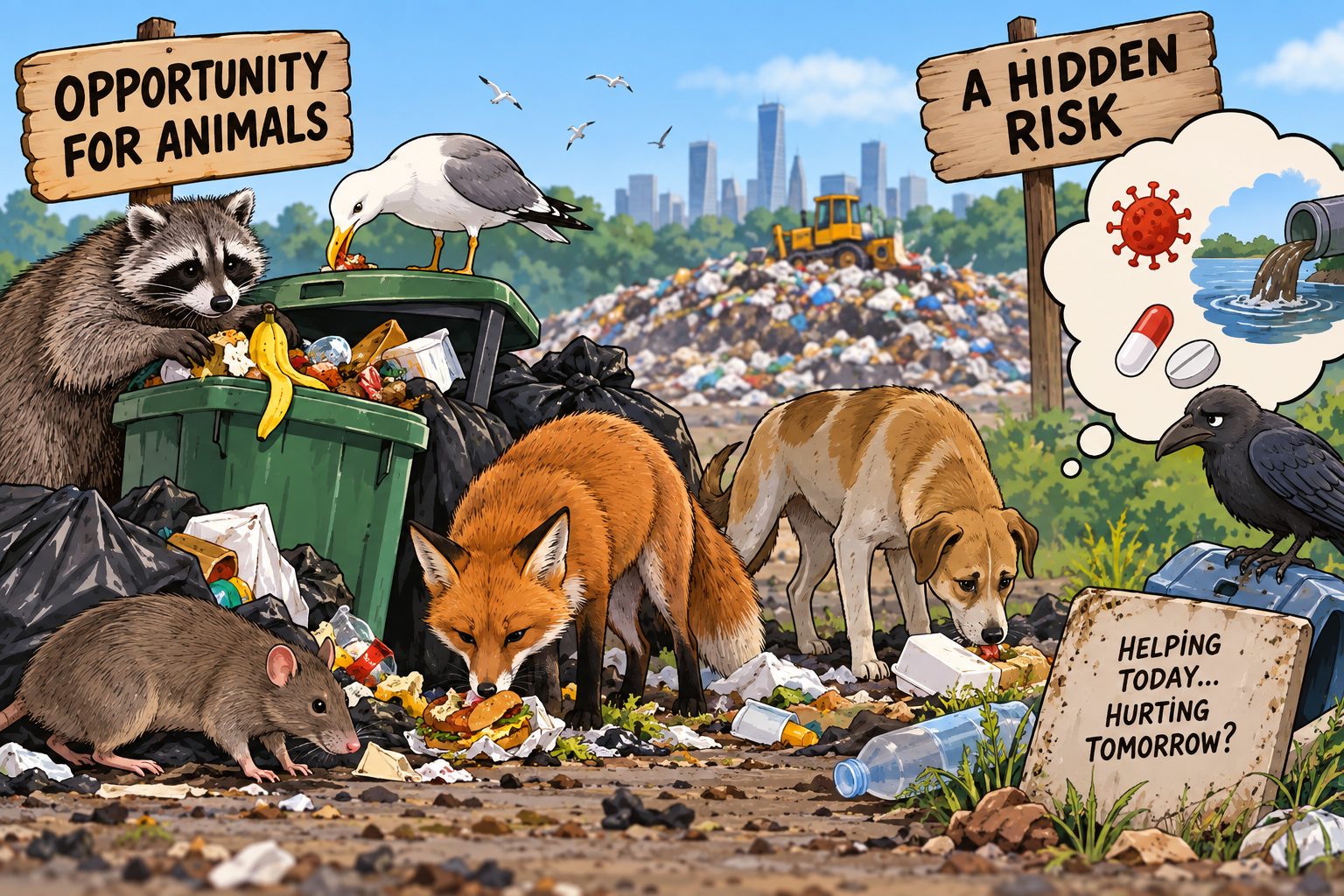
Urban wildlife may exploit discarded food, gardens, buildings, road verges or other features created by human activity. This produces a complicated ecological trade-off: an area can simultaneously be attractive because it contains resources and dangerous because it contains people.
The global mammal study illustrates this complexity. In more developed landscapes, some mammals actually showed increased overall activity as human activity increased, while becoming more nocturnal. The researchers interpreted this as consistent with animals exploiting human-associated resources while shifting their activity to reduce encounters with people.
This helps explain why urban adaptation should not be interpreted simply as animals becoming “comfortable” around humans.
An animal can tolerate or exploit human infrastructure while still treating direct human encounters as a risk.
The Cost of Changing the Daily Routine
Changing activity time may solve one problem while creating another.
Research on suburban wild boar during a period of increased human activity found more fragmented sleep and higher energy expenditure, even though measured movement distance and home-range size did not change.
Other research suggests that disturbance can alter relationships between predators and prey.
A 2026 meta-analysis examined how human disturbance affects temporal niche partitioning the way species separate their activity across the day. Human activity can push species toward different periods or, in some circumstances, increase temporal overlap between predators, prey and competitors.
That is significant because ecosystems are governed partly by timing.
If a predator changes its schedule, its prey may respond. If prey changes its schedule, competitors may encounter it at different times. A change that begins as an attempt to avoid people can therefore propagate through ecological relationships.
The consequences may be difficult to see from a single camera image.
They emerge when thousands of observations are considered together.
The Most Important Lesson: Wildlife Does Not Adapt in One Uniform Way
The phrase “wildlife is learning our routines” is useful as a starting point, but it can also oversimplify the science.
Some animals avoid people.
Some become more nocturnal.
Some exploit human resources.
Some become more flexible.
Some continue avoiding human-dominated areas regardless of whether people are temporarily present.
A 2025 USGS-linked study using GPS data from 229 individual mammals representing 10 species across 14 U.S. national parks found that, averaged across species and parks, animals avoided the human footprint whether parks were open or closed. Yet responses differed substantially among species and landscapes; some species consistently avoided human influence while others showed more context-dependent responses.
That variability is precisely why broad claims about “urban wildlife” can be misleading.
There is no single urban animal strategy.
There are many.
What This Means for Conservation
Understanding wildlife routines could make conservation more precise.
If animals repeatedly avoid a trail during peak visitor hours but use it when people are absent, managers may not always need to prohibit access permanently. In some situations, adjusting the timing of human activity could provide animals with predictable periods of reduced disturbance.
Research on temporal road closures has explored exactly this idea. A study in Scientific Reports examined a seasonal night-time closure of a road in Banff National Park as a way to provide wildlife with a predictable period free from human activity.
This approach is particularly relevant as protected areas balance conservation with recreation.
The objective is not necessarily to remove people from every landscape. It may be to understand when our presence matters most.
That requires better data.
It also requires recognising that a behavioural adjustment is not necessarily evidence that an ecosystem is healthy. An animal surviving in a landscape by shifting entirely into the night may be demonstrating flexibility or absorbing a cost that is difficult to detect.
A New Way of Thinking About Human-Wildlife Coexistence
For decades, maps have been central to conservation: protected areas, migration corridors, nesting sites and habitat boundaries.
The emerging research suggests that another dimension deserves equal attention: time.
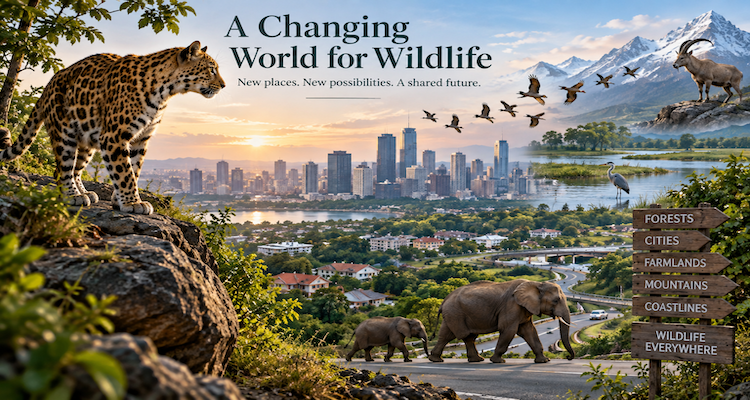
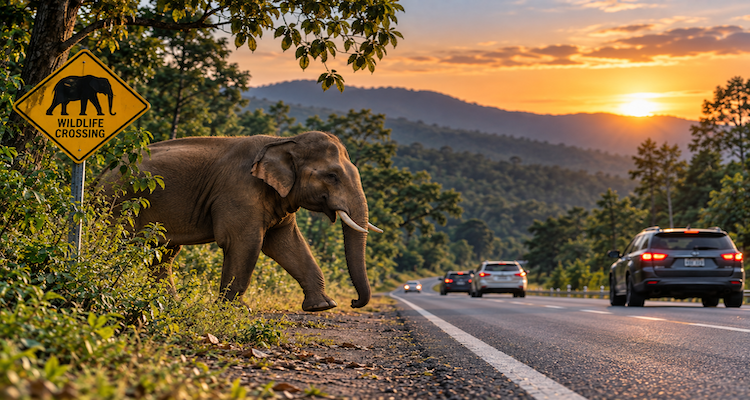
A forest is not the same environment at 8 a.m. and 11 p.m. A city park can be a crowded human space in the afternoon and a wildlife corridor several hours later. A road may represent a barrier at one time and a usable crossing at another.
Wildlife is responding to these changing conditions with remarkable behavioural flexibility, but that flexibility has limits.
The most useful question is therefore not whether animals are “learning” us.
It is whether our increasingly predictable patterns of movement, noise, light, recreation and resource use are becoming part of the ecological rules animals must navigate and what those adaptations cost them.
Scientists now have the tools to watch those rules unfold over days, seasons and years.
The challenge is turning that knowledge into landscapes where wildlife does not merely find a way around us, but has enough safe space—and enough safe time to thrive.
Conclusion
Wild animals do not need to understand human calendars for our routines to influence their lives. Repeated patterns of traffic, recreation, lighting, food availability and human presence can become powerful environmental signals.
Research increasingly shows that animals respond by changing where and when they move. Some shift toward darkness, some alter their routes, some exploit human resources, and others continue to avoid human-dominated areas. The differences between species are as important as the overall pattern.
What scientists are watching, then, is more than a collection of unusual animal behaviours. They are observing a fundamental ecological negotiation over time and space.
As technology makes that negotiation easier to measure, conservation may increasingly depend not only on where wildlife lives, but on whether wildlife still has the right hours in which to live there.
This content is published for informational or entertainment purposes. Facts, opinions, or references may evolve over time, and readers are encouraged to verify details from reliable sources.
Related News
- The Animals That Benefit From Human Waste Until the Advantage Turns Against Them
- Why Wildlife Is Showing Up in Places Scientists Once Considered Unlikely
- The Hidden Wildlife Cost of Roads: What Animals Lose Beyond the Roadkill We See
- Why Animals Are Learning to Live With Cities Instead of Escaping Them