







The Animals That Benefit From Human Waste Until the Advantage Turns Against Them
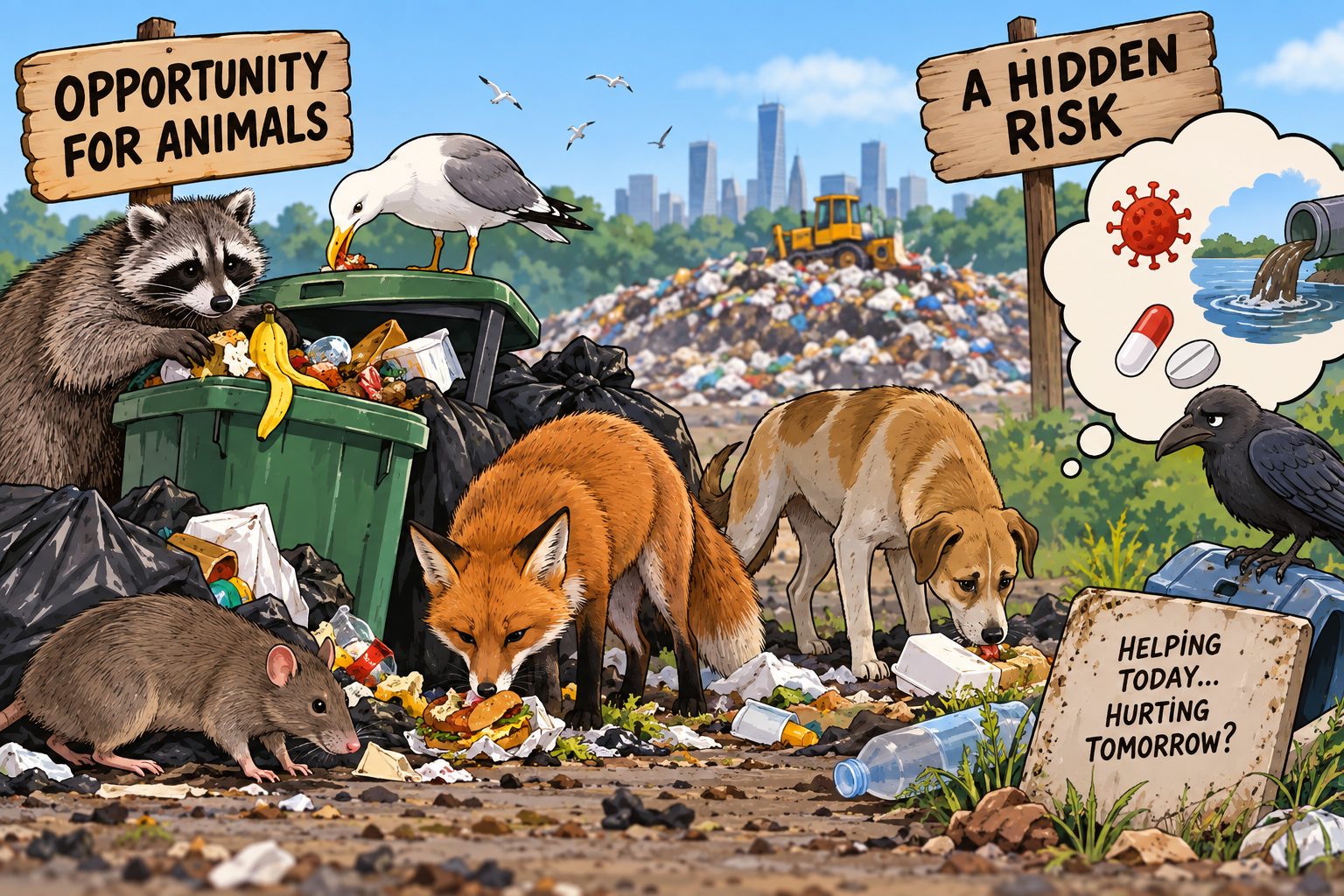
For some wild animals, human waste is an accidental food subsidy. Discarded meals, overflowing bins, landfill sites, crop leftovers and unsecured garbage can provide calories that are easier to obtain than natural food. Gulls gather around landfills, raccoons exploit household waste, baboons raid urban neighborhoods, and bears can learn to associate people with highly rewarding food.
The attraction is understandable from an evolutionary perspective: animals generally seek food that provides energy at an acceptable cost. The problem begins when a convenient food source also changes behavior, movement, health, reproduction or exposure to danger. Research increasingly shows that an apparently beneficial food supply can become an ecological trap—an environment that looks attractive to an animal but ultimately carries substantial costs.
That makes human waste more than a sanitation problem. It is becoming part of the ecology of human-dominated landscapes.
Key Takeaways
- Human food waste can provide predictable, energy-rich resources that alter where some wild animals forage.
- Gulls, raccoons, bears and baboons show different consequences from exploiting human-derived food.
- Easy calories can come with nutritional problems, behavioral changes, disease exposure and greater human conflict.
- Landfill closures can force animals to travel farther or switch habitats rather than simply eliminating their dependence.
- Food conditioning can be particularly dangerous because animals may begin actively seeking people and their belongings.
- Better waste management can therefore protect wildlife while also reducing conflict between animals and communities.
Why Human Waste Is So Attractive to Wildlife
Wild animals do not distinguish between a natural food source and a discarded human meal according to our ideas about what belongs in the environment.
They respond to energy, accessibility and risk.
Human settlements can create unusually concentrated food resources. A restaurant dumpster may contain more calories in a few minutes of foraging than an animal would obtain through a much longer search for natural food. Landfills can provide food at predictable locations, while household garbage can create repeated opportunities close to roads, buildings and parks.
Scientists refer to these resources as anthropogenic food subsidies food supplied indirectly by human activity.
A major review in BioScience describes agricultural crops and food waste as important opportunities for wildlife living in human-modified landscapes, while also documenting behavioral and ecological consequences of exploiting those resources.
The important point is that an animal can benefit at one level while paying a cost at another.
More available food may reduce the time required to forage. But it can also change movement patterns, increase population density in particular locations, expose animals to pollutants or pathogens, and bring them into closer contact with people.
Gulls Turn Landfills Into Artificial Feeding Grounds
Few animals illustrate the relationship more visibly than gulls.
Landfills provide large and relatively predictable quantities of food waste. Research on lesser black-backed gulls using GPS tracking found that when nearby landfills closed, the birds travelled farther and spent more time foraging. They also changed the habitats they selected.
That finding is significant because it demonstrates that landfill food is not merely an occasional snack. For some gull populations, it can influence their daily movement strategy.
But the nutritional benefit comes with another problem: what else is consumed along with the food?
A study of yellow-legged gulls in Portugal found anthropogenic debris in 28.8% of pellets collected from breeding locations and 89.7% of pellets from urban and landfill resting sites. The researchers linked the availability of human-associated food sources with debris ingestion and called for improved waste management.
Another study examining landfill gulls in North America estimated that enormous concentrations of gulls can transport substantial quantities of nitrogen and phosphorus from landfill sites to surrounding ecosystems. That means the effects of waste consumption can extend beyond the animals eating it and influence nutrient movement through the wider environment.
The lesson is subtle: removing waste from human environments does not necessarily make its ecological consequences disappear. Wildlife may simply redistribute its movements in response.
Raccoons Get Easy Calories But Their Physiology Can Change
Raccoons are highly adaptable omnivores and are particularly successful in cities partly because human environments provide abundant food opportunities.
But easy access to food waste is not necessarily physiologically neutral.
A study published in Conservation Physiology compared raccoon populations with different presumed levels of access to anthropogenic food. Raccoons at the site with the highest presumed access were significantly heavier and had higher levels of glycated serum protein, a marker associated with elevated blood glucose. The researchers concluded that urban diets could have physiological consequences related to glucose metabolism, while emphasizing that further research was needed to understand longer-term evolutionary effects.
This distinction matters.
It would be inaccurate to say that eating human garbage automatically makes every raccoon unhealthy. The study did not establish that all urban food waste causes disease.
What it does show is that a diet built partly around human food can be associated with measurable physiological differences.
That is one reason the ecological consequences of food waste cannot be judged simply by asking whether animals appear to have more food.
Baboons Show How Food Can Reshape Behavior
Chacma baboons around Cape Town provide an especially clear example of how valuable human food can alter animal behavior.
Research published in Scientific Reports examined male baboons that raid suburban areas for anthropogenic food. GPS and motion tracking showed that raiding males spent most of their time around the urban edge, making short, highly active incursions into developed areas. Their activity also increased in areas where deterrence by human rangers was more likely.
The attraction is partly explained by food quality.
A comparative study of Cape Peninsula baboons reported observations of individuals appearing overweight, lethargic and having poor teeth, while noting that human foods accessed during raids can be rich in processed carbohydrates and saturated fats. The study was exploratory and comparative rather than proof that human food alone causes these conditions, but it illustrates why access to high-energy food can have consequences beyond simply providing extra calories.
The issue remains current. In September 2026, Reuters reported that Cape Town authorities planned to permanently cage around 60 chacma baboons in Simon’s Town amid continuing conflict between people and baboons. Authorities and critics offered sharply different views of the causes and appropriate response, but both sides of the dispute point to the same underlying challenge: human development and accessible food have brought wildlife and people into repeated contact.
This is where a food subsidy can become a conflict subsidy.
Bears Reveal the Most Dangerous Turning Point
Among wildlife examples, bears demonstrate particularly clearly why human food can become dangerous to the animal providing the food.
A bear that finds natural berries, insects or other forage near a campsite may eventually move away. A bear that discovers that campsites, vehicles or garbage containers contain concentrated calories can learn something different: humans are associated with food.
This process is called food conditioning.
The U.S. National Park Service distinguishes food conditioning from simple habituation. Habituated animals may become less responsive to people without actively seeking rewards from them. Food-conditioned animals, by contrast, learn to seek human-associated food or garbage.
Once that behavior develops, the consequences can be severe.
The National Park Service states that food-conditioned bears can become increasingly bold around people and may ultimately have to be removed when they pose a safety risk.
Yellowstone provides recent examples. In May 2025, park officials killed an 11-year-old male grizzly after repeated attempts to obtain human food and garbage from developed areas. In July 2025, another food-conditioned black bear was lethally removed after incidents involving human food at a backcountry campsite.
The tragedy is that the animal is not necessarily behaving irrationally.
From the bear’s perspective, the reward has been reinforced repeatedly.
From the human perspective, the same behavior becomes unacceptable or dangerous.
When More Food Produces More Risk
The phrase “benefit from human waste” can therefore be misleading if it is interpreted only in terms of calories.
A food subsidy can affect several dimensions of an animal’s life:
- Foraging: animals may spend less time searching for food.
- Movement: animals can concentrate around predictable waste sources.
- Diet: processed or nutritionally imbalanced food can replace natural foods.
- Behavior: repeated rewards can make animals bolder around people.
- Disease exposure: concentrated animal activity around waste can increase opportunities for pathogen transmission.
- Population dynamics: abundant food can alter density, reproduction or competition.
- Human conflict: animals can increasingly enter homes, roads, campsites or agricultural areas.
Research from northern Botswana published in 2026 adds another dimension. Scientists examining wildlife and domestic animals using human waste found non-typhoidal Salmonella in banded mongooses, marabou storks, dogs and hippos in their sampled populations. The study does not establish that human waste caused the infections, but it demonstrates why shared waste environments can matter for pathogen ecology.
The distinction between association and causation is important here. Wildlife disease is complex, and waste exposure is only one potential factor.
The Ecological Trap Hidden Inside a Good Meal
Ecologists use the term ecological trap for situations in which animals are attracted to an environment because its apparent cues suggest high quality, while actual survival or reproductive outcomes may be worse than in alternative habitats.
Human food can create that mismatch.
A place may contain abundant calories but also roads, buildings, people, pollution, disease risks or other hazards.
Research on grizzly bears has described this problem in terms of attractive food and human-associated risks. Bears may select areas offering valuable food while simultaneously increasing their exposure to roads and human conflict.
This explains why simply measuring how much food wildlife obtains can produce an incomplete picture.
The better question is:
Does access to human food improve the animal’s overall prospects, or does it merely make one part of its environment more attractive?
That distinction changes how waste management should be viewed.
Removing the Food Source Is Not Always the End of the Story
One might assume that closing a landfill or securing garbage immediately solves the ecological problem.
Sometimes it does reduce access to human food. But animals may respond by changing their behavior.
The GPS study of lesser black-backed gulls found longer and more distant foraging trips following landfill closures. Depending on the colony, birds shifted toward agricultural areas or increased their use of urban habitats.
This suggests that waste-management changes can produce secondary ecological effects.
The same principle applies more broadly. A sudden reduction in an artificial food source can change where animals travel, which habitats they use and how they interact with other species.
That does not mean communities should leave waste accessible to wildlife. Rather, it means conservation managers should consider the behavioral transition instead of assuming that removing one food source has only one consequence.
What Better Waste Management Actually Accomplishes
The most practical lesson is not that wildlife should be denied food. It is that human communities should avoid creating artificial dependence on human food.
The National Park Service recommends secure food storage, proper garbage disposal and avoiding intentional feeding because preventing food conditioning protects both people and wildlife.
At a broader level, better waste management can reduce:
- concentrated wildlife activity around garbage;
- opportunities for animals to become conditioned to human food;
- ingestion of plastics and other debris;
- unnecessary human-wildlife encounters;
- some pathways for pathogen exposure;
- the likelihood that animals repeatedly return to developed areas.
This is especially important because animals do not control the availability of these resources. Humans create them.
A dumpster, landfill or unsecured food container is effectively an ecological intervention, even if nobody intended it to be one.
The Bigger Lesson: Wildlife Is Adapting to Our Waste
The animals exploiting human waste are not simply “becoming pests.”
They are responding to a landscape that humans have changed.
Gulls have learned where predictable food concentrations occur. Raccoons exploit urban calories. Baboons adjust their movement around suburban food opportunities. Bears can learn that people and their property represent highly rewarding food sources.
Their flexibility can help them survive in environments that would otherwise be difficult to use.
But flexibility has limits.
When an artificial food source changes diet, movement, social behavior or exposure to people, the short-term advantage can carry long-term costs. In the most severe cases, an animal attracted by our waste can become a danger to people and then become the animal that pays the price.
The deeper issue is therefore not whether wildlife “benefits” from human waste. It is what kind of benefit we are creating, for how long, and what ecological cost accompanies it.
Human waste is not merely something that animals find.
In many landscapes, it has become part of the food web.
And when humans change the food web, animals change with it.
Conclusion
Human food waste can function as an unintended subsidy for wildlife, providing abundant and predictable calories in landscapes increasingly shaped by people. Yet studies of gulls, raccoons, baboons and bears show that the apparent advantage can carry consequences ranging from altered movement and physiology to disease exposure and dangerous human-wildlife conflict.
The most useful way to think about the problem is not as wildlife exploiting humans or humans feeding wildlife. It is as a feedback loop.
We create accessible food. Animals learn to exploit it. Their behavior changes. Human-animal encounters increase. Management becomes more difficult.
Breaking that loop begins with something surprisingly simple: making human waste less available as wildlife food.
That does not merely keep animals away from garbage.
It can help keep wild animals wild.
This content is published for informational or entertainment purposes. Facts, opinions, or references may evolve over time, and readers are encouraged to verify details from reliable sources.