






The Hidden Wildlife Cost of Roads: What Animals Lose Beyond the Roadkill We See
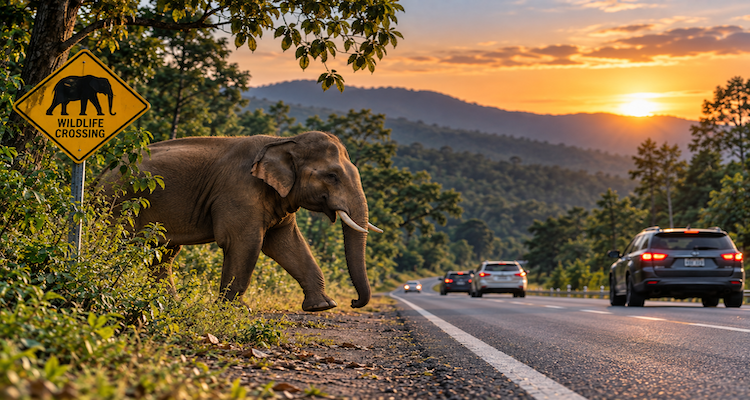
A dead animal beside a highway is the most visible sign of how roads affect wildlife but it is only one part of the story. Roads can divide habitats, alter animal movement, change behavior, disrupt interactions between species and, over time, isolate populations that once exchanged individuals freely.
Research in the field of road ecology increasingly shows that the ecological footprint of a road extends well beyond the pavement itself. Animals may avoid noisy or brightly lit roads, cross them less often, or take greater risks when food, water or breeding sites lie on the other side. For species that do cross, repeated vehicle encounters can create mortality that is difficult to detect accurately.
A 2026 systematic review and meta-analysis covering 160 studies found that road proximity was associated with lower wildlife outcomes on one of the principal effect measures analyzed, while also emphasizing that responses varied substantially among species and locations. The important lesson is that there is no single “road effect.” Different animals experience the same infrastructure in very different ways.
Key Takeaways
- Roads can damage wildlife populations even when relatively few animals are visibly killed on the pavement.
- Habitat fragmentation can prevent animals from reaching food, mates and seasonal habitats safely.
- Road avoidance may reduce mortality but can also isolate populations and restrict gene flow.
- Noise, artificial light and altered roadside habitat can affect animals beyond the physical road corridor.
- Wildlife crossings can restore movement, but their effectiveness depends on species, landscape and design.
- Better road planning increasingly treats ecological connectivity as infrastructure rather than an afterthought.
The Road Is More Than a Strip of Pavement
The ecological footprint of a road begins with construction. Vegetation is removed, soil and drainage patterns can be altered, and continuous habitat can be divided into smaller patches.
But the effects continue after construction.
USGS research describes roads as contributing to habitat loss, reduced habitat quality, fragmentation and mortality from vehicle collisions. Roads can also influence survival and reproduction, including in animals capable of crossing roads relatively easily.
This creates an important distinction: a road does not have to kill an animal to affect its survival.
An animal that stops using part of its traditional range because of traffic may effectively lose access to habitat that still exists physically. Researchers therefore increasingly consider functional connectivity whether animals can actually move through a landscape not simply whether green space remains on a map.
Some Animals Cross Roads. Others Learn Not To.
Wildlife responses to roads are highly variable.
Some species appear willing to cross roads, increasing their exposure to vehicles. Others avoid them, which can reduce collision risk but create another problem: fragmentation.
USGS research on small mammals and reptiles found that road avoidance can isolate populations, while animals that do not avoid roads may face greater mortality from collisions.
The difference matters because movement is not optional for many species.
Animals may need to travel between feeding areas, nesting sites, water sources, seasonal habitats and breeding populations. A road can therefore function as a filter rather than an absolute wall allowing some individuals or species through while restricting others.
That distinction is one reason road impacts can remain difficult to see from a passing car.
The Genetic Cost Can Take Longer to Appear
One of the least visible consequences of roads occurs at the population level.
When roads reduce movement between groups of animals, fewer individuals may cross from one population to another. Over generations, this can reduce gene flow and increase genetic differentiation.
A review of empirical research found that roads often, though not universally, affect genetic diversity and differentiation, particularly where infrastructure restricts movement. The researchers also noted that roads rarely function as completely impermeable barriers; some animals continue to cross them.
This is important because genetic effects may not be obvious when a road is first built.
A population can appear stable while becoming progressively more isolated. In that sense, the ecological cost of a road may emerge slowly, through changes in movement and reproduction, rather than through an immediately visible decline.
The Effects Spread Beyond Wildlife-Vehicle Collisions
Collision mortality receives much of the public attention because it is visible. Road ecology, however, encompasses a much wider collection of effects.
Research has documented changes involving habitat quality, animal movement, population structure and interactions among species. Roads can also introduce noise, artificial light and other environmental changes into areas surrounding the pavement.
A 2024 review of research on interactions between species found that roads have been studied in connection with predation, competition, mutualism and parasitism. The review identified landscape changes, edge effects and road pollutants among the major road-related impacts examined in the literature.
That broadens the question considerably.
The ecological issue is not simply “How many animals are killed by cars?”
It is also:
What happens to an ecosystem when the movement and behavior of many species change around a road?
Even the Roadside Can Change Wildlife Behavior
Roads can create unusual ecological conditions.
Vegetation beside roads may differ from surrounding habitat. Some species may exploit these areas for food or movement, while others avoid them. A review of mammal road use found documented road use by 116 mammal species across six continents, showing that roads can sometimes attract animals rather than simply repel them.
This creates a complicated conservation problem.
A roadside may provide an attractive food source while simultaneously placing animals closer to traffic. In other cases, roadside vegetation can connect otherwise separated areas or facilitate the spread of species that would not otherwise move through the landscape.
The same road feature can therefore produce different ecological consequences depending on the species and surrounding landscape.
Why Wildlife Crossings Matter and Why They Are Not a Simple Fix
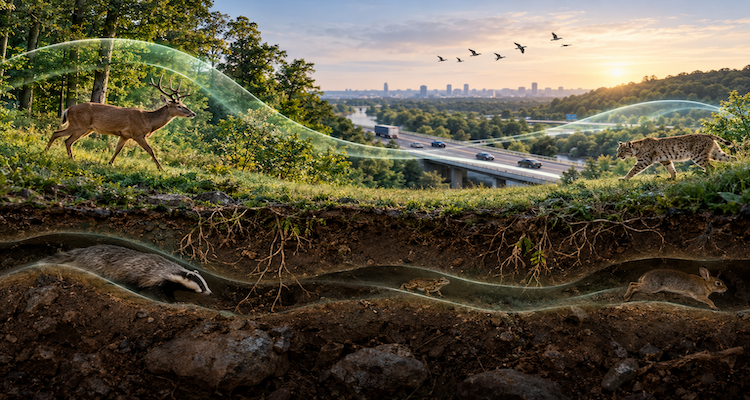
Wildlife bridges, underpasses, fencing and other crossing systems are designed to reconnect habitat and reduce collisions.
The basic concept is straightforward: instead of forcing wildlife across traffic, infrastructure can provide a safer route underneath or above it.
But effectiveness depends on design and context.
A 2024 global assessment examined 313 studies concerning wildlife crossing structures and found that only 14% evaluated whether crossings actually changed animal movement across roads. That finding highlights an important evidence gap: documenting animals using a crossing is not necessarily the same as demonstrating that the structure restored meaningful ecological connectivity.
A 2026 modeling study similarly found that crossing concentrations vary according to landscape characteristics and animal traits, suggesting that mitigation works best when planners identify where and how particular species are most likely to cross.
In other words, building a bridge is not automatically equivalent to solving fragmentation.
The crossing has to connect the right habitats, be accessible to the species concerned and work within the surrounding landscape.
Asia Shows Why the Issue Is Becoming More Important
The problem is particularly relevant in regions experiencing rapid infrastructure expansion.
A 2026 review of road impacts on animals in Asia examined 589 publications covering 36 countries. The researchers reported documented road mortality involving approximately 1,048 species and identified at least 155 species using wildlife crossing structures.
The scale of the review illustrates another challenge: road ecology cannot be treated solely as a North American or European conservation issue.
As transportation networks expand through increasingly fragmented landscapes, decisions about where roads are built—and how they intersect wildlife movement routes can become conservation decisions as well.
The IUCN has likewise emphasized that linear transport infrastructure can disrupt ecological connectivity, fragment habitats and interfere with natural ecological processes, while also producing effects such as pollution, altered hydrology and barriers to wildlife movement.
The New Question for Road Planning
For decades, transportation planning has understandably focused on moving people and goods efficiently and safely.
Road ecology adds another question:
Can the road perform its transportation function without unnecessarily severing the ecological connections around it?
That changes how infrastructure can be evaluated.
Instead of concentrating only on the number of vehicle collisions recorded, planners can consider wildlife movement patterns, habitat connectivity, seasonal migration, species-specific crossing behavior and the location of ecological bottlenecks.
The 2026 meta-analysis of road effects also points to a continuing research problem: traffic and road characteristics are not consistently reported across studies, making it harder to establish broadly transferable relationships between traffic intensity and wildlife impacts.
Better data therefore matters almost as much as better infrastructure.
Camera traps, GPS tracking, genetic analysis and landscape modeling are increasingly capable of revealing movements that humans cannot observe directly. These tools can help identify where animals are avoiding roads, where they repeatedly attempt crossings and where populations may be becoming isolated.
What Drivers and Communities Can Do
Large infrastructure decisions belong to transportation agencies and conservation planners, but ordinary road users also have a role.
Where wildlife-warning signs are present, reducing speed and remaining alert can lower collision risk. Extra caution is particularly important in areas known for animal movement and during periods when wildlife activity increases.
Communities can also contribute through reporting systems and local wildlife monitoring. Reliable observations can help researchers identify collision hotspots and movement corridors that might otherwise receive little attention.
The broader lesson is that wildlife protection does not necessarily mean stopping road development. It means recognizing ecological connectivity as one of the systems that roads intersect.
Conclusion
The most important wildlife cost of a road may be the one nobody sees.
A carcass on asphalt provides immediate evidence of a collision. What remains invisible is the animal that stopped crossing, the breeding population that became more isolated, the habitat patch that became functionally inaccessible, or the ecological relationship disrupted by changing movement patterns.
Modern road ecology therefore asks a more sophisticated question than how many animals die on roads. It asks how transportation networks reshape the ability of wildlife to move, reproduce and remain connected across landscapes.
That perspective does not make roads inherently incompatible with conservation. It makes their design more consequential.
A road can be a route for people while becoming a barrier for wildlife. The challenge is to design transportation systems that recognize both realities.
This content is published for informational or entertainment purposes. Facts, opinions, or references may evolve over time, and readers are encouraged to verify details from reliable sources.
Continue Exploring
- How Renewable Energy Projects Are Becoming Unexpected Allies for Wildlife Recovery
- Nocturnal Nations: Animals That Rule the Night
- The Letter That Arrived 48 Years Late and Explained a Mystery Tizi Hodson Never Solved
- What the Shiva Lingam Has Meant Across Centuries and Why Its Meaning Is Often Simplified