





Why Some Wild Animals Are Becoming Night Creatures
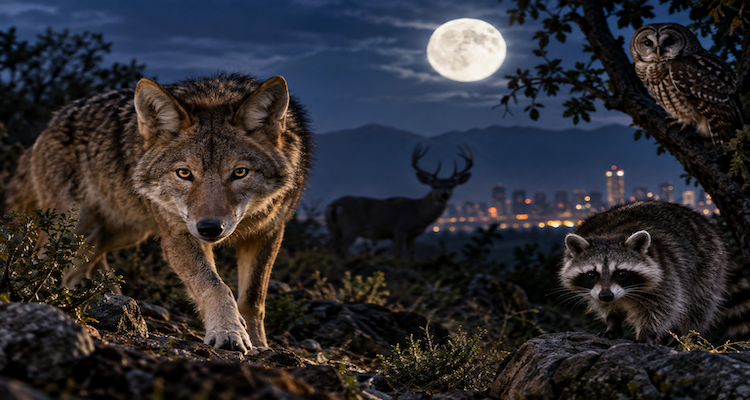
For many wild animals, darkness is no longer simply part of a natural daily rhythm. In landscapes heavily shaped by people, some species are changing when they move, feed and search for resources. Animals that once spent substantial time active during daylight can shift activity toward dusk, dawn or nighttime when human encounters become costly.
This does not mean wildlife everywhere is “turning nocturnal.” The response varies considerably by species, habitat, diet and the type of human disturbance involved. But research using camera-trap data increasingly shows that the timing of animal activity can change as human pressure increases. A 2024 global analysis covering 163 mammal species found that greater human activity was associated with increased nocturnality in more developed landscapes, with particularly strong responses among carnivores and hunted species.
That shift matters because time is an ecological resource. When animals move their activity into different hours, they may avoid people but they can also change their relationships with predators, prey, competitors and food sources.
Key Takeaways
- Human activity can push some wildlife toward nighttime or twilight activity as a way of reducing encounters with people.
- The shift is not universal; species respond differently according to habitat, diet, body size and human pressure.
- Camera-trap research shows that landscape modification is strongly associated with increased nocturnality in many mammal populations.
- Artificial light creates a second problem by changing natural night conditions and disrupting biological rhythms.
- Becoming more nocturnal can provide animals with a temporal refuge, but it may also alter feeding, sleep, reproduction and species interactions.
- Protecting periods of natural darkness can therefore be part of wildlife conservation, not merely a lighting preference.
The Night Can Become a Refuge From People
Wild animals do not experience human presence only as physical development. Roads, vehicles, recreation, hunting, agriculture, logging, construction and other activities create predictable periods when people are more active.
For an animal that can safely move after people have gone home, changing its schedule may provide a way to continue using a landscape without directly confronting humans.
This is known as temporal avoidance: instead of abandoning an area completely, an animal changes the time at which it uses it.
The evidence is particularly clear in mammal research. A 2024 study in Nature Ecology & Evolution examined 499 populations representing 163 species across 102 camera-trap projects. The researchers found substantial variation among species, but in more developed landscapes animals generally became more nocturnal as human activity increased. Large carnivores and hunted species showed especially notable changes in nighttime activity.
The important point is that a camera detecting an animal at night does not necessarily mean the species has become naturally nocturnal. It may instead indicate that the animal is adjusting its schedule to a human-dominated environment.
Why Twilight Can Be Just as Important as Night
The choice is not always simply “day versus night.”
Some species shift toward crepuscular activity, concentrating movement around dawn and dusk. This can reduce exposure to people while preserving some advantages of daylight.
Research from 10 tropical forest landscapes in Southeast Asia found that disturbed forests showed community-level shifts toward dawn and dusk activity. The study also found that different groups responded differently: rarer specialist species tended to become more nocturnal, while some medium-sized generalists became more diurnal.
That finding is important because it challenges the idea that human disturbance produces one universal wildlife response.
A forest can therefore contain several behavioral strategies at once:
- Some animals avoid daylight almost entirely.
- Others concentrate activity around twilight.
- Some generalist species may remain active during the day.
- Some species may reduce their overall activity rather than simply changing its timing.
The result is a reshuffling of the daily schedule of an entire animal community.
Humans Change the Clock, Not Just the Landscape
Wildlife conservation has traditionally focused heavily on where animals live: forests, wetlands, grasslands, protected areas and migration corridors.
But research increasingly demonstrates that when animals can safely use those places also matters.
An animal may still have access to suitable habitat on a map while losing safe access during the hours when it historically fed or travelled.
The 2024 Southeast Asian study described this as a change in the temporal dimension of wildlife communities. Human disturbance including forest edges, logging, hunting, human presence and artificial lighting can alter diel activity patterns.
This creates an overlooked conservation question:
Is an animal’s habitat still functionally available if humans occupy it during the animal’s safest or most productive hours?
That distinction could matter particularly for hunted species and large carnivores, which may face higher consequences from encountering people.
Artificial Light Creates a Different Kind of Night
Human disturbance does not stop when people leave.
Streetlights, buildings, commercial lighting, vehicles and illuminated infrastructure can transform darkness itself.
Artificial light at night can affect animals that are naturally active after sunset as well as species that are shifting their activity into nighttime hours.
A major meta-analysis published in Nature Ecology & Evolution found broad biological effects of artificial light at night, including changes in physiological measures, daily activity patterns and life-history traits. The researchers emphasized that the timing, intensity and spectrum of outdoor lighting can influence its ecological effects.
This produces a potentially important contradiction.
An animal may move into nighttime hours to escape people, yet nighttime lighting can make that refuge less suitable.
In other words, the night can be a refuge from human presence without being a refuge from human influence.
Light Can Also Disturb Animals That Never Become Nocturnal
Artificial lighting is not simply an issue for animals changing their schedules.
Experiments on free-living great tits found that artificial nighttime lighting caused birds to wake earlier and reduced their total sleep time by more than 5 percent in the experimental conditions.
More recent research has also shown that artificial nighttime light can affect biological rhythms at multiple levels. A 2022 study of great tits found that behavioral changes associated with nighttime light were accompanied by changes in clock-gene expression, while other physiological systems did not shift consistently. The researchers described this as evidence of deeper circadian disruption.
That distinction matters. Wildlife may appear to have adapted behaviorally while still experiencing physiological costs that are less visible.
A change in activity time, therefore, should not automatically be interpreted as successful adaptation.
Becoming Nocturnal Can Change the Food Web
Changing the clock can also change who meets whom.
Predators often time their activity around prey availability. Competitors can separate themselves by feeding at different times. Herbivores may coordinate movement with vegetation and temperature. Many ecological relationships therefore depend not only on location but also on timing.
The Southeast Asian research found that human disturbance changed activity patterns across species and feeding groups, although it did not find a corresponding overall change in predator-prey or competitor temporal overlap in its analysis.
That qualification is important.
It would be misleading to say that animals becoming nocturnal automatically destabilizes food webs. The evidence is more complicated. Some relationships may change, while others can remain relatively stable because species shift together or because species composition itself changes.
The broader lesson is that behavioral adaptation can reshape ecosystems in ways that are difficult to see from population counts alone.
Not Every Animal Can Make the Same Adjustment
The ability to change activity hours is constrained by biology.
A species may depend on daylight for visual foraging. Another may rely on nighttime temperatures. A predator may follow prey availability rather than human schedules. A species with limited habitat may have nowhere else to go.
This helps explain why responses to human activity can differ dramatically even between species living in the same landscape.
The global 2024 mammal study found changes in nocturnality ranging from large increases to large decreases across populations. It also found that the response depended on landscape modification and trophic group.
That variability is one of the most important findings in the research.
There is no universal wildlife strategy called “become nocturnal.”
Instead, animals appear to be making different behavioral trade-offs under different environmental pressures.
What This Means for Conservation
The findings suggest that wildlife management needs to consider time as well as space.
Protected areas, wildlife corridors and habitat restoration remain important, but conservation planning can also ask:
- When are people using a particular landscape?
- When are animals most active?
- Are roads and recreation disrupting critical movement periods?
- Does artificial lighting penetrate otherwise suitable habitat?
- Are hunted species increasingly confined to nighttime activity?
- Are animals maintaining normal behavior or simply tolerating a more stressful schedule?
Reducing unnecessary nighttime disturbance may sometimes provide wildlife with a temporal refuge without requiring additional land.
That does not mean every dark period should be completely free of human activity. People need lighting, transportation and access to landscapes. The evidence instead supports a more targeted approach: where lighting or nighttime disturbance is not necessary, reducing its intensity, duration or ecological footprint can benefit wildlife.
The Bigger Picture: Wildlife Is Adapting to a Human Clock
The most revealing part of the nocturnal shift is not that some animals are active after dark.
Many species have always been nocturnal.
The important change is that human activity can alter the timing of wildlife behavior, sometimes pushing animals toward hours that reduce direct encounters with people. Research across large datasets shows that this response is real but highly variable, rather than a simple global transformation of wildlife into nighttime creatures.
That makes the phenomenon a useful reminder of how deeply humans influence ecosystems.
A landscape can look unchanged while its biological timetable has shifted.
The forest may still be standing. The animals may still be present. The camera traps may still record them.
But the hours in which they feel safe enough to live their lives may be moving.
Conclusion
Some wild animals are becoming more nocturnal because changing their daily schedule can reduce encounters with people and allow them to continue using increasingly human-dominated landscapes. The evidence, however, does not support treating nocturnality as a universal or necessarily beneficial adaptation.
For some species, nighttime provides a temporal refuge. For others, shifting activity can bring new costs, including altered feeding opportunities, disrupted biological rhythms or changing interactions with other species. Artificial light adds another layer by transforming the darkness that many animals depend on.
The deeper conservation lesson is straightforward: protecting wildlife means protecting not only where animals live, but also when they can safely live there.
This content is published for informational or entertainment purposes. Facts, opinions, or references may evolve over time, and readers are encouraged to verify details from reliable sources.