








The Rain That Falls Twice: How Forests Help Create Their Own Weather
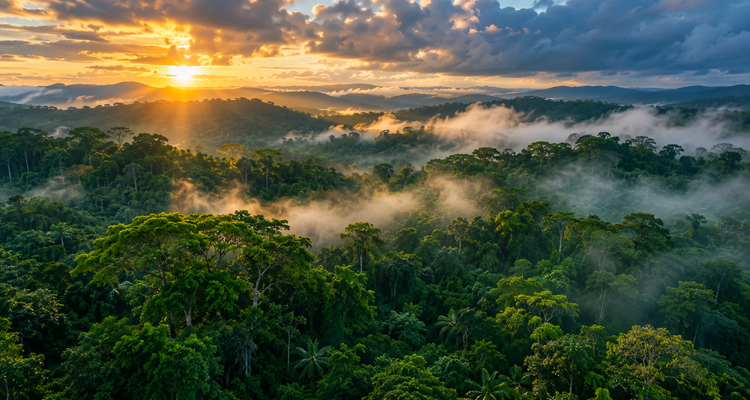
Rain does not always finish its journey when it reaches the ground. In the world’s great forests, trees return enormous amounts of water to the atmosphere, helping sustain the clouds and rainfall on which entire ecosystems depend.
But a surprising amount of that water will soon begin another journey upward.
Deep beneath the canopy, tree roots absorb moisture from the ground. The water travels through trunks and branches before escaping through tiny openings in leaves as invisible vapor. That vapor joins the atmosphere, where it can eventually contribute to new clouds and rainfall.
In this way, forests do more than receive rain. They help sustain the atmospheric conditions that bring it back.
Scientists call this process moisture recycling, and it is particularly important in vast tropical forests such as the Amazon and Congo Basin.
Understanding it changes how we think about forests. They are not simply landscapes shaped by climate. They are active participants in the processes that shape climate itself.
A forest is more than a collection of trees
Most people learn the water cycle as a simple sequence: sunlight evaporates water, vapor forms clouds, rain falls, and water returns to rivers and oceans.
That explanation is correct, but incomplete.
On land, vegetation plays an important role in transferring water back into the atmosphere. Trees act as biological pathways connecting underground water supplies with the air above them.
This movement involves two closely related processes.
Transpiration occurs when plants absorb water through their roots and release water vapor through microscopic pores, called stomata, in their leaves.
Evaporation occurs when liquid water changes into vapor from surfaces such as soil, wet leaves, and other vegetation.
Together, these processes are called evapotranspiration.
In a tropical rainforest, where vegetation is abundant and water moves continuously through plants and soil, evapotranspiration can be a major source of atmospheric moisture.
The process also helps cool the landscape. Converting liquid water into vapor requires energy, so evapotranspiration redirects some of the Sun’s energy away from heating the surface.
This is one reason a forest can influence both the moisture and temperature of the air above it.
NASA’s research on the Amazon describes how water released through leaves contributes to atmospheric moisture and cloud formation, helping maintain the forest’s water cycle.
How rain can fall twice
Imagine a parcel of moist air moving inland from the Atlantic Ocean toward the Amazon rainforest.
As the air rises and cools, some of its water vapor condenses into cloud droplets. Eventually, rain falls over the forest.
The story does not end there.
Some of the rainwater enters the soil, where trees can absorb it. As those trees transpire, part of the water returns to the atmosphere. Winds then carry the moisture onward, where it may contribute to another rainfall event.
The same water molecule can participate in this cycle repeatedly, although any particular molecule may also leave the region through rivers or atmospheric transport.
The journey of recycled rainforest moisture
Conceptual illustration of atmospheric moisture recycling. The returning rain may fall elsewhere, and not all evaporated water becomes local rainfall.
This repeated movement is why the phrase rain that falls twice captures something important about forest ecosystems.
It does not mean every raindrop falls exactly twice. Rather, rainfall can contain water that has already fallen, been taken up by vegetation, and returned to the atmosphere.
In large forested regions, that repeated exchange becomes an important part of the regional water cycle.
How much of a rainforest’s rain comes from the forest itself?
Scientists estimate moisture recycling using atmospheric observations, climate models, and methods that trace where water vapor originates and where it eventually falls.
The results show that forest-generated moisture makes a substantial contribution to tropical rainfall, but there is no single percentage that applies everywhere.
A 2026 study published in Water Resources Research examined moisture recycling in the Amazon and Congo rainforests using data from 1980 to 2023.
It estimated that moisture evaporated from within the respective rainforest regions supplied approximately:
Amazon rainforest
21.3%
of average annual rainfall from within-region recycled moisture
Congo rainforest
23.7%
of average annual rainfall from within-region recycled moisture
These estimates describe moisture recycled within the defined rainforest regions. They are not percentages of rainfall produced exclusively by individual trees, nor do they include all moisture originating from other land areas.
Other studies have examined the wider Amazon basin and produced different estimates because they use different geographic boundaries and methods.
For example, the Science Panel for the Amazon’s 2021 assessment estimated that, averaged across the region, approximately 28% of Amazon rainfall had previously fallen within the basin, with higher recycling rates toward the western Amazon.
The invisible connection between forests and distant rain
A forest’s influence does not stop at the edge of its canopy.
Once water vapor enters the atmosphere, winds can transport it hundreds or thousands of kilometers. The moisture released by one forest may eventually contribute to rainfall over another forest, agricultural land, or a distant watershed.
Researchers sometimes describe these connections as atmospheric moisture pathways.
The term flying rivers is also used, especially when discussing large flows of atmospheric moisture across South America. It is a metaphor, not a literal river suspended in the sky.
These pathways help explain why forests can affect rainfall far beyond the places where their trees grow.
A landmark study published in Nature in 2012 examined satellite observations and atmospheric transport patterns across the tropics.
The researchers found that over more than 60% of tropical land areas studied, air that had traveled over extensive vegetation in preceding days was associated with at least twice as much rainfall as air that had passed over relatively little vegetation.
The result showed a strong connection between vegetation exposure and subsequent rainfall. It did not mean that every forest doubles rainfall or that vegetation alone determines how much rain falls.
Nevertheless, the study demonstrated why the history of an air mass matters: where air has traveled can influence how much moisture it carries.
Trees help shape the atmosphere, not just supply water
Water vapor is only part of the relationship between forests and weather.
Forests also change how the land absorbs sunlight, transfers heat, and interacts with moving air.
A dense canopy has a different surface structure from open farmland or bare ground. Trees create aerodynamic roughness, affecting turbulence and the exchange of heat and moisture between the surface and atmosphere.
Their shade and evapotranspiration influence near-surface temperatures. Their roots can access stored soil moisture, allowing some forests to continue transpiring when shallow soil layers become dry.
These characteristics interact.
When trees release water vapor, they influence atmospheric humidity. When they change surface heating, they can affect rising air and local circulation. When they alter turbulence, they influence how heat and moisture mix upward.
None of these processes guarantees rainfall.
Clouds require suitable atmospheric conditions, and moisture may be transported away before it condenses. In some circumstances, land-cover changes can even increase local rainfall temporarily by altering heating and circulation.
This complexity is essential to understanding what happens when forests disappear.
What happens to rainfall when forests are cut down?
A cleared landscape often has less capacity to draw water from deeper soil and release it through leaves. The resulting reduction in evapotranspiration can decrease the moisture supplied to the atmosphere.
But the rainfall response is not always immediate or uniform.
A 2023 study published in Nature, titled Tropical deforestation causes large reductions in observed precipitation, examined tropical forest loss and rainfall across multiple spatial scales.
It found that deforestation was associated with substantial rainfall reductions, especially over larger affected areas, supporting the importance of moisture recycling in regional precipitation.
A 2025 study in Nature investigated how Amazon deforestation affects precipitation across wet and dry seasons.
The researchers found that during the wet season, cleared areas could experience increased local rainfall because changes in surface heating altered atmospheric circulation.
Yet surrounding regions experienced reductions, and during the dry season rainfall declined across cleared areas and the surrounding distances examined.
At the continental scale, the modeled effects of deforestation reduced precipitation in both seasons.
A temporary increase in rain directly above a cleared patch does not mean deforestation benefits the wider water cycle.
The location, season, scale, and atmospheric conditions all influence the outcome.
Why the dry season is especially important
Tropical rainforests do not experience identical rainfall throughout the year.
Many have wetter and drier seasons, and the ability of trees to continue supplying moisture during relatively dry periods can help sustain atmospheric humidity.
Deep-rooted vegetation may access water unavailable to shallower-rooted plants, although the extent of this ability varies with species, soils, groundwater, and drought severity.
During dry periods, recycled moisture can become particularly valuable because less rain is arriving from other sources.
The 2026 Water Resources Research analysis found that the proportion of rainfall supplied by moisture recycled within rainforest regions increased during the main dry seasons studied in both the Amazon and Congo.
The increase was modest in the Amazon, from an annual average near 21% to approximately 22% during its analyzed dry-season months, and larger in the Congo, from approximately 24% to 27% during its analyzed main dry season.
If forest loss reduces the moisture entering the atmosphere, it can weaken a system that helps vegetation endure dry periods.
That creates the possibility of a reinforcing cycle: forest loss contributes to drying, and increased drying makes remaining forests more vulnerable to fire, tree mortality, and further degradation.
Scientists continue to investigate how strong these feedbacks may become and how they interact with global climate change.
Can a forest lose its ability to sustain its own rainfall?
This question is especially important for the Amazon.
A healthy rainforest maintains a complex relationship among trees, soil moisture, rainfall, and atmospheric circulation. Disturbances to one part of that relationship can influence the others.
Researchers have therefore examined whether extensive forest loss and warming could push some Amazon ecosystems toward a substantially drier condition.
A 2026 Nature study, Deforestation-induced drying lowers Amazon climate threshold, investigated how forest loss and declining moisture recycling may affect the climate conditions needed to sustain the rainforest.
Its findings reinforce concerns that deforestation-driven drying can reduce the resilience of forest ecosystems.
However, there is no single, universally established deforestation percentage at which the entire Amazon would suddenly stop functioning as rainforest.
The risk varies geographically and depends on rainfall patterns, temperature, forest degradation, fire, land-use change, and greenhouse-gas-driven warming.
A useful way to understand the concern is that a forest does not need to disappear completely before its influence on regional rainfall begins to weaken.
Some of the atmospheric changes can begin while substantial forest remains.
Why protecting forests also means protecting water
Forests are frequently discussed as carbon stores and wildlife habitats. Both roles are fundamental, but their contribution to the water cycle deserves equal attention.
Forest conservation can help preserve the movement of moisture between soil, vegetation, and atmosphere.
That matters for several connected reasons.
-
Ecosystem resilience: Moisture recycling helps maintain the humid conditions on which many forest species depend.
-
Agriculture and water supplies: Rainfall influenced by forested landscapes can support regions beyond the forests themselves.
-
Temperature regulation: Evapotranspiration helps limit surface heating by transferring energy into the atmosphere as latent heat.
-
Drought vulnerability: Preserving vegetation and soil-water processes can help maintain regional moisture exchange during dry periods.
These benefits are not interchangeable with simply planting any tree anywhere.
A mature tropical rainforest has a complex structure, deep-rooted vegetation, diverse species, and long-established interactions with soils and atmospheric conditions.
Restoring degraded landscapes can provide valuable benefits, but the effects depend on which species are planted, local water availability, ecosystem type, and the scale of restoration.
Planting trees in naturally open ecosystems can have different consequences from restoring a degraded native forest.
The goal should therefore be to protect and restore ecologically appropriate vegetation, not to assume that increasing tree cover always produces more rainfall.
The bigger lesson: Weather is partly shaped by the living world
It is tempting to imagine weather as something that happens above us, largely separate from the life on the ground.
Forests reveal a more interconnected reality.
The atmosphere influences vegetation through rain, sunlight, wind, and temperature. Vegetation influences the atmosphere through moisture, heat exchange, and surface structure.
Neither controls the other completely.
The oceans remain enormous sources of atmospheric water, and large-scale circulation determines where much of that moisture travels. But across major forested landscapes, living vegetation can make an important contribution to how water is redistributed.
The rain that falls over a rainforest may have traveled from the ocean, passed through leaves, entered the atmosphere again, and returned to Earth as rain somewhere else.
It is a reminder that the water cycle is not simply a journey through rivers, clouds, and seas.
It also passes through living things.
A second life for every raindrop
When rain reaches the forest floor, some of it will feed streams, replenish groundwater, or remain in the soil.
Some will rise again through trees.
That returning moisture may travel with the wind, join a cloud, and fall over another part of the landscape. Across an immense forest, countless exchanges like these help sustain the regional water cycle.
This is the deeper meaning of rain falling twice.
Forests cannot summon storms at will, and they do not manufacture water. What they can do is help keep existing water moving through the atmosphere in ways that influence future rainfall.
Protecting a forest, then, is not only about preserving what grows beneath its canopy.
It is also about protecting part of the natural system that helps bring rain back.
This content is published for informational or entertainment purposes. Facts, opinions, or references may evolve over time, and readers are encouraged to verify details from reliable sources.