







When Human Change Outruns Our Ability to Measure Nature
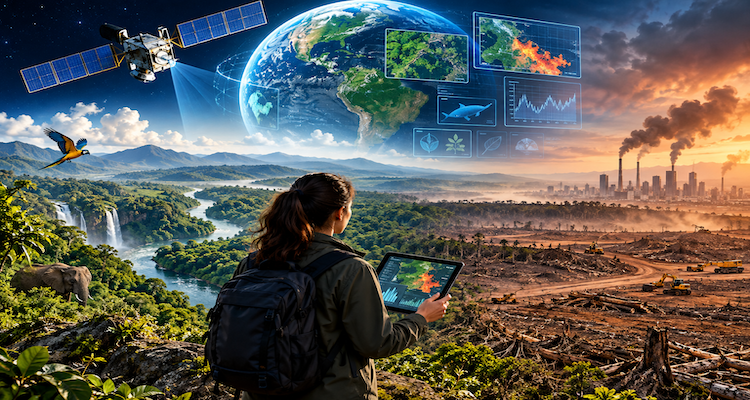
Humanity can now watch forests change from space, track atmospheric chemistry across the planet and collect billions of records describing where species have been observed. Yet one of the most important environmental problems is becoming harder to answer with precision: How quickly is nature actually changing, and how much of that change are we failing to see?
The problem is not that science has stopped measuring the planet. In many ways, environmental observation has become dramatically more sophisticated. Satellites, automated sensors, biodiversity databases, environmental DNA, acoustic monitoring and computer models can reveal changes that earlier generations could barely detect.
The problem is that human pressure on natural systems is also operating across more places, more species and more interconnected processes than any single monitoring system can capture.
That creates a potentially consequential gap between what is happening in nature and what can be confidently measured about it.
Key Takeaways
- Human pressure is changing land, water, climate and biodiversity simultaneously rather than through isolated environmental problems.
- Scientists have powerful new monitoring technologies, but biodiversity observations remain uneven across species, regions and time.
- Global environmental indicators simplify complex systems, making measurement useful but never complete.
- Faster monitoring can improve decisions, but better data does not automatically prevent ecological damage.
- The biggest measurement challenge may be detecting cumulative changes before they become difficult or expensive to reverse.
- Closing data gaps is increasingly becoming part of environmental protection itself.
The Planet Is Changing Faster Than a Traditional Survey Can Follow
Environmental science has traditionally depended on repeated observations: measure a forest, survey a species, sample a river, record temperature, compare the results over time.
That approach remains essential. But the scale of human influence has changed.
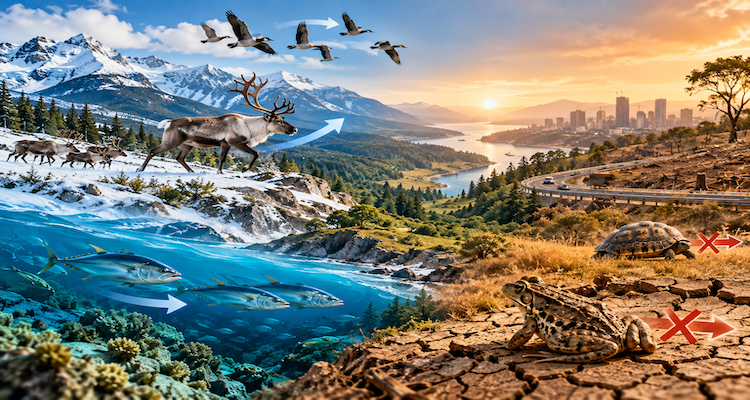
The IPBES global assessment identified five major direct drivers of biodiversity and ecosystem change: changes in land and sea use, direct exploitation of organisms, climate change, pollution and invasive alien species. These pressures frequently interact rather than operate independently.
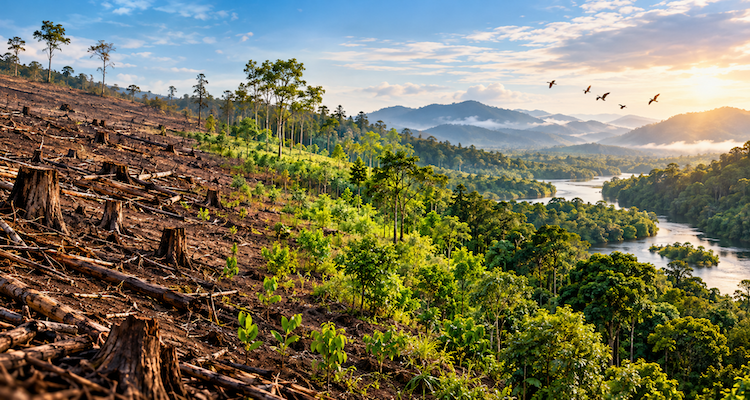
A forest, for example, can be affected simultaneously by land conversion, changing rainfall, higher temperatures, fire, pollution and the removal of particular species. Measuring one pressure in isolation may therefore provide only part of the picture.
This is one reason Earth-system science increasingly treats the planet as a connected system.
The planetary-boundaries framework illustrates the challenge. The 2025 Planetary Health Check reports that seven of nine assessed planetary boundaries have been transgressed, including climate change, biosphere integrity, land-system change, freshwater change, biogeochemical flows, novel entities and ocean acidification.
That does not mean seven environmental catastrophes suddenly occurred. A planetary boundary is a scientific framework for assessing pressure on Earth-system processes, not a countdown clock for immediate collapse.
The important point is different: the measurements increasingly indicate that human influence extends across several interconnected systems at once.
The Data Revolution Is Powerful and Still Incomplete
Technology is changing environmental observation.
NASA, for example, describes how satellite observations can be combined with ground measurements to monitor ecosystem changes across large and difficult-to-access areas. Remote sensing can repeatedly observe landscapes that would be impossible for field teams to survey continuously.
But observing land cover is not the same as observing biodiversity.
A satellite may detect that vegetation has changed. It may identify forest loss, surface-water changes or other physical characteristics. It cannot necessarily tell researchers everything about which species disappeared, which populations declined, how food webs changed or whether an ecosystem lost an important ecological function.
That distinction matters.
Biodiversity data are especially difficult because scientists are not sampling every species equally. GBIF’s documentation identifies geographic and temporal gaps, sampling bias, incomplete metadata and uneven monitoring capacity as continuing challenges for biodiversity analysis. Some species and regions simply have far more observations than others.
This creates an uncomfortable possibility: the easiest parts of nature to measure can become the parts we understand best, while poorly monitored systems remain comparatively invisible.
A Species Can Be Missing From the Data Without Being Missing From the Planet
There is an important distinction between absence and absence of evidence.
If researchers do not record a species in a particular location, that does not necessarily mean the species is not there. It may mean that nobody surveyed the location, the survey happened at the wrong time, the species was difficult to detect, or the available data were never digitized or shared.
GBIF has documented major gaps in biodiversity records and noted that some areas of Asia, Africa and South America have historically had substantial gaps in species occurrence data. Its analysis also found that data completeness is influenced by factors such as research capacity and the mobilization of existing information.
This becomes particularly important when scientists build indicators from large datasets.
A dataset containing millions or billions of observations may look comprehensive while still being unevenly distributed. Large numbers do not automatically eliminate bias.
A 2024 study published in Nature highlighted another dimension of the problem: biodiversity time-series analyses can be affected by spatial, temporal and evolutionary structures in the underlying datasets. In other words, even when long-term observations exist, interpreting the direction and magnitude of biodiversity change requires careful statistical treatment of how those observations were collected.
The challenge is therefore not simply collect more data.
It is collect the right data, in the right places, repeatedly enough, with enough context to interpret what they mean.
The Measurement System Is Becoming an Environmental Infrastructure
This is why international biodiversity policy increasingly treats monitoring as a core part of environmental action rather than a technical afterthought.
The Kunming-Montreal Global Biodiversity Framework established a monitoring framework containing headline, component, complementary and other indicators for assessing progress. In 2025, the Convention on Biological Diversity adopted further technical updates and continued work on additional indicators to address gaps in the framework.
The CBD has also explicitly identified gaps that still need attention. Its technical work has considered whether existing indicators adequately cover particular aspects of biodiversity targets, including areas where measurements are incomplete or unavailable.
This reveals something larger about environmental science.
The world is no longer asking only:
What is happening to nature?
It is increasingly asking:
How do we know, how quickly can we know, and how confident should we be?
Those are different questions.
And they matter because environmental decisions are often made before perfect information exists.
Faster Sensors Do Not Automatically Mean Faster Understanding
There is a temptation to believe that better technology will solve the measurement problem.
Sometimes it does.
Satellite systems can provide repeated observations. Automated acoustic sensors can record wildlife sounds over long periods. Environmental DNA can help detect organisms from genetic material in water or other environmental samples. Large biodiversity databases can connect observations from researchers, institutions and citizen scientists.
But every measurement technology has limits.
A sensor detects what it is designed to detect. A model reflects its assumptions and the quality of its inputs. A database can only reveal what has been recorded and made accessible. A satellite measures particular physical properties rather than the entire ecological system.
The solution is therefore unlikely to be a single universal monitoring technology.
The more realistic direction is an integrated observation system in which satellites, field surveys, biological records, sensors, models and local knowledge complement one another.
NASA’s work on combining satellite observations with ground measurements is an example of this principle. The objective is not to replace field science with remote sensing, but to use different forms of evidence together to create a more complete picture.
The Real Risk Is the Lag Between Change and Recognition
The most consequential measurement problem may not be uncertainty itself.
Science routinely works with uncertainty. It quantifies it, reports it and improves estimates as new evidence arrives.
The greater danger is recognition lag.
An environmental change may begin locally. It may initially appear statistically insignificant. Several pressures may accumulate before their combined effect becomes obvious. By the time a long-term dataset clearly establishes a trend, the underlying ecological conditions may already have shifted substantially.
This is especially important for systems with thresholds or nonlinear responses.
The planetary-boundaries framework is partly designed around this concern. Its purpose is to identify pressure on Earth-system processes before society is forced to deal only with visible consequences. The framework itself does not predict exactly when a particular ecosystem will collapse; rather, it provides a way of thinking about the risks associated with increasing human pressure.
That distinction should remain central to environmental reporting.
A measurement is not a prophecy.
But neither is uncertainty a reason to ignore a growing signal.
What Better Environmental Measurement Should Look Like
The next generation of environmental monitoring will need more than greater volume of data.
It will need better coverage, interoperability and transparency.
Three priorities stand out.
First, fill geographic and taxonomic gaps. Monitoring should not concentrate only where research institutions are strongest or where species are easiest to observe.
Second, connect different measurement systems. Satellite imagery, field observations, biodiversity databases, genetic evidence and ecological models become more useful when they can be interpreted together.
Third, measure uncertainty honestly. A global indicator should not create the impression that every ecosystem has been observed with equal precision. Knowing where the evidence is weak is itself valuable information.
This is also where open biodiversity infrastructure matters. GBIF’s work emphasizes the importance of data accessibility, standardized information and knowledge of the provenance and limitations of observations when developing biodiversity indicators.
Better environmental intelligence is therefore not simply a scientific objective. It is becoming part of the infrastructure needed for conservation, policy, business planning and risk management.
The Planet Does Not Wait for the Dataset to Be Complete
There is a paradox at the center of modern environmental science.
Humanity has never possessed more powerful tools for observing Earth. At the same time, the complexity and speed of human-driven environmental change make complete measurement impossible.
That should not lead to scientific pessimism.
It should lead to better priorities.
The goal cannot be to wait until every species, river, forest and ecological interaction has been measured perfectly. Such a standard would make action impossible.
The more useful goal is to make monitoring fast enough, broad enough and transparent enough to identify meaningful changes while there is still room to respond.
The central question is therefore shifting from whether science can measure environmental change to whether society can build measurement systems that keep pace with the changes it is creating.
The answer is not yet yes.
But recognizing that gap may be one of the most important measurements science can make.
This content is published for informational or entertainment purposes. Facts, opinions, or references may evolve over time, and readers are encouraged to verify details from reliable sources.