


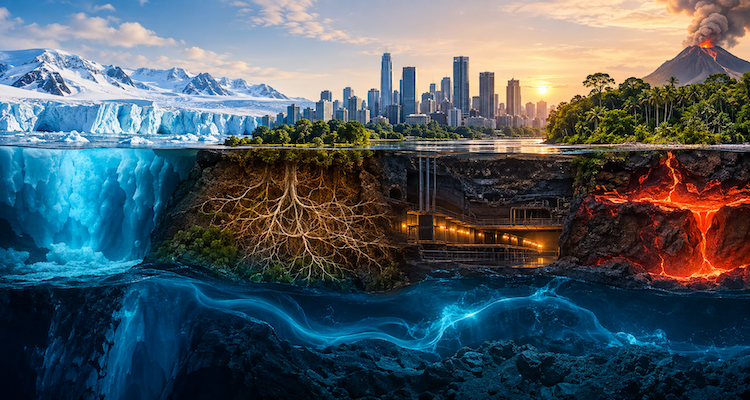






Why Scientists Are Paying More Attention to What Happens Underground
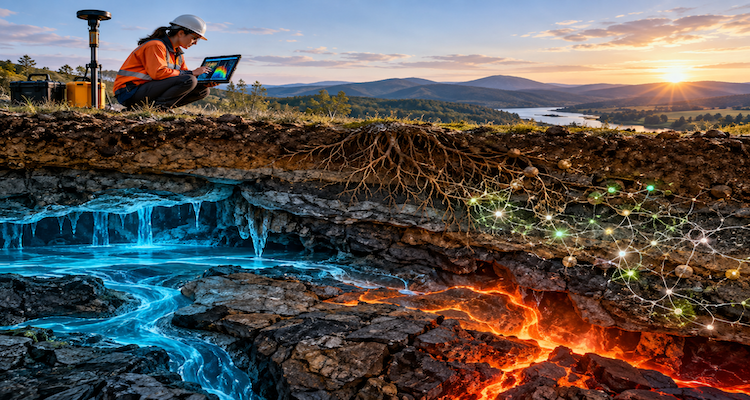
For much of modern science, the ground beneath our feet was treated mainly as a place to extract resources, build foundations, bury waste or draw water. That view is changing. Scientists increasingly see the subsurface as a complex system that influences water security, energy storage, carbon management, mineral supplies, ecosystems and even some environmental risks.
The shift is partly technological: improved drilling, geophysical mapping, sensors, chemical analysis and computer modelling are making it possible to investigate environments that were once extremely difficult to observe. But there is also a practical reason for the renewed attention. As societies search for lower-carbon energy systems, resilient water supplies and new sources of critical minerals, many of the relevant resources and many of the associated risks are located underground.
The result is a new scientific question: How can we understand and use the subsurface without treating it as an empty space?
Key Takeaways
- Groundwater, minerals, microbes, heat and gases make the subsurface an active Earth system rather than an inert layer of rock.
- Scientists are mapping underground formations more closely because they may support energy storage and carbon-management technologies.
- Groundwater monitoring is becoming increasingly important for understanding drought, climate variability and future water availability.
- Underground environments contain microbial communities whose activities can influence natural cycles and human operations.
- Critical-mineral research increasingly connects geology below the surface with energy and technology supply chains.
- Greater use of the subsurface also makes monitoring essential because storage, extraction and injection can alter underground systems.
The Underground Is More Active Than It Looks
The first challenge is conceptual.
From the surface, underground geology can appear static. In reality, rocks contain fractures, pores and interconnected spaces through which water and gases can move. Chemical reactions occur between fluids and minerals, temperatures change with depth, and microorganisms inhabit environments ranging from shallow soils to much deeper geological formations.
Groundwater is one of the clearest examples. USGS describes groundwater as water occupying pores and cracks in soil and rock, with some groundwater potentially remaining underground for thousands of years.
That makes the subsurface a slow-moving part of the water cycle rather than simply a hidden reservoir.
Long-term monitoring is therefore important. The USGS Groundwater Climate Response Network had 588 monitoring sites across the United States and its territories as of October 2024, including nearly 500 with real-time data. The network is designed to help researchers understand how atmospheric conditions such as drought affect groundwater levels.
This matters because changes underground can persist after conditions at the surface have changed.
Climate Research Is Moving Below the Surface
Climate change is often discussed through atmospheric temperature, glaciers, oceans and extreme weather. But groundwater is also part of the picture.
A 2025 USGS assessment examined how climate drivers affect components of the water cycle, including groundwater, and emphasized that understanding these interactions is important for future water-availability planning.
Regional studies demonstrate why the relationship is complicated. A 2025 USGS-linked study of the upper Colorado River basin compared wetter conditions from 1982–1999 with drought conditions from 2000–2022 and found substantial changes in streamflow and runoff. Groundwater and surface-water systems were examined together because they interact rather than operating as completely separate systems.
This is one reason scientists increasingly treat underground water as part of a connected environmental system.
Rainfall does not simply become river water. Some infiltrates into soil and rock, some becomes groundwater recharge, some returns to the atmosphere through evaporation and transpiration, and some eventually re-enters rivers and other surface-water systems.
Understanding those pathways becomes particularly important when climate conditions and human water use change simultaneously.
The Deep Earth Also Contains a Hidden Biological World
Another reason scientists are looking underground is biological.
The terrestrial subsurface hosts microbial communities that can survive under conditions very different from those at the surface. A 2024 Nature Reviews Microbiology review described the terrestrial subsurface as potentially the largest reservoir of microbial life on Earth and examined how drilling, mining, contamination and resource extraction can alter subsurface microbial communities.
These organisms are not merely a scientific curiosity.
Microbes can participate in chemical reactions involving minerals, gases and organic compounds. Their activity can influence the chemistry of underground environments and, in some circumstances, affect human operations involving resource extraction or subsurface storage.
That creates a two-way relationship.
Humans alter underground environments through drilling, mining and injection. Those altered environments can then change microbial activity, which may in turn affect geochemical processes and infrastructure.
The emerging picture is therefore much more complicated than simply “rock below, life above.”
Underground Space Is Becoming Part of the Energy System
The energy transition is another major reason for increased subsurface research.
Renewable electricity does not always arrive at the same time that consumers need it. Solar generation, for example, varies throughout the day and season. Scientists and engineers are consequently examining whether geological formations can provide places to store energy or energy-related gases.
USGS research includes underground storage possibilities involving natural gas, compressed air, pumped hydroelectric systems and geothermal energy. The agency notes that additional geological investigation is necessary to determine where suitable formations exist.
The Department of Energy also describes underground thermal energy storage as a way of using subsurface formations to store heat for later use. Such systems can potentially shift heating and cooling demand and make use of the relatively stable temperatures found underground.
Research published in 2026 by USGS scientists examined geothermal district-energy systems combined with seasonal underground thermal storage across several U.S. cities. The study modelled how climate and hydrogeology affect performance and economics, illustrating how subsurface characteristics can become part of energy-system planning rather than simply geological background information.
The important point is that underground storage is not automatically useful simply because geological space exists. Temperature, pressure, permeability, groundwater movement, rock properties and local geology all influence whether a particular site is technically suitable.
Carbon Storage Depends on Understanding the Rocks
Carbon dioxide storage provides an even stronger reason to understand what happens underground.
Geologic carbon storage involves injecting CO₂ into suitable geological formations. The gas can occupy pore spaces, dissolve into formation fluids and potentially participate in chemical reactions with surrounding minerals.
Scientists therefore need to understand much more than the size of an underground formation. They need to know how fluids move through it, how rocks respond, how pressure changes and how effectively the stored carbon can remain contained.
USGS research specifically examines potential risks associated with underground CO₂ storage, including leakage, effects on drinking water and induced seismicity.
There is also a related research area called carbon mineralization. In suitable rocks, CO₂ can react with minerals containing calcium, magnesium and iron to form carbonate minerals. USGS research is examining whether these processes could support long-term carbon storage while potentially making certain critical minerals available as byproducts.
That does not mean every underground carbon-storage project will produce minerals or that geological storage is risk-free. It shows why detailed subsurface science is essential before such technologies can be deployed responsibly.
Critical Minerals Are Bringing Geology Closer to Technology
Modern technology depends on materials that come from geological systems.
The U.S. Geological Survey’s 2025 Critical Minerals List contains 60 minerals, including the 50 minerals on the previous list plus 10 additions. The agency evaluates mineral criticality partly in terms of potential supply-chain disruption.
This has increased interest in understanding where minerals occur, how they formed and whether they can be recovered economically and responsibly.
One example is the relationship between geothermal resources and lithium-rich brines. USGS research describes the Salton Sea region of California as an area where geothermal heat and lithium occur together in subsurface brines, creating the possibility of recovering both resources from related geological systems.
This illustrates a broader change in thinking.
The question is no longer simply “Where is the mineral?”
Scientists increasingly need to ask:
- What geological processes concentrated it?
- What fluids move through the formation?
- What other resources occur alongside it?
- Can extraction affect groundwater?
- Can existing infrastructure serve multiple purposes?
- What environmental consequences could follow?
In other words, resource exploration is becoming increasingly dependent on understanding the entire underground system.
Better Technology Is Making the Invisible Measurable
The growing interest in the subsurface would be difficult without better ways of observing it.
Researchers can combine drilling, geological mapping, seismic measurements, geochemical analysis, remote sensing, groundwater monitoring and numerical modelling to build increasingly detailed pictures of underground environments.
But the difficulty of direct observation remains important.
USGS notes that collecting groundwater from wells extending thousands of metres underground is challenging because pressure and temperature conditions differ dramatically from those at the surface. Sampling itself can change dissolved gases and cause minerals to precipitate, potentially altering what researchers are trying to measure.
That is a useful reminder that underground science is not simply a matter of drilling a hole and looking inside.
The measurement process itself has to be carefully designed.
More Underground Activity Also Means More Responsibility
The increased scientific attention does not mean the underground is becoming a limitless new frontier.
Every major use introduces questions about interactions between geological systems and human activity.
Carbon storage requires containment and monitoring. Energy storage requires suitable formations and careful pressure management. Mineral extraction can affect groundwater and surrounding geology. Geothermal systems require detailed knowledge of heat and fluid movement. Even research drilling can alter previously isolated environments.
The scientific literature is increasingly examining these interactions rather than treating each underground application separately. The 2024 Nature Reviews Microbiology review, for example, highlights how human activities such as drilling, mining and resource extraction can change subsurface microbial ecosystems.
This is perhaps the most important shift in perspective: the subsurface is not simply a warehouse of resources. It is an interconnected system.
What Scientists Still Do Not Know
Despite advances in measurement and modelling, major uncertainties remain.
Scientists cannot directly observe every underground process at the scale at which it occurs. Geological formations can vary considerably over relatively short distances, and models necessarily simplify complex systems.
There are also uncertainties about how underground environments respond over long periods when humans introduce new pressures, fluids, gases or heat.
That makes monitoring and continuous scientific evaluation important.
The more societies depend on the subsurface, the more valuable long-term measurements become. A baseline collected before a project begins can provide information that would otherwise be impossible to reconstruct later.
This is particularly relevant to groundwater, where long records can reveal changes that are difficult to identify from short-term measurements.
Conclusion
Scientists are paying more attention to what happens underground because the subsurface has become increasingly relevant to problems that are usually discussed at the surface.
It contains groundwater that supports ecosystems and human communities, geological formations that may store carbon or energy, minerals needed for modern technologies, heat that can be used for energy systems, and microbial ecosystems that influence underground chemistry.
The deeper lesson is not that humanity has suddenly discovered a hidden world beneath its feet. Scientists have studied the subsurface for centuries.
What has changed is how many important questions now depend on understanding it at the same time.
Water security, energy storage, carbon management, mineral supply and environmental protection increasingly intersect below ground. As those connections become clearer, underground science is moving from a specialized branch of Earth science toward a central part of planning for how societies use natural resources.
The challenge will be to use that knowledge without treating geological space as an unlimited resource. The better scientists understand what is happening below the surface, the better equipped decision-makers will be to determine where intervention is appropriate and where leaving an underground system undisturbed may be the wiser choice.
This content is published for informational or entertainment purposes. Facts, opinions, or references may evolve over time, and readers are encouraged to verify details from reliable sources.
Related News
- The Places on Earth That Are Changing Without Looking Different
- Nature’s Signals, Science’s Answers: How Scientists Are Turning Living Systems Into Environmental Early Warnings
- Discovering What the Earth Is Telling Us
- Earth, Energy, and Everything in Between: How One Energy System Connects the Planet, Economy and Digital Age