






Why Shiva’s Damru Became a Symbol of Cosmic Sound
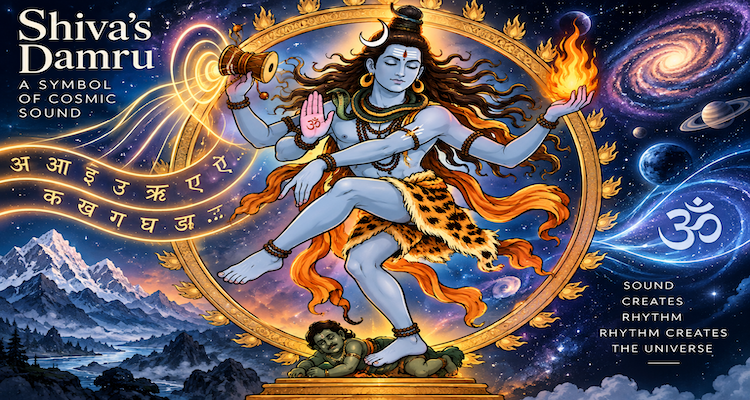
The small hourglass-shaped damru held by Shiva is easy to overlook beside the more dramatic symbols associated with him. Yet in the imagery of Shiva as Nataraja, the drum carries an unusually powerful idea: that sound can represent the beginning of creation itself.
This is not a scientific claim that a physical drumbeat created the universe. It is a religious and philosophical symbol developed through Hindu traditions and expressed with particular force in the iconography of Nataraja. In this tradition, rhythm, movement and sound are connected with creation, while fire represents destruction and the cosmic dance joins the two within a larger cycle.
The symbolism becomes even more interesting through the traditional association between Shiva’s drum and the Maheshvara Sutras, fourteen sound sequences used in the grammatical system of Panini. Here, the damru is connected not simply with music, but with ordered language and the structure of sound itself.
Key Takeaways
- The damru represents primordial sound and creation in the iconography of Shiva as Nataraja.
- Nataraja’s drum and flame together express creation and destruction within a cyclical conception of existence.
- Hindu tradition associates fourteen beats of Shiva’s damru with the Maheshvara Sutras of Sanskrit grammar.
- The historical Sanskrit-grammar tradition should be distinguished from the devotional story of Shiva revealing those sounds.
- The damru’s symbolism connects rhythm, language, movement and cosmic order rather than describing a scientific theory of creation.
The Damru in the Image of Nataraja
The clearest visual expression of the damru’s symbolism appears in representations of Shiva Nataraja, the Lord of Dance.
The Metropolitan Museum of Art describes its Chola-period Nataraja as an image combining Shiva’s roles as creator, preserver and destroyer. In the sculpture, Shiva holds a damru in his upper right hand, while his upper left hand carries fire. The museum explains the drum as the source of the primordial vibrating sound of creation.
The National Museum of New Delhi gives a similar interpretation. Its description of a 12th-century Chola Nataraja identifies the damaru as symbolizing the power of creation, while the fire represents destruction. The sculpture also incorporates protection, liberation and the subduing of Apasmara, the figure associated with ignorance.
The symbolism therefore works as a complete visual system.
The drum is not an isolated object. It appears opposite the flame, inside the movement of the cosmic dance. One signals emergence; the other signals dissolution.
That pairing is central to understanding why the damru became associated with cosmic sound.
Why Sound Represents Creation
The idea behind the damru is broader than the ordinary meaning of music.
Sound is something that begins with vibration and then becomes perceptible. In religious and philosophical interpretations, this makes sound a useful symbol for manifestation: something previously unexpressed becomes expressed.
The Nataraja image turns this abstract idea into a visual sequence.
The drum produces rhythm.
The rhythm accompanies Shiva’s dance.
The dance represents cosmic activity.
The flame represents destruction.
The resulting image does not describe creation as a single historical event. Instead, it presents existence as a continuing process of creation, preservation, destruction, concealment and grace. The National Museum of New Delhi explicitly identifies these as the five activities, or pancakrityas, represented through Shiva’s cosmic dance.
This is why calling the damru merely a “musical instrument” misses much of its significance.
Within the iconography, it becomes a symbol of ordered vibration and cosmic activity.
The Connection With Sanskrit and the Maheshvara Sutras
One of the most fascinating traditions surrounding Shiva’s damru concerns Sanskrit grammar.
The Maheshvara Sutras, also known as the Shiva Sutras in this context, are fourteen compact sequences used by the Sanskrit grammarian Panini in organizing sounds for his grammatical system.
The fourteen sequences are not simply a conventional alphabet recitation. They provide an efficient way of grouping Sanskrit sounds for the grammatical operations of Panini’s Ashtadhyayi. A linguistic study of Panini’s system describes the aksharasamamnaya as a fourteen-part sound catalogue and explains how the sequences enable Panini to form compact sound-class references called pratyaharas.
Within the traditional account, however, their origin is described differently.
According to this tradition, Shiva sounded his damru fourteen times at the conclusion of his cosmic dance. The resulting sound sequences became the Maheshvara Sutras and were revealed for the benefit of sages and, in later tradition, associated with Panini.
An educational publication from India’s National Institute of Open Schooling records this traditional explanation and describes the fourteen sutras as the organized phonemes used in Panini’s grammatical system.
This distinction matters.
The Maheshvara Sutras are historically significant components of the Paninian grammatical tradition. The story that Shiva’s damru produced them is a traditional sacred account of their origin, not something that can be established as a historical recording of a physical event.
That distinction allows the symbolism to be appreciated without confusing religious tradition with historical evidence.
From Cosmic Rhythm to Language
The connection between the damru and Sanskrit gives the symbol another layer.
A drum produces repeated pulses. Language organizes sounds into meaningful patterns. Rhythm organizes movement into recognizable structure.
In the traditional imagination, these ideas can be connected: sound becomes pattern, pattern becomes language, and language becomes a vehicle for meaning.
The Maheshvara Sutras demonstrate the remarkable technical organization of Sanskrit phonemes within Panini’s grammatical framework. The Matheson Trust likewise describes the fourteen sutras as a recitation of Sanskrit phonemes and notes their traditional association with Shiva and the damru.
This does not mean that modern linguistics establishes the damru as the literal physical source of Sanskrit.
Rather, the story expresses a philosophical idea: language itself can be imagined as emerging from primordial sound.
That is a much more precise way to understand the tradition than simply saying that “Shiva created Sanskrit.”
Why the Damru Is Shaped Like an Hourglass
The damru’s physical form also contributes to its symbolism.
It is generally depicted as a small double-headed drum with a narrow centre. When played, the two heads produce alternating sounds as the instrument is moved.
In the Nataraja image, that compact shape sits naturally within Shiva’s hand while remaining visually distinct from the larger and more dramatic flame.
The instrument therefore communicates something about rhythm and duality: two sides connected through a narrow centre, producing a unified rhythmic effect.
Interpretations of the damru’s shape vary across religious traditions and later devotional explanations, so not every symbolic meaning attributed to its geometry should be treated as an ancient or universally accepted doctrine.
What is much more firmly established in the Nataraja iconography is its association with the sound of creation. Museums including the Met, the National Museum of India and the Museum of Fine Arts, Houston independently describe this symbolism.
The Damru, the Flame and the Cycle of Existence
The damru becomes especially meaningful when viewed together with the fire in Shiva’s other raised hand.
The Metropolitan Museum explains that the drum represents the first sounds of creation while the fire represents destruction. The entire Nataraja composition therefore brings opposing processes into a single image.
The National Museum similarly describes the damru as the power of creation and the flame as destructive power.
This is one reason Nataraja is more than an image of a dancing deity.
The sculpture presents a philosophy of existence through movement.
Creation is not isolated from destruction. Destruction is not simply an ending. Both belong to a continuing cosmic rhythm.
The damru therefore represents the opening movement of a cycle rather than a one-time event.
Why “Cosmic Sound” Is a Better Symbolic Description Than a Scientific One
Modern science describes the early universe using physical models involving space, time, matter, radiation and fundamental interactions. The traditional claim about Shiva’s damru belongs to a different category of thought.
It is a religious and philosophical metaphor for manifestation through vibration and sound.
Treating the damru as proof of a scientific cosmological theory would blur two fundamentally different systems of explanation.
The value of the symbol does not depend on turning it into physics.
Its importance lies in what it communicates within its own tradition: that existence can be understood as dynamic, rhythmic and continually transforming.
This distinction is particularly important today, when ancient religious symbols are sometimes presented as if they were literal predictions of modern scientific discoveries. Such comparisons can be intellectually interesting, but they should be identified as interpretations rather than established scientific connections.
A Symbol That Outlived Its Original Setting
The Nataraja form became especially prominent in South India during the Chola period. The Smithsonian’s National Museum of Asian Art notes that artists in the Tamil region began producing this form in the early tenth century, drawing on devotional poetry and highly developed metalworking traditions. Nataraja images subsequently became part of temple ritual and public religious life.
The National Museum’s collection also contains Chola-period Nataraja bronzes in which the damru remains an essential part of the visual vocabulary.
That historical development helps explain why the symbol remains recognizable today.
The damru survived not simply because it was an attribute of Shiva, but because it condensed an enormous philosophical idea into one small object.
A hand-sized drum could represent sound.
Sound could represent creation.
Creation could be placed within a cycle of preservation and destruction.
And the entire process could be expressed through dance.
Conclusion
Shiva’s damru became a symbol of cosmic sound because Hindu artistic and philosophical traditions used sound, rhythm and vibration as powerful ways to express manifestation and cosmic activity.
In Nataraja’s hand, the drum does not stand alone. It is part of a carefully constructed visual language: the damru signifies creation, the flame destruction, the raised foot liberation, and the figure beneath Shiva’s foot the overcoming of ignorance. Museums documenting Nataraja imagery consistently identify these relationships.
Its association with the Maheshvara Sutras adds another remarkable dimension. The historical importance of those fourteen sound sequences to Paninian Sanskrit grammar is documented, while their revelation through Shiva’s damru belongs to a traditional sacred narrative.
The enduring power of the damru lies precisely there: it turns an abstract idea about the origin and order of existence into something that can be seen, heard and imagined.
The drum is small.
The idea it carries is cosmic.
This content is published for informational or entertainment purposes. Facts, opinions, or references may evolve over time, and readers are encouraged to verify details from reliable sources.