






The Meaning Behind Shiva’s Ashes: Why Nothingness Became a Sacred Symbol
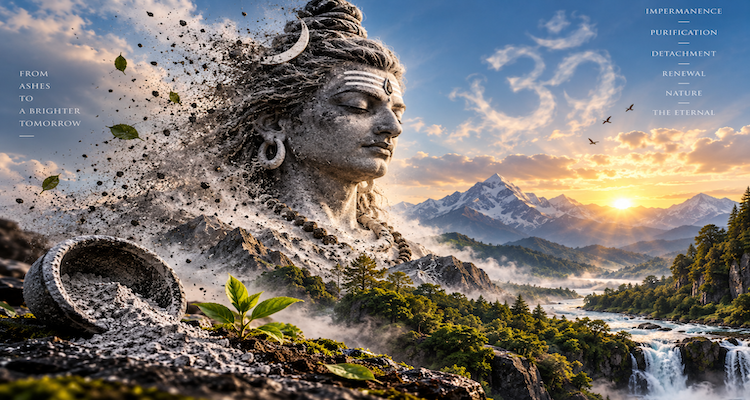
Few images associated with Shiva are as striking as the ascetic covered in white ash. The ash is not merely an unusual ornament or a visual sign of renunciation. In Shaiva traditions, bhasma or vibhuti can represent impermanence, purification, disciplined living, detachment and the transformation of what appears to be an ending into a spiritual reminder.
The symbolism becomes especially powerful because ash is what remains after something has been consumed by fire. It strips away distinctions of appearance and permanence. Wealth, beauty, status and even the physical body are ultimately subject to change. Shiva’s relationship with ash therefore places mortality directly inside a tradition that also understands Shiva as a transcendent divine presence.
Historical and religious sources show that ash was not simply a later artistic association with Shiva. Early Shaiva ascetic traditions included practices involving ash and cremation grounds, while religious texts developed elaborate explanations for applying sacred ash and wearing the Tripundra, the three horizontal ash lines associated with Shaiva identity.
Key Takeaways
- Shiva’s ash symbolizes impermanence, reminding devotees that physical forms and worldly status do not last forever.
- Sacred ash, or bhasma, became an important ritual and identity marker within several Shaiva traditions.
- The Tripundra consists of three horizontal ash lines and carries multiple theological interpretations in Shaiva texts.
- Shiva’s association with cremation grounds connects spiritual practice with direct contemplation of death and detachment.
- The symbolism of ash is broader than destruction: fire transforms material form, leaving behind what remains.
- Different Shaiva texts and traditions assign different meanings to bhasma, so no single interpretation explains every practice.
Why Shiva Is So Closely Associated With Ash
Shiva occupies an unusual position in Hindu religious imagination. He can appear simultaneously as the serene yogi, the cosmic dancer, the compassionate deity and the frightening lord associated with cremation grounds.
The latter imagery is particularly important when understanding the symbolism of ash.
The Metropolitan Museum of Art describes historical representations of Shiva as an ascetic associated with burning grounds, ash, skulls and other imagery connected with death. A seventeenth-century Mughal painting discussed by the museum similarly depicts Shiva as an ash-covered figure within a cremation-ground setting.
This imagery creates a deliberate confrontation with something many societies prefer to avoid: mortality.
A cremation ground does not preserve distinctions between social identities. The body that once represented youth, beauty, wealth or authority is eventually reduced to material remains. Ash therefore becomes an uncompromising symbol of impermanence.
In Shiva’s iconography, that impermanence is not necessarily presented as something to fear. Instead, it becomes something to contemplate.
From Fire to Ash: The Symbolism of Transformation
Ash carries an important paradox.
Fire destroys the visible form of an object, but ash demonstrates that transformation has occurred. A piece of wood is no longer wood after burning, yet something remains.
Shaiva traditions developed this physical process into religious symbolism. Textual traditions concerning bhasma describe sacred ash as something produced through fire and used ritually on the body. The Shiva Purana, for example, distinguishes different categories of ash and describes its ritual application, including its use for the Tripundra.
This helps explain why the popular interpretation of Shiva’s ash as simply “death” is incomplete.
The deeper symbolism can include transformation, purification and detachment.
The body becomes a temporary surface on which the devotee places a reminder: everything visible changes. The purpose is not necessarily to glorify destruction, but to remember what lies beyond attachment to temporary forms.
What Is Vibhuti or Bhasma?
The terms vibhuti and bhasma are commonly used for sacred ash, although their precise ritual meanings can vary between traditions and textual contexts.
Bhasma is associated with ash produced through ritual fire, while vibhuti is widely used for sacred ash connected with Shiva worship.
The practice has a long textual history. Shaiva materials discuss the preparation, application and ritual significance of sacred ash, including specific instructions for applying it to the body. A study of Shaiva Upanishadic traditions documents sections dealing specifically with the origin, preparation and ritual application of bhasma.
The symbolism also became part of religious identity.
In some Shaiva communities, ash applied to the forehead functions as a visible marker of devotion and affiliation. Historical evidence concerning the Pashupata tradition, one of the early organized ascetic movements within Shaivism, is particularly revealing: its ascetics were associated with ash-smearing practices and cremation grounds.
That means the ash was not simply decorative. It could communicate a particular way of approaching religious life.
The Three Lines of the Tripundra
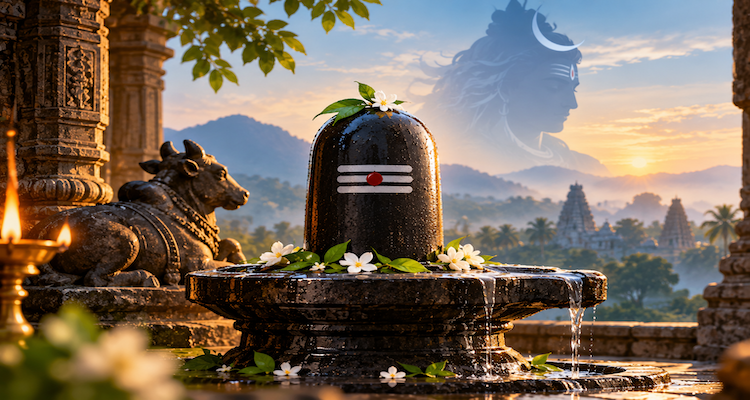
One of the most recognizable Shaiva uses of sacred ash is the Tripundra: three horizontal lines drawn across the forehead.
The mark is described in religious sources as three parallel lines of sacred ash and is closely associated with Shaivite practice.
The three lines have been interpreted in several ways across Hindu textual traditions. One text, for example, associates them with Brahma, Vishnu and Mahesha, as well as with the three qualities or gunas of nature.
These multiple interpretations are important because they show that religious symbols rarely have only one fixed meaning.
The Tripundra can simultaneously function as:
- a mark of Shaiva devotion;
- a ritual practice;
- a reminder of spiritual discipline;
- a symbol interpreted through theological concepts; and
- a visible expression of religious identity.
The exact meaning can depend on the particular Shaiva tradition and text being consulted.
Why the Cremation Ground Matters
The cremation ground is one of Shiva’s most unsettling sacred spaces.
Rather than placing the divine exclusively in beautiful temples, mountains or celestial realms, Shaiva imagery can place Shiva amid corpses, bones, smoke and ashes.
The story of Karaikkal Ammaiyar, a celebrated Shaiva saint from Tamil tradition, provides an important historical-cultural example. The Metropolitan Museum notes that her hymns praise Shiva’s preference for cremation grounds and his wild dancing form.
This imagery challenges the assumption that spirituality must be separated from uncomfortable realities.
Death is not outside the spiritual landscape.
It is part of it.
For an ascetic tradition, the cremation ground could therefore become a place for confronting attachment, fear and the temporary nature of the body.
The ash on Shiva’s body makes that lesson visible.
Nothingness Does Not Necessarily Mean Emptiness
The phrase “nothingness” can be misleading if interpreted as meaning that Shiva represents simple non-existence.
Within Hindu philosophical and Shaiva traditions, questions about the self, consciousness, reality and liberation are considerably more complex.
One interpretive tradition presented in discussions of Shiva’s sacred ash understands the burning process symbolically: when material forms are destroyed, ash remains, while spiritual reality is not reduced to those temporary forms. Such interpretations connect bhasma with ideas of transcendence and the Self.
That should be understood as a theological interpretation, not as a scientifically demonstrable claim.
The distinction matters.
Religious symbolism is designed to communicate meanings about existence, devotion and spiritual practice. It should not be confused with an empirical scientific explanation of consciousness or death.
The power of the symbol comes precisely from this different way of asking questions.
Ash as a Reminder Against Attachment
Perhaps the most accessible meaning of Shiva’s ash is detachment.
Human beings naturally invest enormous importance in possessions, appearance, reputation and social position. Ash challenges all of these assumptions with one physical image.
What happens to the body after death?
What remains of status?
What remains of possessions?
What remains of beauty?
The ash does not answer these questions with a philosophical essay. It places the question on the body itself.
This is one reason the symbol remains relevant beyond strictly ritual settings. Its underlying message can be understood as a discipline of perspective: temporary things should not be mistaken for permanent ones.
That does not necessarily mean rejecting ordinary life.
Rather, in a devotional interpretation, it can mean participating in life without treating temporary possessions or identities as the entirety of existence.
The Historical Tradition Behind the Symbol
The association between ash and Shiva developed across multiple Shaiva traditions rather than emerging from one single historical moment.
The Pashupata movement, which flourished in early centuries of the Common Era, was among the earliest organized Shaiva ascetic traditions. Its practitioners were associated with distinctive ascetic practices, including ash-smearing and cremation-ground observances.
Shaivism subsequently developed into numerous traditions across India and beyond. Evidence from South Asia and Southeast Asia shows that Shaiva practices and institutions developed in different historical environments, meaning that symbols could acquire additional local meanings while retaining connections to Shiva worship.
This history cautions against reducing “the meaning of Shiva’s ash” to a single universal definition.
The symbol has a family of related meanings shaped by theology, ritual, asceticism, mythology and regional practice.
Shiva’s Ash and the Story of Kama
Ash also appears in one of Shiva’s famous mythological episodes.
According to the story represented in a nineteenth-century Indian print held by the Metropolitan Museum of Art, Kama, the god of desire, attempts to disturb Shiva’s meditation. Shiva opens his third eye, and Kama is reduced to ashes. The story eventually continues toward the restoration of cosmic and relational order through Shiva’s recognition of Parvati’s connection with Sati.
The episode adds another dimension to the symbolism.
Ash can represent not only mortality but the burning away of desire.
Again, this is religious symbolism rather than a literal prescription that human desire must simply disappear. In the story, desire itself is not permanently eliminated from the universe. Instead, the myth explores the tension between ascetic withdrawal and the forces that sustain worldly and cosmic life.
That tension is central to Shiva’s character.
He is both ascetic and householder, destroyer and benefactor, terrifying and compassionate.
The ash belongs naturally to that paradoxical image.
Why the Symbol Still Resonates
The continuing visibility of vibhuti and the Tripundra demonstrates how an ancient religious symbol can remain meaningful in contemporary devotional life.
Its appeal does not depend on ash being considered beautiful.
Quite the opposite.
Ash is visually plain. It lacks the color and luxury associated with many forms of ornamentation. That simplicity is part of its message.
A jewel can signify wealth.
A crown can signify authority.
Fine clothing can signify status.
Ash can signify the temporary nature of all three.
That makes it a particularly powerful symbol of renunciation.
At the same time, it would be inaccurate to claim that every Hindu who encounters Shiva’s ash understands it in exactly the same way. Religious traditions are internally diverse, and the textual and ritual sources themselves provide multiple layers of interpretation.
The Deeper Lesson of Shiva’s Ashes
The most compelling meaning of Shiva’s ash may be found in the tension between nothingness and presence.
Ash tells us that forms disappear.
Shiva’s iconography asks what, if anything, remains beyond those forms.
For devotees, the answer can be theological: Shiva, the Self, liberation or divine reality. For an observer approaching the symbol culturally rather than devotionally, the ash can still communicate a profound human idea that every visible identity is temporary.
This is why the symbol has endured.
Shiva’s ash does not promise that death can be avoided. It does something more demanding: it asks people to look directly at impermanence and reconsider what deserves attachment.
The white ash across Shiva’s body therefore carries a message that is both stark and strangely liberating.
Everything that takes form can change.
What matters is how we understand that change and how we live while we still have form.
Conclusion
Shiva’s sacred ash is far more than an identifying feature in religious art. Across Shaiva traditions, bhasma or vibhuti has been connected with ritual practice, ascetic identity, purification, impermanence, detachment and contemplation of mortality.
Its strongest symbolism comes from the simplicity of the material itself. Fire reduces complex forms to ash, and ash makes permanence difficult to imagine.
That is why nothingness can become sacred.
The ash does not merely represent what has disappeared. In Shiva’s tradition, it can become a reminder to look beyond temporary appearances and to recognize that spiritual reflection often begins when attachment to appearances is questioned.
This content is published for informational or entertainment purposes. Facts, opinions, or references may evolve over time, and readers are encouraged to verify details from reliable sources.