


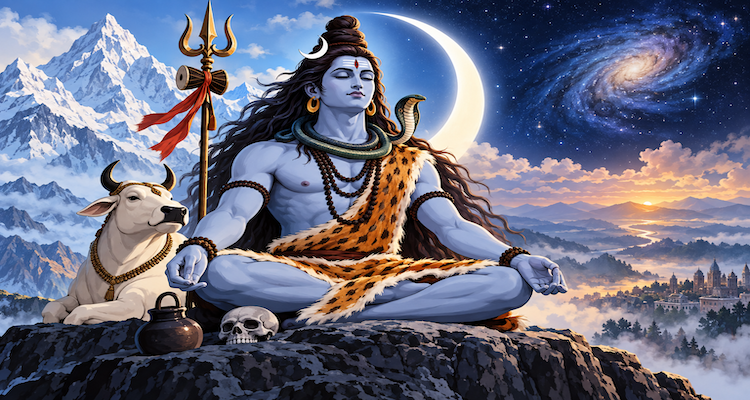






The Deeper Meaning of Shiva’s Third Eye Is Not Simply About Destruction
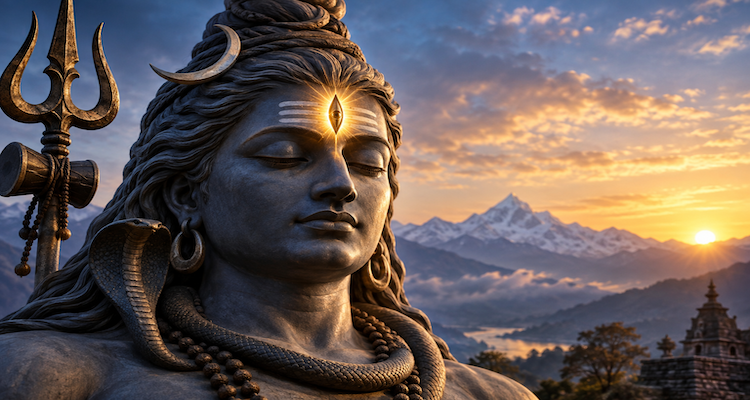
Shiva’s third eye is among the most recognizable symbols in Hindu sacred art, yet its popular interpretation is often reduced to a single idea: when the eye opens, something is destroyed. The mythology is more layered than that.
Across Shiva traditions, the forehead eye is associated with extraordinary perception, ascetic power, fire, and a vision that reaches beyond ordinary appearances. The Metropolitan Museum of Art describes the third eye as signifying Shiva’s “all-seeing nature,” while other traditional and scholarly interpretations connect it with yogic power and wisdom.
The important distinction is that destruction is only one expression of what the third eye represents. In the stories surrounding Shiva, its fire can destroy desire, illusion, arrogance, or obstacles—but the larger symbolism concerns seeing reality beyond the limitations of ordinary perception. The third eye is therefore less a symbol of destruction for its own sake than a symbol of a different kind of seeing.
Key Takeaways
- Shiva’s third eye is traditionally associated with extraordinary perception and divine or contemplative knowledge.
- Its destructive fire appears prominently in the story of Shiva burning Kama, the deity of desire, to ashes.
- The symbolism connects destruction with transformation rather than simple annihilation.
- The third eye reflects Shiva’s identity as both a powerful ascetic and a complex divine figure.
- Hindu texts and artistic traditions give the third eye several meanings rather than one universally fixed interpretation.
More Than a Weapon: The Third Eye as a Different Way of Seeing
The first mistake in interpreting Shiva’s third eye is to treat it simply as a supernatural weapon.
In Hindu iconography, Shiva is commonly represented with three eyes, including a vertical eye in the center of his forehead. The Metropolitan Museum of Art identifies this eye as a sign of Shiva’s all-seeing nature, while an educational resource from the museum describes it as indicating divine omniscience.
That symbolism changes the meaning of the familiar image.
The two ordinary eyes can be understood, at the level of symbolism, as belonging to ordinary perception: seeing forms, movement, people and the visible world. The third eye belongs to a different register. It represents a form of perception that is not limited to what is immediately visible.
This interpretation also fits Shiva’s identity as a yogic and ascetic deity. A 1969 study published in the Purana journal described the third eye as an emblem of Shiva’s ascetic power and associated it with a form of contemplative vision.
The result is a useful distinction: Shiva’s third eye does not merely allow him to destroy. It allows him to see—and that seeing can expose what ordinary perception fails to recognize.
Why Fire Became Central to Its Meaning
Fire is one of the most important elements in the mythology of Shiva’s third eye.
One of the best-known stories appears in the Shiva Purana. Kama, the deity associated with desire and attraction, attempts to disturb Shiva’s deep meditation. Shiva eventually opens his third eye, and fire emerging from it reduces Kama to ashes.
The story has often been simplified into a warning against desire. Its meaning is more nuanced.
Shiva is not presented as destroying the existence of desire from the universe. In the mythology, Kama has a continuing role. What is destroyed in the episode is the immediate force of desire that has interrupted Shiva’s ascetic concentration.
A study of the third eye’s symbolism published in Purana similarly connects the eye with Shiva’s ascetic power and the destruction of Kama. The Shiva Purana itself describes the fire from the third eye reducing Kama to ashes.
This makes the episode important symbolically: the third eye represents the capacity to confront something powerful without remaining controlled by it.
Desire is not necessarily portrayed as something that can simply be erased from existence. Instead, the story dramatizes what happens when disciplined awareness confronts an impulse powerful enough to disturb concentration.
Destruction Can Mean Transformation
The word “destruction” can be misleading when applied to Shiva.
Shiva is simultaneously associated with destruction, creation, preservation, asceticism, fertility, dance and liberation. His symbolism repeatedly places apparently opposite forces together.
The clearest artistic example is Shiva Nataraja.
In the famous Chola-period representation of Shiva as Lord of Dance, the Metropolitan Museum explains that Shiva embodies creation, preservation and destruction within an endless cycle of time. The drum in one hand represents primordial creation, while fire in another represents destruction. Under his foot is a figure associated with illusion or ignorance.
That visual language provides an important context for understanding the third eye.
In Shiva’s world, destruction is not necessarily the opposite of creation. Something may need to end for another state to emerge. Ignorance can be overcome. Illusion can be broken. Attachment can be challenged. A cycle can reach its end before another begins.
The third eye’s fire therefore belongs to a broader symbolic universe in which destruction can be part of transformation.
The Third Eye and the Destruction of Illusion
One of the most interesting connections appears when the third eye is considered alongside Shiva’s iconography as Nataraja.
The figure being trampled beneath Nataraja’s foot represents apasmara, commonly interpreted in museum explanations as illusion or ignorance that obstructs spiritual liberation.
The symbolism is significant because the problem is not simply an external enemy.
The obstacle is a condition of consciousness.
This gives the third eye a deeper interpretive dimension. If ordinary vision allows a person to perceive the external world, the symbolic third eye represents the possibility of recognizing what lies behind misleading appearances.
In this reading, the “destruction” associated with Shiva becomes destruction of misunderstanding.
The idea should not be confused with a scientific claim about a literal biological eye or a supernatural physical process. It belongs to religious mythology, philosophy and sacred symbolism.
That distinction matters because modern discussions sometimes attempt to equate Shiva’s third eye with the pineal gland or claim that ancient traditions scientifically predicted modern neuroscience. Such claims require separate evidence and should not be presented as established facts simply because the metaphor appears appealing.
Why Shiva Needed a Third Eye in the First Place
There are several traditional explanations and stories concerning Shiva’s three eyes, and they should not be collapsed into a single origin story.
One striking account explains the third eye in connection with Shiva’s consort Parvati. A publication associated with the Metropolitan Museum describes a tradition in which Parvati covers Shiva’s eyes, causing darkness, after which Shiva creates another eye to restore light.
The story gives the third eye a meaning beyond anger or destruction.
It becomes associated with illumination.
That is an important clue to the wider symbolism. The eye is not merely something that burns. It also restores vision.
This is why interpreting Shiva’s third eye only as an instrument of destruction misses one of the most revealing tensions in the mythology: the same symbol can represent fire and illumination, wrath and wisdom, destruction and revelation.
A Symbol That Refuses a Single Meaning
Religious symbols rarely function like dictionary definitions.
The third eye is a good example.
In different texts and artistic traditions, it can be connected with:
- extraordinary or divine perception;
- Shiva’s yogic and ascetic power;
- fire;
- the destruction of Kama;
- wisdom;
- illumination;
- the perception of what ordinary sight cannot reveal;
- and the overcoming of illusion or limitation.
A 1969 scholarly discussion of Shiva’s third eye in the Purana journal emphasizes precisely this complexity, noting that the symbol carries several overlapping and sometimes apparently contradictory associations in Puranic mythology.
That complexity is not a weakness in the tradition. It is part of what makes the symbol durable.
Shiva himself is a deity of paradoxes: ascetic and householder, terrifying and compassionate, destroyer and creator, stillness and movement. The third eye reflects the same pattern.
What the Third Eye Can Mean for a Modern Reader
The third eye can be approached religiously, philosophically, artistically or culturally, and those approaches should not be confused.
For a devotee, it may carry devotional and theological significance.
For a scholar of religion, it offers insight into how Hindu traditions represent divine perception and ascetic power.
For an art historian, it is an important element of Shiva’s iconography, appearing across centuries of South Asian sculpture and painting.
For a reader interested in symbolism, it can serve as a powerful metaphor for the difference between seeing something and understanding it.
That last interpretation should be described as an interpretive application rather than presented as the single meaning of the ancient symbol.
The deeper lesson is therefore not simply “open your third eye and destroy negativity.” That modern motivational formulation may be attractive, but it can flatten a much older and more complicated tradition.
The traditional imagery asks a harder question: What happens when perception becomes powerful enough to expose what ordinary perception cannot?
The Fire That Destroys Desire Does Not End the Story
The story of Kama provides another reason not to interpret the third eye as pure annihilation.
According to the Shiva Purana, the fire that destroys Kama does not simply disappear after burning its target. The mythology continues with the problem of containing the extraordinary fire generated by Shiva’s third eye.
In one account, the fire becomes so powerful that it threatens the wider world and is eventually transformed and contained.
The narrative itself therefore complicates the idea of destruction.
Power has consequences.
Fire can destroy an obstacle, but uncontrolled fire can also become another danger. The story makes the third eye a symbol not merely of power but of a force that must exist within a larger cosmic order.
That is consistent with a broader feature of Shiva mythology: extraordinary spiritual or cosmic power is rarely presented as simple or uncomplicated.
Why the Symbol Has Survived for Centuries
The third eye has remained visually powerful because it compresses several ideas into a single image.
It tells the viewer that Shiva sees differently.
It signals his association with yoga and ascetic discipline.
It recalls stories in which fire emerges from his forehead.
It connects him with the destruction of Kama and, more broadly, with forces that disrupt spiritual concentration.
And within the wider iconography of Shiva, it participates in a much larger philosophy of transformation, where destruction and creation belong to the same cosmic process.
Historical artworks demonstrate how enduring the symbol became. The Metropolitan Museum’s collection includes representations of Shiva with a prominent third eye dating back many centuries, including a Kushan-period image from around the third century CE and a seventh-century Shiva linga with a face displaying what the museum calls the “third eye of supreme wisdom.”
The symbol is therefore not a modern invention or merely a contemporary meditation metaphor. It is deeply embedded in the historical visual representation of Shiva.
Conclusion
Shiva’s third eye is often remembered for the flames that emerge from it, but the fire is only part of the story.
Its deeper significance lies in the kind of vision it represents: a vision associated with Shiva’s ascetic power, extraordinary perception and ability to confront forces that ordinary awareness cannot overcome. In the story of Kama, that vision becomes destructive; in other traditions and artistic contexts, it is connected with wisdom, illumination and all-seeing awareness.
The most useful way to understand the third eye, therefore, is not as a symbol that simply means “destruction.”
It is a symbol of seeing beyond the surface and of the transformation that can follow when illusion, attachment or ignorance is confronted.
That is why the third eye remains one of Shiva’s most enduring images. Its fire is memorable, but its deeper subject is vision.
This content is published for informational or entertainment purposes. Facts, opinions, or references may evolve over time, and readers are encouraged to verify details from reliable sources.