








The Tiny Creatures That Survive Without Oxygen by Breathing Something Else Entirely
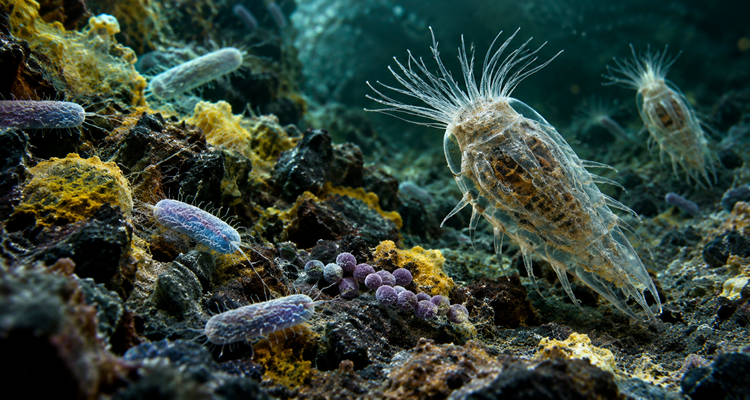
Deep beneath the seafloor, inside oxygen-starved sediments, and even within other animals, extraordinary organisms survive without the gas most complex life depends on. Their secret reveals that nature has more than one way to power life.
For humans, oxygen is essential. Without it, our cells rapidly lose the ability to produce enough energy to keep vital organs functioning. Yet across Earth, countless microscopic organisms thrive in environments where oxygen is scarce or entirely absent.
Some live in muddy sediments beneath lakes and oceans. Others inhabit underground rocks, waterlogged soils, or the digestive systems of animals. Rather than using oxygen to release energy from nutrients, certain microorganisms rely on substances such as nitrate, sulfate, or iron compounds.
And the surprises do not end with bacteria.
Scientists have identified a microscopic animal parasite that has lost the genetic machinery required for conventional oxygen-based respiration. Researchers have also reported tiny marine animals living in permanently oxygen-free sediments.
These discoveries challenge a familiar assumption: that all animals must use oxygen to survive.
But there is an important distinction. Some organisms genuinely respire using chemicals other than oxygen, while others survive through different oxygen-independent metabolic processes. Understanding that difference makes their biology even more remarkable.
What Does It Mean to Live Without Oxygen?
Most animals obtain energy through aerobic cellular respiration, a process in which cells use oxygen to help extract usable energy from nutrients.
Inside human cells, mitochondria perform a central role in this process. They help generate adenosine triphosphate, or ATP, the molecule that powers countless cellular activities.
Oxygen serves as the final electron acceptor in the mitochondrial electron transport chain. Without it, this energy-producing system cannot operate normally.
However, oxygen is not the only substance capable of accepting electrons during biological energy production.
Some microorganisms have evolved alternative chemical pathways that allow them to generate energy without using molecular oxygen.
This is known as anaerobic respiration.
The distinction matters because anaerobic respiration is not simply breathing less oxygen. It is a fundamentally different biochemical strategy.
According to the US National Academies, microorganisms can use nitrate, sulfate, certain metals, and even carbon dioxide as electron acceptors in oxygen-free environments.
In other words, the chemistry supporting life is more flexible than human physiology might suggest.
The Microbes That Use Chemicals Instead of Oxygen
These microscopic organisms possess metabolic abilities that allow them to exploit chemical resources unavailable to oxygen-dependent animals.
1. Bacteria That Respire Using Nitrate
Certain bacteria can use nitrate compounds instead of oxygen during respiration.
In some environments, these microorganisms participate in denitrification, a process that converts nitrate into other nitrogen-containing substances, potentially including nitrogen gas.
This process is especially important in soils, wetlands, sediments, and wastewater treatment systems.
It also plays a significant role in Earth’s nitrogen cycle.
Without these microorganisms, nitrogen would circulate through ecosystems very differently.
2. Microbes That Use Sulfate
Other microorganisms rely on sulfate as an electron acceptor.
Known as sulfate-reducing microorganisms, they are common in oxygen-depleted marine sediments and other suitable environments.
As they metabolize organic substances or hydrogen, they can produce hydrogen sulfide.
Hydrogen sulfide is the compound associated with the distinctive rotten-egg smell sometimes encountered in stagnant mud and certain natural waters.
The odor may be unpleasant to humans, but the underlying chemistry is part of a major ecological process.
Sulfate reduction helps recycle carbon and sulfur through environments where oxygen-based decomposition is limited.
3. Microorganisms That Use Iron
Some bacteria can obtain energy by transferring electrons to ferric iron, the oxidized form of iron represented as Fe(III).
In suitable conditions, this process converts ferric iron into ferrous iron, Fe(II).
These reactions can alter the chemistry of sediments, groundwater, and minerals.
Iron-reducing microorganisms are particularly interesting because their activities connect biology with geology.
They demonstrate that living cells can participate directly in transformations of Earth’s mineral environment.
4. Archaea That Produce Methane
Another remarkable group consists of methane-producing archaea, commonly called methanogens.
These organisms can survive in oxygen-free environments such as wetlands, sediments, and animal digestive systems.
Some use hydrogen to reduce carbon dioxide, producing methane through a metabolic process called methanogenesis.
Although this process shares features with anaerobic energy metabolism, methanogenesis has its own distinctive biochemical machinery.
These organisms are important in the global carbon cycle because methane is a powerful greenhouse gas.
Their existence also demonstrates that environments unsuitable for human respiration can support active and complex microbial ecosystems.
The Microscopic Animal That Lost Its Ability to Use Oxygen
Henneguya salminicola is a microscopic parasite related to jellyfish and other cnidarians.
One of the most surprising discoveries in oxygen-independent biology involves a microscopic parasite called Henneguya salminicola.
Despite its tiny size and unusual appearance, this organism belongs to the animal kingdom.
It is a myxozoan, part of a group of highly simplified parasitic animals evolutionarily related to jellyfish and corals.
In a study published in Proceedings of the National Academy of Sciences in 2020, researchers examined its genetic material and discovered something extraordinary.
The parasite appeared to have completely lost its mitochondrial genome.
The team also found that the organism lacked essential genes involved in conventional aerobic respiration.
This provided strong evidence that Henneguya salminicola no longer relies on oxygen-based cellular respiration.
How Did Scientists Discover This?
Researchers compared Henneguya salminicola with a related parasite, Myxobolus squamalis.
Using genetic sequencing and microscopy, they searched for mitochondrial DNA and the molecular components necessary for aerobic respiration.
The related species retained a mitochondrial genome.
Henneguya salminicola did not.
The researchers also identified major losses among genes associated with the mitochondrial electron transport chain.
Interestingly, the parasite still possessed structures resembling mitochondria, known as mitochondrion-related organelles.
These findings suggested that the organism had not simply stopped using oxygen temporarily. Its evolutionary history had fundamentally changed the cellular machinery responsible for energy production.
So What Does This Animal Use Instead?
This is where the scientific mystery becomes particularly interesting.
Researchers established that Henneguya salminicola lacks the machinery for conventional aerobic respiration, but they did not fully determine how it obtains all the energy required for survival.
It may rely on anaerobic metabolic pathways, potentially obtaining energy-rich compounds from its host.
However, its exact energy metabolism remains incompletely understood.
Crucially, scientists have not demonstrated that this parasite breathes sulfate, nitrate, or iron instead of oxygen.
Its significance lies in showing that an animal can evolve away from the oxygen-dependent cellular system found in most other animals.
The researchers also noted that laboratory cultivation difficulties make its metabolism challenging to investigate further.
Tiny Animals in the Oxygen-Free Depths of the Mediterranean
In 2010, researchers reported finding three types of tiny animals belonging to the phylum Loricifera in sediments from the L’Atalante basin.
This deep-sea environment is exceptionally hostile to most familiar animals.
Its dense, salty waters and sediments include regions where free oxygen is absent.
Yet researchers reported evidence suggesting that these microscopic animals were metabolically active in the oxygen-free sediment.
The organisms appeared to possess unusual cellular structures resembling hydrogenosomes, organelles associated with anaerobic energy metabolism in certain microorganisms.
The findings were published in BMC Biology under the title The First Metazoa Living in Permanently Anoxic Conditions.
Why Was This Discovery So Unusual?
Before this research, scientists already knew that some animals could tolerate oxygen deprivation for limited periods.
But surviving temporarily without oxygen is different from completing an entire life cycle in a permanently oxygen-free environment.
The researchers proposed that these loriciferans could live and reproduce under such conditions.
If confirmed, this would demonstrate an extraordinary adaptation among multicellular animals.
However, the interpretation has been debated, and later scientific discussions have emphasized the need for stronger evidence about the organisms’ biology.
The 2020 Henneguya salminicola study itself noted the uncertainty surrounding earlier claims about oxygen-independent loriciferans.
For that reason, the Mediterranean discovery is best understood as intriguing evidence rather than definitive proof that all the reported animals complete their life cycles without oxygen.
How Can Life Produce Energy Without Oxygen?
The key is understanding that respiration is fundamentally about transferring electrons, not simply inhaling air.
In aerobic respiration, oxygen accepts electrons at the end of a series of biochemical reactions.
This helps cells maintain the energy gradients needed to produce ATP.
Certain microorganisms use different electron acceptors to accomplish a comparable task.
Oxygen-based vs. oxygen-free respiration
Aerobic
Oxygen is the final electron acceptor
Anaerobic
Another chemical accepts electrons
Conceptual comparison. Both processes can help cells conserve energy as ATP, although the pathways and energy yields differ.
Anaerobic respiration is not identical to fermentation.
Fermentation also allows cells to generate ATP without using oxygen, but it does not rely on an external terminal electron acceptor in the same way that respiratory electron transport does.
This distinction helps explain why oxygen-independent life includes several different metabolic strategies.
There is no single alternative to oxygen that all anaerobic organisms use.
Instead, evolution has produced numerous solutions shaped by the chemistry of each environment.
Why Would Evolution Favor Life Without Oxygen?
At first, abandoning oxygen-based respiration might appear disadvantageous.
For many organisms, aerobic respiration is an efficient way to extract energy from nutrients.
But evolutionary success depends on surviving and reproducing in a particular environment, not on maximizing energy production under every possible condition.
In oxygen-poor sediments, an organism capable of using sulfate may have access to resources that oxygen-dependent competitors cannot exploit.
Similarly, parasites living within particular host tissues may benefit from metabolic systems adapted to limited oxygen availability.
Over generations, natural selection can favor organisms whose cellular machinery matches their surroundings.
In some lineages, biological systems that are no longer necessary may gradually disappear.
The loss of mitochondrial DNA in Henneguya salminicola provides an especially striking example of how far such evolutionary changes can go.
It illustrates a broader principle: biological complexity does not always increase through evolution. Organisms can also become highly specialized by losing structures and functions that their ancestors possessed.
What These Creatures Tell Us About Life Beyond Earth
The discovery of oxygen-independent organisms has implications beyond Earth’s oceans and sediments.
Astrobiologists study extreme environments because they help scientists understand which conditions may support life elsewhere.
Earth’s oxygen-rich atmosphere is not representative of every planetary environment.
Other worlds may contain liquid water, minerals, and chemical compounds without having substantial amounts of free molecular oxygen.
If microorganisms can obtain energy through chemical reactions involving iron, sulfur, or other substances on Earth, similar metabolic possibilities may be worth investigating beyond our planet.
Mars, for example, contains iron-bearing minerals, while some icy moons are considered promising targets in the search for environments that might support chemical energy sources.
However, the presence of suitable chemicals does not prove that extraterrestrial life exists.
Living organisms also require appropriate environmental conditions, accessible nutrients, and biochemical systems capable of sustaining themselves.
The important lesson is more modest but scientifically powerful.
Oxygen is not a universal prerequisite for every possible form of life.
That realization broadens the range of environments scientists can reasonably investigate when searching for life beyond Earth.
Could Humans Ever Survive Without Oxygen?
The existence of oxygen-independent organisms naturally raises a question: could humans eventually develop the same ability?
Under ordinary biological conditions, the answer is no.
Human cells depend heavily on aerobic metabolism, particularly in organs with high energy requirements such as the brain and heart.
Although some human cells can produce ATP through oxygen-independent glycolysis, this process cannot sustain the entire body indefinitely without oxygen.
The specialized metabolic adaptations of anaerobic microorganisms also cannot simply be transferred to humans.
Their biochemical systems reflect extensive evolutionary histories involving different genes, enzymes, cellular structures, and ecological conditions.
Studying them may improve scientific understanding of metabolism, but it does not mean humans are close to becoming oxygen-independent.
Why Oxygen-Free Life Matters to Earth’s Ecosystems
These tiny organisms are not merely biological curiosities.
They perform essential work in environments that are largely invisible to us.
Anaerobic microorganisms help decompose organic matter, recycle nutrients, transform metals, and influence the movement of carbon, nitrogen, and sulfur through ecosystems.
Their activities affect wetlands, oceans, soils, groundwater, and engineered wastewater systems.
Some also influence greenhouse gas production.
Without oxygen-independent microbial metabolism, many of Earth’s natural chemical cycles would function very differently.
The organisms may be microscopic, but their collective environmental influence is enormous.
Their existence also reminds scientists that visible animals represent only a small part of the planet’s biological diversity.
Much of life’s metabolic ingenuity exists in places humans rarely observe directly.
A Different Definition of What Life Needs
For humans, oxygen feels inseparable from survival.
Every breath reinforces the idea that life depends on the air around us.
But Earth’s smallest inhabitants tell a more complicated story.
Some microorganisms use nitrate, sulfate, or iron compounds to power respiration. Others generate energy through fermentation or specialized anaerobic metabolic pathways.
And at least one microscopic animal parasite has evolved so extensively that it has lost the machinery for conventional oxygen-based respiration.
These discoveries do not mean that oxygen is unimportant. It remains essential to humans and most familiar animals.
They reveal something more interesting: life is not defined by a single method of producing energy.
Across billions of years, evolution has developed multiple ways for organisms to exploit the chemistry of their surroundings.
In places where oxygen disappears, life does not necessarily disappear with it.
Sometimes, it simply finds another way to keep going.
This content is published for informational or entertainment purposes. Facts, opinions, or references may evolve over time, and readers are encouraged to verify details from reliable sources.