






The Ancient Festivals That Celebrate a New Year When the Rest of the World Thinks It’s an Ordinary Day
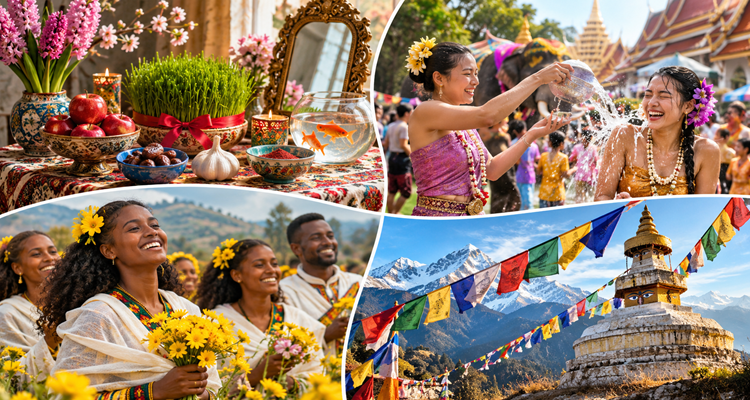
From Ethiopia’s flower-filled September celebrations to Thailand’s water-soaked April festivities, ancient New Year traditions reveal that humanity has never agreed on when a year should begin.
For much of the world, January 1 marks a fresh beginning. Calendars change, fireworks illuminate the sky, and people make resolutions for the months ahead. Yet across different cultures, some of the most meaningful New Year celebrations happen on dates that might look entirely ordinary to someone elsewhere.
In Ethiopia, September brings a new year alongside the end of the rainy season. In Iran and parts of Central Asia, the arrival of spring signals a fresh beginning. Thailand welcomes its traditional New Year in April with water, blessings, and family reunions. Across Himalayan communities, a lunar calendar determines when another year begins.
These celebrations are not simply alternative versions of January 1. They preserve different ways of understanding time, nature, community, and renewal.
The fascinating truth is that New Year’s Day has never belonged to a single date. Its meaning depends on the calendar a society follows, the natural cycles it recognizes, and the traditions it chooses to preserve.
Why Does the New Year Begin on Different Dates?
The Gregorian calendar, used internationally for most civil and commercial purposes, begins on January 1. But it is only one of several systems through which people have organized the passage of time.
Historically, calendars often developed around three important observations: the movement of the Sun, the phases of the Moon, and the changing agricultural seasons.
Solar calendars track the Earth’s yearly journey around the Sun. Lunar calendars organize months around the Moon’s phases. Lunisolar calendars combine lunar months with adjustments that keep them aligned with the seasons.
For farming communities, the beginning of a new agricultural cycle could be more significant than an administratively chosen date. For religious communities, a sacred calendar might determine when renewal, reflection, and celebration should occur.
That is why New Year traditions remain remarkably diverse. Some coincide with spring, others with autumn, and still others move across the Gregorian calendar from year to year.
1. Nowruz: The Persian New Year That Arrives With Spring
Long before January 1 became the internationally familiar beginning of the year, communities across the ancient Persian cultural world were celebrating renewal with the arrival of spring.
That tradition continues through Nowruz, a name that means new day in Persian.
Nowruz is closely associated with the spring equinox, when the Sun crosses the celestial equator and the Northern Hemisphere enters astronomical spring. Its roots extend back more than 3,000 years, and the celebration has connections to ancient Iranian religious and cultural traditions.
Today, Nowruz is observed by communities across numerous countries and among diasporas worldwide.
One of its best-known customs is the Haft-Sin table, traditionally arranged with seven symbolic items whose Persian names begin with the letter sin. These may include sprouts representing renewal, apples associated with beauty and health, and vinegar symbolizing patience and maturity.
Families clean their homes, prepare festive meals, visit relatives, and welcome the season with renewed hopes.
Yet Nowruz is more than a spring festival. It expresses a view of time in which the natural world’s awakening offers a meaningful moment for human renewal.
UNESCO recognizes Nowruz as intangible cultural heritage, reflecting its importance across multiple societies.
2. Songkran: Thailand’s New Year Celebrated With Water
Every April, parts of Thailand transform into scenes of joyful water celebrations. Streets fill with people carrying water containers, families gather, and visitors encounter one of Southeast Asia’s most recognizable festivals.
But Songkran is far older and more meaningful than its famous public water fights suggest.
Songkran marks Thailand’s traditional New Year and is associated with the Sun’s transition into Aries in traditional astrological reckoning.
Water has a central symbolic role. Pouring it respectfully over the hands of elders expresses gratitude and seeks blessings. Ritual bathing of Buddha images symbolizes purification and reverence.
Families also visit temples, make offerings, remember ancestors, and spend time together.
The festival therefore connects several forms of renewal: cleansing away misfortune, restoring family relationships, honoring spiritual traditions, and welcoming prosperity.
Although Thailand uses January 1 as its official civil New Year, Songkran remains an important cultural celebration.
In 2023, UNESCO inscribed Songkran on its Representative List of the Intangible Cultural Heritage of Humanity, recognizing the traditions and community relationships associated with the festival.
3. Enkutatash: Ethiopia’s New Year Begins in September
When: Usually September 11, or September 12 in the relevant leap-year cycle | Where: Ethiopia
For someone following the Gregorian calendar, September 11 might seem like an ordinary date. In Ethiopia, however, it marks a new beginning.
The Ethiopian New Year, known as Enkutatash, follows the Ethiopian calendar, which differs from the Gregorian system in both its year numbering and structure.
The Ethiopian calendar contains 12 months of 30 days each, followed by a short thirteenth month of five or six days.
Enkutatash arrives as the rainy season gives way to brighter skies and renewed vegetation.
Yellow Adey Abeba flowers become especially associated with the celebration. Children may sing traditional songs, visit neighbors, and offer flowers or drawings.
The name Enkutatash is commonly translated as gift of jewels, a phrase linked in Ethiopian tradition to stories about the Queen of Sheba.
The festival’s importance, however, extends beyond its traditional stories. It connects the beginning of a year to the visible transformation of the landscape.
While many Northern Hemisphere cultures associate spring with March or April, Ethiopia’s seasonal experience gives September its own sense of renewal.
The country’s official tourism materials describe Enkutatash as a celebration of the end of the rains, the arrival of flowers, and the beginning of a fresh year.
4. Losar: A Himalayan New Year Guided by the Moon
When: Varies, generally February or March | Where: Tibetan and Himalayan communities
In the Himalayan world, the arrival of a new year is not always announced by a fixed date on the international calendar.
Instead, lunar and lunisolar traditions help determine when the celebration begins.
Losar, meaning New Year, is observed in different forms among Tibetan and Himalayan communities, including Sherpa, Tamang, and Gurung populations.
The celebrations are not identical. Different communities follow distinct traditions and may observe their New Year on different dates.
Preparation often begins before the festival itself. Families clean their homes, prepare special foods, and arrange offerings.
Prayer flags, incense, religious observances, and gatherings with relatives may form part of the celebrations.
In some communities, rituals honor protective deities and express wishes for well-being in the coming year.
What distinguishes Losar is the relationship between spiritual life and the passage of time.
The festival is not merely a celebration of another completed year. It is also an opportunity to renew religious commitments, strengthen relationships, and seek blessings for the future.
UNESCO’s documentation of Himalayan Losar traditions emphasizes both their diversity and their continuing importance to community identity.
5. Thingyan: Myanmar’s New Year of Cleansing and Generosity
Myanmar’s traditional New Year celebration, Thingyan, shares certain features with Thailand’s Songkran, especially the use of water.
But Thingyan has its own history, calendar, and cultural expressions.
The festival generally lasts five days, with its exact timing determined through Myanmar’s traditional calendar system.
Water is used to symbolize the removal of the previous year’s troubles. Public celebrations can include playful splashing, but many activities focus on spiritual and communal responsibilities.
People may offer food, support charitable activities, meditate, visit religious sites, and honor older family members.
Some communities arrange flowers and leaves associated with the days of the week in decorative vessels placed outside their homes.
An especially meaningful feature is the emphasis on generosity. Welcoming a new year becomes an occasion to contribute to the well-being of others.
Thingyan was inscribed on UNESCO’s Representative List of the Intangible Cultural Heritage of Humanity in 2024.
The recognition highlights how the festival continues to transmit cultural knowledge through family participation, public celebrations, and religious practice.
6. Gifaataa: An Ethiopian New Year That Begins With Reconciliation
When: Between mid-September and early October | Where: Wolaita community, Ethiopia
Not every New Year tradition is primarily concerned with changing seasons or symbolic purification.
Among the Wolaita people of southern Ethiopia, Gifaataa places particular importance on repairing relationships before the next year begins.
Families prepare by cleaning their surroundings and returning home to reunite with relatives.
Disputes may be resolved as part of the preparations, reflecting the idea that a fresh beginning should not carry forward unresolved hostility.
The festival includes traditional meals, blessings from elders, music, dancing, and communal bonfires.
Celebrations extend over several days and conclude with a major community gathering known as goolo-igetta, which can include horse riding and further blessings.
Gifaataa offers a particularly meaningful interpretation of renewal: a new year is not simply something that happens when a calendar changes. It is something a community prepares for through reconciliation and shared responsibility.
UNESCO added Gifaataa to its Representative List of the Intangible Cultural Heritage of Humanity in 2025, recognizing its role in preserving Wolaita traditions and strengthening intergenerational connections.
What These New Year Festivals Have in Common
Although these traditions developed in different cultural and geographic settings, several recurring themes emerge.
Nowruz follows the arrival of spring, while Enkutatash reflects Ethiopia’s seasonal transformation. Natural cycles give the passage of time visible meaning.
Water rituals during Songkran and Thingyan symbolize purification and the hope of leaving past misfortunes behind.
Family reunions, respect for elders, shared meals, and reconciliation are central to many traditional New Year celebrations.
Maintaining a traditional New Year allows communities to pass on historical knowledge, spiritual practices, and collective memories.
A Calendar of New Years Beyond January 1
The following table offers a practical overview. Dates are approximate where traditional calendar calculations or regional customs produce variations.
| Festival | Usual Gregorian timing | Principal cultural setting |
|---|---|---|
| Losar | February–March, varying | Tibetan and Himalayan communities |
| Nowruz | March 20–21 | Iranian and Central Asian cultural traditions |
| Songkran | April 13–15 | Thailand |
| Thingyan | Mid-April | Myanmar |
| Enkutatash | September 11 or 12 | Ethiopia |
| Gifaataa | Mid-September–early October | Wolaita, Ethiopia |
These dates should not be treated as interchangeable. Each festival has its own cultural significance, and some communities observe additional days or follow different local calendars.
Why Ancient New Year Traditions Still Matter
Modern life depends on standardized timekeeping.
International travel, scientific research, financial transactions, and digital communication would become considerably more complicated without broadly shared calendar conventions.
But a common civil calendar does not eliminate the need for cultural calendars.
A society can use January 1 for administrative purposes while continuing to recognize another date as a meaningful religious, seasonal, or traditional beginning.
These overlapping systems reveal something important about cultural continuity.
Traditions do not necessarily disappear when societies adopt new technologies or administrative practices. They can adapt, coexist, and retain meanings that a standardized calendar cannot fully express.
For younger generations, annual festivals also provide opportunities to learn songs, prepare traditional foods, understand rituals, and hear stories from older relatives.
Their continued celebration helps preserve forms of knowledge that might otherwise be difficult to transmit.
At the same time, these festivals are not frozen remnants of the ancient world. They are living traditions. Public celebrations change, urban lifestyles influence participation, and communities reinterpret customs while maintaining connections to their histories.
That ability to adapt is part of what keeps them relevant.
Is January 1 Really the Beginning of the Year?
In the Gregorian calendar, yes.
But the calendar itself does not establish a universal cultural or natural beginning to time.
A year describes an astronomical cycle, while the decision about where to mark its beginning is shaped by human convention.
Different civilizations developed different answers based on their environments, beliefs, and historical experiences.
January 1 is therefore a widely shared starting point, not the only meaningful one.
For someone celebrating Nowruz, the spring equinox can express a deeper sense of renewal. For a family observing Enkutatash, September may represent the year’s most significant transition. For communities celebrating Losar, a lunar calendar connects the occasion to longstanding spiritual traditions.
None of these systems becomes less meaningful simply because another calendar is more widely used internationally.
The World Has More Than One Beginning
Imagine looking at an ordinary date on your phone and discovering that, somewhere else, families are preparing festive meals, exchanging blessings, visiting sacred places, or gathering to welcome a new year.
The contrast is a reminder that calendars do more than count days. They reflect how people understand their relationship with nature, history, spirituality, and one another.
The ancient New Year festivals that survive today preserve different answers to the same human question: When should we begin again?
For some, the answer comes with spring flowers. For others, it arrives with the rains ending, the Moon’s changing phases, or the symbolic washing away of the past.
And perhaps that is the most meaningful lesson these traditions offer.
A new beginning does not have to wait until January 1.
Sometimes, what looks like an ordinary day on one calendar is the most important day of the year on another.
This content is published for informational or entertainment purposes. Facts, opinions, or references may evolve over time, and readers are encouraged to verify details from reliable sources.