









The Electricity That Goes to Waste Because Nobody Needs It at the Right Time
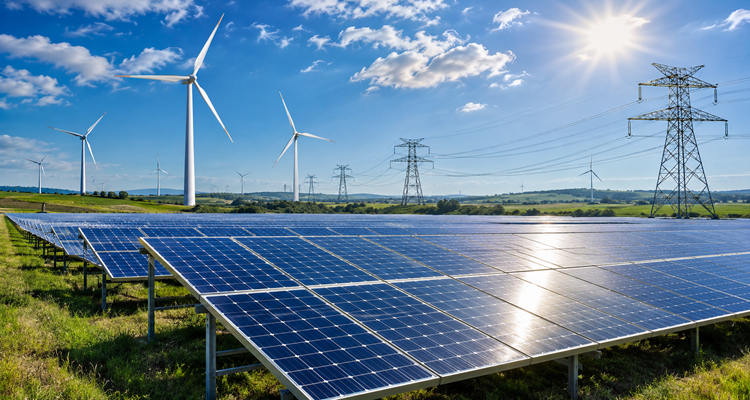
Solar panels can produce more electricity than the grid can use, while wind turbines may be forced to slow down even when the wind is blowing. This overlooked problem reveals why the future of clean energy depends not only on generating more power, but also on using it at the right time.
A solar farm can be producing electricity under a bright afternoon sun, with every panel ready to turn sunlight into useful energy. Yet some of those panels may be instructed to reduce their output. Elsewhere, wind turbines may stand idle or spin below their potential despite favorable wind conditions.
Nothing is necessarily wrong with the equipment. The sunlight is available. The wind is blowing. The electricity could be generated.
The problem is that the power system cannot use all of it at that particular moment.
This phenomenon is called renewable energy curtailment. It occurs when solar and wind facilities produce less electricity than they could because of insufficient demand, transmission bottlenecks, or operational requirements needed to keep the grid stable.
It sounds contradictory in a world trying to produce more clean electricity. But it exposes an increasingly important challenge: generating electricity and having electricity available when people need it are two different achievements.
The invisible waste in a system built for instant consumption
Electricity has an unusual characteristic compared with many other products: in a conventional power grid, generation and consumption must remain closely balanced in real time.
A farmer can store harvested grain. A factory can keep manufactured goods in a warehouse. But electricity cannot simply accumulate inside transmission wires until someone decides to use it.
It must be consumed, stored through suitable technology, exported elsewhere, or prevented from being generated.
Grid operators continuously adjust the system to maintain this balance. When electricity production exceeds what the network can safely absorb, some generating facilities must reduce output.
For solar and wind farms, that means allowing some of the available renewable energy potential to go unused.
There is an important distinction here. Curtailed electricity is generally not electricity that was generated and then thrown away. It is electricity that could have been generated but was not.
That distinction matters because curtailment is different from the energy lost as heat in transmission lines or inefficient equipment.
The U.S. National Renewable Energy Laboratory explains that curtailment can arise from system-wide oversupply, grid security requirements, and local transmission constraints.
How much renewable electricity is being left unused?
GLOBAL TECHNICAL CURTAILMENT | IEA 2026 REPORT
Nearly 200 TWh
Estimated wind and solar electricity generation curtailed in major markets during 2025.
Source: IEA Renewables 2026. The 2031 figure is a projection, not an observed result.
The International Energy Agency’s Renewables 2026 report estimates that technical curtailment of wind and solar power in major markets nearly doubled in 2024 and again in 2025.
Its analysis indicates that curtailed renewable generation approached 200 terawatt-hours in 2025. Under its main projection, that amount could exceed 800 terawatt-hours by 2031.
A terawatt-hour is one billion kilowatt-hours, making these quantities significant even on the scale of national electricity systems.
However, these numbers need context.
The IEA reports that curtailed wind and solar electricity represented less than 5% of total variable renewable generation in major markets in 2025. In other words, most available renewable electricity was still being used.
The problem is not that renewable energy has become broadly unusable. It is that the difficulty of absorbing additional generation is growing in certain places and at certain times.
Why the sunniest hours can be the least useful
Solar power creates a particular scheduling challenge because its strongest production often occurs around the middle of the day.
Electricity demand does not necessarily follow the same pattern.
On a mild spring afternoon, offices may be operating normally, but residential heating and cooling demand can be relatively low. Solar installations may be producing substantial amounts of electricity while the grid has limited additional demand.
Later, as the sun begins to set, people return home, switch on lights, prepare meals, and use household appliances.
Demand can rise just as solar production falls.
This creates a mismatch between the hours when electricity is abundant and the hours when it is especially valuable.
Consider a simplified example:
| Time | Solar supply | Electricity demand |
|---|---|---|
| 12 p.m. | Very high | Moderate |
| 3 p.m. | High | Moderate |
| 7 p.m. | Low | High |
| 10 p.m. | None | Moderate |
Illustrative daily pattern, not measured data. Actual demand varies by region, weather, and season.
Without sufficient storage, flexible demand, or transmission connections, the grid may reject some midday solar output and then rely on other energy sources in the evening.
This is one reason why installing more solar panels does not automatically solve every electricity supply problem.
The panels may increase the amount of energy available across the year without necessarily increasing supply during the hours when it is most needed.
California shows how the mismatch works
California provides a well-documented example of renewable energy curtailment.
According to the U.S. Energy Information Administration, the California Independent System Operator curtailed approximately 3.4 million megawatt-hours of utility-scale wind and solar generation in 2024, a 29% increase over 2023.
Solar accounted for 93% of the curtailed energy.
Curtailment was especially pronounced during spring, when solar production was strong and electricity demand was relatively modest.
The issue was not simply that California had installed too many solar panels.
Its electricity network also faced transmission constraints, while some conventional generating units needed to remain available for reliability and evening demand.
This combination illustrates a broader challenge: the grid must coordinate not just how much electricity is produced, but where it is produced, how quickly other generators can adjust, and when consumers require power.
California has expanded battery storage to help address the mismatch. Batteries can absorb some of the midday solar surplus and deliver electricity several hours later.
But storage does not eliminate every constraint, particularly when periods of abundant renewable production last longer than available storage capacity.
Sometimes electricity is needed, but the wires cannot deliver it
The phrase “nobody needs the electricity” describes only part of the problem.
Sometimes consumers need power, but they are located too far from the renewable energy source, or the transmission network lacks sufficient capacity to move additional electricity safely.
Imagine a wind farm generating substantial power in a sparsely populated region.
A distant city could use that electricity. But if the transmission lines connecting the two locations are already operating near their limits, the wind farm may have to reduce production.
The electricity is not unwanted. It is stranded.
This is known as transmission congestion.
It explains why building renewable generation without adequate grid infrastructure can produce disappointing results.
A country may have excellent wind resources in one region and high electricity demand in another. Without sufficient transmission capacity, those advantages cannot be fully combined.
The IEA’s analysis of modern electricity grids identifies congestion and renewable curtailment as growing challenges, emphasizing that expanding generation and improving network operations must happen together.
Why electricity prices can sometimes turn negative
An especially surprising consequence of oversupply is that wholesale electricity prices can fall below zero.
Under certain market conditions, generators may effectively pay to continue supplying electricity rather than immediately reduce production.
This can happen because of contractual arrangements, financial incentives, or the technical and economic costs of changing a generator’s output.
Negative wholesale prices do not mean that every household suddenly receives free electricity.
Retail bills generally include network charges, taxes, and other costs, while consumer tariffs may not reflect real-time wholesale prices.
Still, negative prices reveal something important about electricity’s changing value.
A kilowatt-hour produced during a shortage can be extremely valuable. The same quantity produced during a period of oversupply may have little or even negative market value.
The IEA has documented an increasing number of negative-price hours in several electricity markets as renewable generation expands.
The implication is significant: the economic value of electricity increasingly depends on when and where it is available, not merely how much is produced.
The technologies that could rescue otherwise unused electricity
There is no single solution to renewable energy curtailment. Different technologies address different parts of the problem.
Batteries can charge when electricity is abundant and release it when demand rises. They are especially useful for shifting solar electricity from midday into the evening.
Surplus electricity pumps water uphill into a reservoir. When electricity is needed, the water flows downhill through turbines to generate power.
Stronger connections between regions allow surplus electricity to reach consumers elsewhere, reducing the need to curtail local generation.
Electric vehicles, industrial equipment, water heaters, and other suitable loads can sometimes shift consumption toward periods of abundant electricity.
Each approach has limitations.
Batteries have finite storage capacity and lose some energy during charging and discharging. Pumped-storage facilities require appropriate geography and substantial infrastructure. New transmission lines can take years to plan and construct.
Flexible demand also depends on consumer needs. Hospitals, essential industrial processes, and many household activities cannot simply stop or move to a different hour.
The IEA emphasizes that effective renewable integration requires a combination of storage, stronger networks, flexible demand, and coordinated planning rather than reliance on one technology.
What if we changed when we use electricity?
For more than a century, electricity systems have largely been designed to adjust generation to meet demand.
Renewable energy introduces another opportunity: adjust some demand to take advantage of generation.
This does not mean asking people to reorganize their entire lives around the weather.
It means identifying electricity-consuming activities that can happen at different times without reducing convenience, safety, or productivity.
An electric vehicle parked for several hours may not need to begin charging immediately. A commercial refrigeration system may be able to shift some cooling activity within safe temperature limits. Certain industrial processes can be scheduled around periods of inexpensive electricity.
Smart charging systems and automated controls can make some of these adjustments without requiring constant human decisions.
This approach is known as demand flexibility.
In a December 2025 policy brief, the IEA explained that shifting electricity consumption in response to system conditions can improve the use of existing infrastructure, reduce curtailment, and support renewable energy integration.
The larger idea is that flexibility itself has economic value.
Instead of always building enough generation and infrastructure to satisfy every possible demand pattern, electricity systems can sometimes become more efficient by coordinating when suitable activities occur.
Could surplus electricity be used for something entirely different?
Not all excess renewable energy must be stored as electricity.
It can sometimes be converted into another useful form.
Surplus electricity could power heat pumps or electric boilers that store energy as heat for later use. It could support hydrogen production through electrolysis, where electricity splits water into hydrogen and oxygen. It could also supply flexible industrial processes.
These possibilities are attractive because they connect the electricity system with other parts of the economy.
However, turning electricity into another energy carrier and later converting it back generally involves losses.
Producing hydrogen, for example, does not guarantee that using the surplus electricity will be economically worthwhile. Equipment costs, operating hours, infrastructure, and demand for the hydrogen all affect feasibility.
The same applies to attracting energy-intensive industries to areas with abundant renewable generation.
A factory cannot necessarily operate profitably on electricity that is available only unpredictably.
The practical question is not simply whether surplus power can be consumed. It is whether that use delivers enough value to justify the necessary equipment and investment.
Why some renewable energy curtailment may actually be sensible
It is tempting to assume that every unused kilowatt-hour represents a failure.
But eliminating curtailment entirely may be neither technically necessary nor economically desirable.
Imagine a solar farm that produces more electricity than the local network can absorb for a small number of hours each year.
Building an expensive transmission line or a large battery solely to capture that occasional surplus might cost more than the electricity is worth.
In that situation, allowing limited curtailment could be the more economical choice.
Researchers at the National Renewable Energy Laboratory have examined how some curtailment can be compatible with reliable, cost-effective power systems that contain large amounts of wind and solar generation.
The important distinction is between occasional, economically reasonable curtailment and persistent curtailment caused by avoidable infrastructure or planning deficiencies.
A small amount of unused renewable potential does not necessarily indicate a poorly designed grid.
But steadily increasing curtailment can signal that electricity generation is expanding faster than the system’s ability to accommodate it.
This distinction matters when evaluating renewable energy projects, government policies, and claims about wasted clean electricity.
The environmental cost of electricity that never gets used
When renewable electricity is curtailed, the immediate consequence is lost clean generation potential.
The broader environmental impact depends on what happens elsewhere in the electricity system.
If curtailed solar power could have been stored and later displaced electricity from a fossil-fuel power plant, capturing it might have reduced emissions.
If the same electricity had no realistic way to reach demand, the avoided emissions would be less certain.
Renewable curtailment therefore cannot automatically be converted into a precise quantity of wasted emissions without examining the electricity sources that would otherwise have been used.
There are also economic consequences.
Solar panels, wind turbines, land, grid connections, and supporting infrastructure require investment. When renewable facilities produce less electricity than expected, the revenue available to recover those investments may decline.
Depending on market arrangements, some costs may fall on developers, utilities, consumers, or public authorities.
The IEA notes that curtailment can reduce renewable project revenues and, in certain electricity markets, create additional costs when generators receive compensation for output restrictions.
That makes curtailment more than an engineering problem. It is also a question of how effectively societies use the infrastructure they have already paid to build.
The next energy challenge is coordination
For decades, much of the public discussion about clean energy has centered on a straightforward question: how can we generate more electricity without burning fossil fuels?
That question remains essential.
But as solar and wind power expand, another question becomes increasingly important: how can electricity systems make better use of the energy that is already available?
The answer involves coordination across several dimensions.
Electricity must reach the right location. It must arrive at the right time. Storage must bridge some gaps between production and consumption. Flexible equipment must respond when conditions change. Grid operators must maintain reliability throughout.
These are interconnected challenges.
More solar capacity can increase midday supply, but it cannot directly provide electricity after sunset. More batteries can shift energy between hours, but they cannot solve every seasonal shortage. More transmission can connect regions, but it cannot guarantee that distant areas will always have surplus generation available.
A resilient electricity system needs a balanced combination of these capabilities.
The IEA’s Renewables 2026 outlook projects continued growth in wind and solar generation alongside increasing pressure on grid flexibility. Its findings suggest that investment in renewable capacity must be accompanied by improvements in the systems that deliver and manage electricity.
The real lesson of wasted electricity
The electricity that goes unused because nobody needs it at the right time reveals a limitation in how energy systems have traditionally been understood.
We often measure progress by counting the number of solar panels installed, wind turbines constructed, or megawatts of generating capacity added.
Those measurements are important, but they do not tell the whole story.
A successful electricity system must do more than produce large amounts of power. It must deliver useful energy reliably, affordably, and when people actually need it.
Some curtailment will remain a normal part of that system. The goal is not necessarily to capture every possible kilowatt-hour, regardless of cost.
The goal is to avoid wasting valuable opportunities to use clean electricity simply because generation, infrastructure, and demand are poorly aligned.
The future of renewable energy will therefore depend not only on how much sunlight and wind we can capture, but on how intelligently we connect production with consumption.
The next major improvement in clean electricity may come not from generating another unit of power, but from finding a better use for the power we already have the ability to produce.
The information presented in this article is based on publicly available sources, reports, and factual material available at the time of publication. While efforts are made to ensure accuracy, details may change as new information emerges. The content is provided for general informational purposes only, and readers are advised to verify facts independently where necessary.
Related News
- The Power Plants That Get Paid to Stop Producing Electricity
- The Electricity Your Neighbour Uses That Could Make Your Own Power Bill Smaller
- The Electricity We Waste Because Buildings Cannot Predict an Empty Room
- The Energy Paradox of Efficiency: Why Using Less Electricity Does Not Always Mean Using Less Energy