









The Electricity Your Neighbour Uses That Could Make Your Own Power Bill Smaller
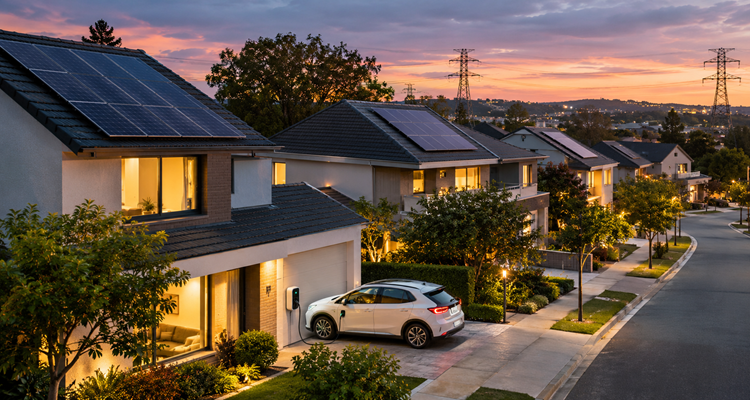
Your electricity bill may depend on more than how much power you consume. The time your neighbours use electricity, and how an entire community manages demand, can influence the cost of keeping the lights on.
Electricity is usually treated as a private expense. You switch on your appliances, your meter records the energy consumed, and your supplier sends a bill. What happens in the house next door might seem irrelevant.
But electricity networks do not operate one household at a time.
When thousands of homes charge electric vehicles, run air conditioners, heat water or cook dinner simultaneously, the electricity system must accommodate that combined demand. Meeting short periods of exceptionally high demand can require expensive generation, additional network capacity and other resources that ultimately contribute to electricity costs.
Now imagine that some of those households change when they use electricity. A neighbour charges their electric car later in the evening. Another household runs its dishwasher when electricity is plentiful. Someone with a home battery supplies stored energy during a busy period instead of drawing power from the grid.
Individually, these changes may be small. Collectively, they can reduce pressure on the electricity system and potentially help contain costs for everyone connected to it.
This is the principle behind demand flexibility, an increasingly important approach to managing electricity systems.
The surprising part is that reducing electricity costs does not always require producing more power. Sometimes, it means making better use of the electricity and infrastructure already available.
Why Your Neighbour’s Electricity Use Matters
The electricity grid is a shared system. Although individual households have separate meters and bills, their combined electricity consumption determines how much power the network must deliver at any given moment.
Electricity demand changes throughout the day.
During relatively quiet periods, many homes consume modest amounts of power. But demand can rise sharply when people return from work, prepare meals, turn on heating or cooling equipment, and use other electrical appliances.
These simultaneous activities create what electricity operators call peak demand.
Peak demand matters because the system must be capable of meeting high levels of consumption even if those levels occur for only a few hours.
That can mean maintaining generation capacity that operates infrequently, reinforcing electricity networks or purchasing power when wholesale prices are elevated.
The International Energy Agency’s research on demand flexibility explains that adjusting when electricity is consumed can improve the use of existing infrastructure, reduce stress during peak periods and lower system costs.
This creates an important connection between households.
Your neighbour’s electricity use does not directly appear on your meter. However, when many households change their consumption patterns, they can influence the costs of operating the shared network.
Those costs may eventually affect electricity tariffs, network charges or the need for future infrastructure investment.
The distinction is essential: a neighbour using electricity differently will not automatically reduce your next bill. The potential benefit comes from coordinated changes across the system and from how electricity markets and regulators distribute the resulting savings.
The Hidden Cost of Everyone Using Electricity at Once
Consider two fictional neighbourhoods with 1,000 homes each.
In both neighbourhoods, households consume exactly the same total amount of electricity over a day.
In the first neighbourhood, most households use their largest appliances between 6 p.m. and 8 p.m.
In the second, some households shift flexible activities to other hours. Electric vehicles charge later, water heaters operate at different times, and batteries help supply power during the evening peak.
Both neighbourhoods may consume the same total number of kilowatt-hours.
Yet the second neighbourhood places a lower maximum demand on the electricity network.
That difference can be economically significant.
Electricity infrastructure must be designed to handle high-demand periods, not merely average consumption. Reducing those peaks can help operators use existing assets more efficiently and, under suitable conditions, delay expensive upgrades.
The International Energy Agency identifies lower peak stress, reduced infrastructure requirements and improved renewable-energy integration among the potential benefits of flexible electricity demand.
In other words, the timing of electricity use can matter almost as much as the total quantity consumed.
How Using More Electricity at the Right Time Can Help
There is another side to this idea.
Reducing consumption during peak periods is useful, but increasing consumption at certain times can also benefit the grid.
This may sound contradictory. After all, households are often encouraged to use less electricity.
The explanation lies in how electricity supply changes throughout the day.
Solar panels can generate substantial electricity during sunny periods. Wind turbines may produce more power during windy conditions, including times when demand is relatively low.
When electricity generation exceeds what the system can conveniently use or export, operators may have to limit renewable generation. In some markets, wholesale electricity prices can become extremely low or even negative.
Flexible consumption can help absorb some of that available power.
For example, a household might charge an electric vehicle during a period of abundant solar generation rather than waiting until a more expensive evening peak.
The household still uses electricity. But it uses electricity at a time when doing so may be more helpful to the system.
The International Energy Agency’s Electricity 2026 analysis highlights the growing importance of shifting demand in both directions: reducing consumption when electricity is scarce and increasing it when supply is abundant.
This is why future electricity systems may increasingly reward not just energy conservation, but also flexibility.
The Technology That Can Turn Neighbourhoods Into Virtual Power Plants
Despite its name, a virtual power plant is not a conventional power station.
It is a coordinated collection of smaller energy resources that can operate together to support the electricity system.
These resources can include rooftop solar panels, home batteries, electric vehicles, smart thermostats and equipment capable of adjusting electricity consumption.
A virtual power plant uses software, communication systems and agreed operating arrangements to coordinate these resources.
Imagine 500 homes equipped with compatible smart devices.
On a particularly demanding evening, a programme might coordinate participating batteries to discharge stored electricity, delay some vehicle charging and make small adjustments to heating or cooling equipment.
The combined effect can reduce the amount of electricity the neighbourhood needs from the wider grid during that period.
From the electricity system’s perspective, this coordinated response can provide a service similar to additional generation capacity or storage.
The US Department of Energy has identified virtual power plants as a potentially lower-cost way to help meet peak electricity demand and reduce some infrastructure requirements. Its research also highlights the role of distributed energy resources in improving grid reliability.
However, virtual power plants do not eliminate the need for conventional electricity infrastructure. Their usefulness depends on factors such as available equipment, customer participation, local network conditions and programme design.
Why coordination matters more than individual devices
A single household battery may have little effect on regional electricity demand.
Thousands of batteries responding together can make a much larger difference.
The same principle applies to electric vehicles and smart appliances.
A single electric vehicle charging at midnight is simply a household using electricity. Thousands of vehicles charging at carefully coordinated times become a potentially valuable resource for the electricity network.
That is the central idea: the benefit comes from turning many small, flexible decisions into a predictable system-wide response.
A Real-World Example: Getting Rewarded for Changing Electricity Use
The United Kingdom provides a practical example of how households can be encouraged to support the grid.
Its Demand Flexibility Service, operated by the National Energy System Operator (NESO), allows eligible households and businesses to receive rewards for adjusting electricity consumption during designated events.
The service began in winter 2022 and subsequently expanded into a year-round arrangement.
In April 2026, it evolved to support incentives for both reducing electricity use during certain periods and increasing consumption when additional demand would help balance the system.
Participants generally join through an approved electricity supplier or aggregator. During an event, the provider explains the relevant period, the action being rewarded and the applicable terms.
For example, a household may receive an incentive for delaying an energy-intensive activity until after a period of high demand.
The financial rewards are not necessarily large.
According to the Centre for Sustainable Energy, participants in 2025 typically saved approximately £1–£5 per event, although individual outcomes depended on consumption patterns and programme arrangements.
The significance lies in what happens when many households participate.
Instead of relying exclusively on additional electricity generation, the system can pay customers to help manage demand.
This demonstrates that household flexibility has an economic value, even if individual payments are relatively modest.
How Much Could Flexible Electricity Use Actually Save?
Savings depend heavily on electricity prices, household equipment, tariff structures and the amount of consumption that can realistically be shifted.
In its December 2025 report, the International Energy Agency estimated that households using dynamic electricity tariffs can typically save around 5–15% on electricity costs. This is a broad estimate, not a guaranteed result for every customer.
To illustrate what a change in timing could mean, consider a hypothetical electricity tariff.
Illustrative electricity cost calculator
Adjust the daily electricity shifted and the price difference between peak and off-peak hours.
Electricity shifted per day
4 kWh
0.15 currency units
18.00
Currency units
Annual savings (365 days)
219.00
Currency units
Illustrative calculation only. Assumes the same electricity consumption is shifted every day. Excludes standing charges, taxes, equipment costs and tariff changes.
The calculation shows how the same amount of electricity can cost less simply because it is consumed at a different time.
However, a household paying a single flat rate throughout the day would not normally receive this direct saving from changing its consumption schedule.
That household might still benefit indirectly if widespread flexibility eventually reduces electricity system costs and those reductions are passed through to customers.
These are two different mechanisms, and they should not be confused.
Why Lower Grid Costs Do Not Automatically Mean Lower Bills
There is an important complication in the relationship between neighbourhood electricity use and household bills.
Electricity bills contain more than the cost of generating electricity.
Depending on the country and tariff, they can include transmission and distribution costs, supplier operating expenses, taxes, policy charges and other regulated components.
Reducing peak electricity demand can lower some costs faced by network operators and electricity suppliers.
But that does not guarantee that an individual customer’s bill will fall immediately.
Several factors determine whether the benefit reaches households:
-
Electricity market rules: Some markets allow demand flexibility to compete directly with generation or other grid services.
-
Tariff design: Time-of-use tariffs can pass price differences to consumers more directly than flat-rate tariffs.
-
Regulatory decisions: Network cost savings may influence future regulated charges, rather than appearing immediately.
-
Participation incentives: Some programmes pay participating households, while others provide broader system benefits.
-
Actual performance: Savings depend on whether demand changes reduce costly peaks or other system constraints.
This distinction is particularly important when assessing claims that smart grids or virtual power plants will make electricity cheaper for everyone.
The technology can create economic benefits. Whether those benefits are shared fairly is partly a matter of market design and public policy.
What Happens If Your Neighbours Have Solar Panels?
Rooftop solar introduces another dimension to neighbourhood electricity economics.
A household with solar panels may produce more electricity than it consumes during sunny periods.
Depending on its equipment and local regulations, that surplus may be exported to the electricity network, stored in a battery or used to power additional appliances.
Locally generated solar electricity can sometimes reduce the amount of power that must be imported from elsewhere.
However, the financial implications depend on the network.
If many homes export large quantities of solar electricity simultaneously, local distribution infrastructure can experience congestion or voltage-management challenges.
This means that solar generation alone does not necessarily eliminate network costs.
Combining solar panels with batteries and flexible consumption can be more useful because electricity can be stored or consumed when it provides greater value.
For example, a neighbourhood battery might absorb surplus solar generation during the afternoon and discharge electricity during the evening peak.
Such arrangements can reduce peak imports, although their financial attractiveness depends on equipment costs, battery performance, market rules and local conditions.
The wider lesson is that producing electricity locally is only part of the equation. Managing when that electricity is used can be equally important.
Could Everyone Benefit, Even Without Smart Devices?
One of the strongest arguments for demand flexibility is that its potential benefits are not necessarily limited to households that own expensive technology.
If coordinated flexibility reduces the need for costly infrastructure, some savings may eventually be reflected in electricity prices or network charges across a wider customer base.
The International Energy Agency identifies lower system costs as one of the broader benefits of demand flexibility.
But there is an important question of fairness.
Households with electric vehicles, batteries and smart heating systems may have greater opportunities to earn rewards or avoid expensive electricity periods.
Meanwhile, renters, lower-income households and people who cannot easily change their electricity use may have fewer options.
Some households must maintain electricity consumption for essential heating, medical equipment or other needs.
A well-designed flexibility programme should not assume that every customer can respond in the same way.
Research published by the UK energy regulator Ofgem in October 2026 found that incentives to reduce peak-time consumption produced modest results in its trials. The research also found that some customers in vulnerable circumstances responded positively when rewards were accessible and understandable.
These findings suggest that incentives can help, but their design matters.
An electricity system that becomes more flexible should ideally reduce costs without placing disproportionate financial pressure on households least able to adjust their consumption.
What You Can Do to Benefit From Flexible Electricity
You do not need to own solar panels or a home battery to explore whether electricity flexibility could save you money.
The most useful starting point is understanding your existing tariff and when you consume electricity.
Check how your electricity is priced.
Find out whether your tariff charges the same rate throughout the day or offers cheaper periods. Moving electricity use does not automatically save money on a flat-rate tariff.
Electric vehicle charging, water heating and certain household appliances may offer flexibility. Prioritise activities that consume meaningful amounts of electricity.
Look at peak rates, off-peak rates, standing charges and other conditions. A tariff with cheaper off-peak electricity may still cost more overall if you cannot avoid expensive hours.
Ask your electricity supplier whether it offers bill credits or rewards for changing consumption during specific events. Availability varies by location.
Never interrupt essential medical equipment or compromise safe indoor temperatures to earn an incentive. Avoid running high-risk appliances unattended or while asleep.
Consumer guidance from the Energy Saving Trust also recommends examining actual electricity consumption before switching to a time-of-use tariff. Such tariffs can benefit flexible households but may increase costs for customers who cannot move much of their consumption.
The Bigger Change: Electricity Consumers Are Becoming Part of the Grid
For much of electricity’s history, the relationship between power stations and households was relatively straightforward.
Power stations generated electricity. Networks delivered it. Consumers used it.
Modern electricity systems are becoming more interactive.
Homes can now generate electricity, store it, export it and adjust consumption in response to changing conditions.
Electric vehicles can become flexible electrical loads. Smart thermostats can help manage heating and cooling demand. Batteries can shift electricity between periods of abundance and scarcity.
When coordinated effectively, these resources can provide services that previously depended more heavily on large power stations and centralised infrastructure.
This does not mean households will replace the traditional electricity grid.
Rather, it means that the grid can increasingly make use of resources already distributed throughout communities.
The result could be a system in which electricity is not simply purchased and consumed, but managed collectively to improve efficiency.
The Bottom Line
The electricity your neighbour uses does not directly increase or decrease the number of kilowatt-hours recorded by your meter.
But the timing and coordination of electricity consumption across your neighbourhood can affect the wider costs of supplying power.
When households collectively avoid expensive demand peaks, use electricity during periods of abundant generation or contribute stored energy when it is needed, the grid may require fewer costly interventions and investments.
Those savings can benefit individual participants through incentives or time-sensitive tariffs. They may also help contain wider electricity costs if market and regulatory arrangements pass the benefits through.
The important question is no longer just how much electricity a household uses.
It is also when that electricity is used, how flexible that consumption can be, and whether the financial value of that flexibility is shared.
Your neighbour’s electricity habits will not magically reduce your next bill. But in a better-coordinated electricity system, thousands of ordinary household decisions could help make power more affordable for everyone.
The information presented in this article is based on publicly available sources, reports, and factual material available at the time of publication. While efforts are made to ensure accuracy, details may change as new information emerges. The content is provided for general informational purposes only, and readers are advised to verify facts independently where necessary.
Related News
- The Electricity We Waste Because Buildings Cannot Predict an Empty Room
- The Energy Paradox of Efficiency: Why Using Less Electricity Does Not Always Mean Using Less Energy
- Why Extreme Weather Is Turning Electricity Resilience Into an Everyday Consumer Issue
- Why Energy Independence Is Becoming a Household Decision, Not Just a National Strategy