









Why Energy Independence Is Becoming a Household Decision, Not Just a National Strategy
Energy independence used to sound like a policy objective discussed by governments: reduce imported oil and gas, build domestic power generation, secure fuel supplies and protect the economy from geopolitical shocks. Increasingly, however, the same idea is moving into the household.
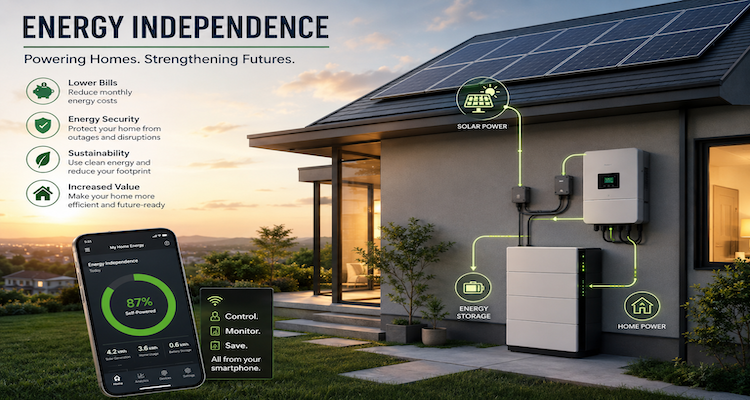
A home with rooftop solar, a battery, an electric vehicle, efficient appliances, smart controls and, in some cases, a heat pump can produce, store and manage a meaningful share of its own energy. It does not necessarily become fully off-grid. Instead, the household gains something more practical: greater control over when it produces, buys, stores and uses electricity.
That distinction matters. The emerging household energy model is less about disconnecting from the grid and more about becoming a flexible participant in it. Falling battery costs, expanding solar deployment, electrification of heating and transport, and increasingly sophisticated energy-management systems are making that model more technically plausible.
Key Takeaways
- Household energy independence increasingly means reducing dependence on purchased energy, not necessarily leaving the electricity grid.
- Solar panels become significantly more useful for independence when combined with batteries and controllable household demand.
- Electric vehicles, heat pumps and smart appliances can become part of a home’s energy-management system rather than simply additional electricity loads.
- Rooftop solar has enough potential to become a significant part of Europe’s future electricity supply, although grid constraints remain a major obstacle.
- Batteries can provide both household resilience and services that help electricity grids manage growing renewable generation.
- The most realistic future may be a household that is grid-connected but increasingly energy-autonomous, rather than completely off-grid.
From Energy Security to Household Energy Control
The traditional idea of energy independence is fundamentally about supply security. Countries want to avoid being excessively exposed to imported fuels, volatile commodity prices or geopolitical disruptions.
For households, the calculation is more immediate.
A family experiences energy dependence through monthly electricity or gas bills, exposure to changing prices and the possibility of losing power during an outage. Technologies that were once separate purchases are increasingly being combined into one residential energy system.
A typical system might include:
- rooftop solar panels;
- a home battery;
- an electric vehicle;
- a heat pump;
- smart thermostats and appliances;
- energy-management software; and
- a connection to the electricity grid.
The important development is not any individual technology. It is the coordination between them.
A solar panel produces electricity when the sun is available. A battery can move some of that electricity to another time. A heat pump can convert electricity into heating or cooling. An EV can represent a large controllable load and, with compatible systems, potentially become part of a home’s energy-management strategy.
The household therefore begins to behave less like a passive electricity customer and more like a small energy system.
Solar Alone Does Not Make a Home Energy Independent
Rooftop solar is the most visible symbol of household energy independence, but panels by themselves have an important limitation: they produce electricity according to sunlight rather than according to household demand.
That mismatch makes storage important.
The U.S. Department of Energy explains that solar production can fall when household electricity demand is rising, particularly around evenings when people return home and begin using appliances and cooling systems. Batteries allow electricity generated earlier to be used later.
There is also an important misconception about solar during blackouts.
A conventional grid-connected solar installation generally shuts down when the grid fails for safety reasons. A properly configured solar-plus-storage system, however, can isolate itself from the grid and continue supplying selected household loads during an outage.
That makes the battery more than an electricity-saving device. It becomes a resilience technology.
Batteries Are Changing the Meaning of the Home Power System
Battery storage is moving rapidly beyond its earlier role as a niche backup technology.
The International Energy Agency estimates that 108 GW of new battery storage capacity was deployed globally in 2025, about 40% more than in 2024. Most of that capacity was utility-scale, but the remaining share included commercial and residential behind-the-meter systems.
At household level, the value of a battery depends heavily on local electricity prices, solar production, tariffs, household consumption and incentives. It is therefore misleading to assume that installing a battery automatically produces financial savings everywhere.
Its value can come from several different functions:
Time shifting: store solar electricity during the day and use it later.
Backup: maintain selected household loads during an outage.
Self-consumption: reduce the amount of solar electricity exported when exporting electricity is less valuable than consuming it at home.
Grid participation: in some markets, aggregated household batteries can participate in programs that provide services to the electricity system.
This last development is particularly significant.
The House Can Become Part of the Grid
The emerging concept of a virtual power plant, or VPP, connects many distributed energy resources through software.
Instead of treating thousands of home batteries, solar systems, EV chargers and flexible appliances as isolated devices, a VPP can coordinate them as a larger pool of resources.
The IEA has highlighted the potential for distributed energy resources and virtual power plants to provide grid services, with advanced optimisation including AI-enabled systems helping coordinate those assets while respecting customer preferences.
This creates an interesting reversal.
Energy independence does not necessarily mean becoming independent from the grid.
A household may become more independent from unpredictable energy purchases while simultaneously becoming more valuable to the grid.
That could change the relationship between utilities and customers. The home becomes both consumer and energy resource.
Electrification Makes the Household More Important
The shift becomes even more significant as transportation and heating move toward electricity.
Global electricity demand grew by around 3% in 2025, according to the IEA, with buildings accounting for nearly 45% of the annual increase in electricity consumption. Electric vehicles and heat pumps were among the factors contributing to rising electricity demand.
This creates a paradox.
Electrification can reduce a household’s dependence on fuels such as natural gas and gasoline, but it can also increase its dependence on electricity.
The answer is not simply to consume less electricity. It is to make electricity use more intelligent.
A household with solar generation can charge an EV when solar production is high. A smart water heater can absorb excess electricity as thermal energy. A battery can shift consumption into another part of the day. A heat pump can potentially be operated with greater attention to electricity prices and grid conditions.
NREL’s residential modelling illustrates this broader concept: solar can be combined with batteries and controllable loads such as water heaters, air conditioning and EVs to increase solar self-consumption and improve the value of the system.
The home is therefore becoming an energy-management problem as much as an energy-generation problem.
Europe’s Rooftops Show How Large the Opportunity Could Become
Europe offers a particularly clear example of why household energy is becoming part of energy policy.
A 2026 analysis by the European Commission’s Joint Research Centre estimated that the rooftops of the EU’s roughly 271 million buildings could accommodate around 2.3 terawatts of solar capacity and generate approximately 2,750 TWh of electricity annually using current photovoltaic technology. The study estimated that rooftop solar could provide around 40% of electricity needed in future zero-emission scenarios by 2050.
That does not mean every building will install panels or that rooftops alone can replace the electricity system.
It demonstrates something more important: the physical space already occupied by buildings represents a substantial distributed energy resource.
And Europe is already seeing strong renewable generation. Eurostat reported that renewables accounted for 47.3% of EU electricity generation in 2025, with solar generation increasing 24.6% from the previous year.
The household therefore becomes relevant not merely because individual families can save money, but because millions of buildings can collectively influence the structure of the electricity system.
The Biggest Limitation May Not Be the Technology
There is a temptation to view household energy independence as a straightforward technology story: install solar, add a battery and become self-sufficient.
Reality is more complicated.
The electricity grid still matters enormously.
A 2026 European Commission analysis identified grid capacity as an increasingly important constraint, warning that planned renewable projects and rooftop solar connections can face delays because networks are not expanding quickly enough to accommodate new generation and demand.
This creates a fundamental tension.
More households producing electricity can reduce pressure on central generation in some circumstances. But large amounts of distributed solar, EV charging, heat pumps and batteries can also create new challenges for local distribution networks.
The solution therefore cannot simply be “more solar.”
It has to include:
- stronger distribution networks;
- better grid management;
- flexible electricity pricing;
- smart meters and controls;
- energy storage;
- demand response;
- improved connection processes; and
- rules that allow households and communities to participate appropriately in energy markets.
Household independence ultimately depends on the wider system working with distributed resources rather than treating them as an afterthought.
Energy Independence Will Not Look the Same for Every Home
The economics and practicality vary considerably.
A detached house with a suitable roof, good solar exposure, a battery and an EV has considerably more control over its energy supply than a renter in an apartment.
But that does not mean renters are excluded.
Community solar and shared-energy models can allow households without suitable rooftops to participate in locally generated renewable electricity. European initiatives are already exploring models that combine renewable generation with energy services for households, including vulnerable consumers.
Energy independence is therefore likely to develop through several models rather than one universal household setup:
| Household model | Main source of independence |
|---|---|
| Solar home | Generates part of its own electricity |
| Solar + battery | Generates and stores electricity |
| Electrified home | Reduces dependence on fossil fuels for heating and transport |
| Smart home | Shifts electricity use to more advantageous periods |
| Community-energy participant | Shares locally generated renewable power |
| Virtual-power-plant participant | Allows household assets to support the wider grid |
This is why the phrase “energy independence” needs to be used carefully.
For most households, complete independence from the grid would be expensive, technically difficult or unnecessary. Energy resilience and energy control may be more realistic goals.
The New Household Energy Question
The question facing consumers is gradually changing.
It used to be:
How much electricity does my home consume?
Increasingly, it may become:
When does my home produce electricity, when does it consume it, how much can it store, and how intelligently can those activities be coordinated?
That shift has implications for homeowners, utilities, technology companies, automakers, appliance manufacturers and policymakers.
The household energy system is becoming more integrated. Solar is connected to storage. Storage interacts with electricity tariffs. EVs add flexible demand. Heat pumps electrify heating. Software coordinates the system.
Even energy efficiency becomes more valuable because reducing demand can make the rest of the system smaller and easier to manage. The IEA notes, for example, that improving building efficiency alongside heat-pump adoption can substantially reduce heating energy demand and peak electricity requirements.
The strongest household strategy, therefore, may not be buying the largest possible solar array or battery.
It may be using less energy, producing some locally, storing what is useful and shifting flexible consumption to the right time.
Conclusion
Energy independence is moving closer to everyday life because the technologies behind the concept are becoming distributed.
Solar panels can turn roofs into generation assets. Batteries can turn electricity into something a household can store and schedule. EVs and heat pumps are turning transport and heating into parts of the electricity system. Software can connect these individual assets into larger networks.
But the lesson is not that every home should attempt to leave the grid.
The more consequential development is subtler: households are gaining the ability to exercise greater control over energy that they previously had to purchase and consume passively.
That could make energy independence less about national self-sufficiency and more about household resilience, flexibility and choice.
The home of the future may still depend on the grid. It may simply depend on it differently.
The information presented in this article is based on publicly available sources, reports, and factual material available at the time of publication. While efforts are made to ensure accuracy, details may change as new information emerges. The content is provided for general informational purposes only, and readers are advised to verify facts independently where necessary.
Related News
- The Energy Paradox of Efficiency: Why Using Less Electricity Does Not Always Mean Using Less Energy
- Why Extreme Weather Is Turning Electricity Resilience Into an Everyday Consumer Issue
- The Hidden Energy Cost of Keeping Everything Available Instantly
- Why Cheap Electricity Could Become the Next Competitive Advantage for Cities