










The Return of Repair Culture: Why Fixing Things Is Becoming a Lifestyle Statement
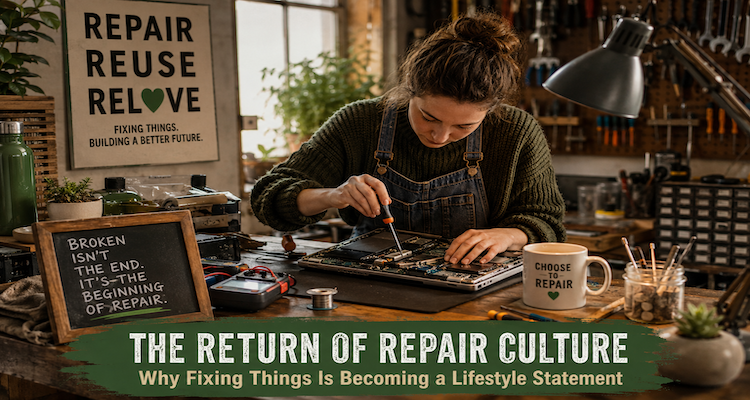
A cracked phone screen, a worn jacket, a faulty coffee machine or a chair with a loose joint used to present a simple choice: fix it or replace it. Increasingly, however, that decision carries a second meaning. Repair is becoming a way for people to express how they think about ownership, consumption, waste and the value of keeping things.
The shift is no longer confined to DIY enthusiasts. Repair cafés, independent technicians, refurbished-product markets and right-to-repair campaigns have helped make fixing things more visible. Governments are also changing the rules around repair. In the European Union, new consumer repair rules began applying on July 31, 2026, giving consumers stronger rights when certain repairable products fail and requiring manufacturers to make repair more accessible.
That combination of cultural change and regulation is significant. Repair is becoming less of an afterthought at the end of a product’s life and more of a consideration at the moment people buy, use and maintain possessions.
Key Takeaways
- Repair is shifting from a cost-saving tactic toward a visible choice about consumption, ownership and product longevity.
- EU rules applying from July 2026 are making repair a more formal part of consumer rights and product policy.
- Repair cafés show that fixing objects can also preserve practical skills and strengthen local social connections.
- Repairability increasingly depends on parts, manuals, software access and product design not simply whether someone knows how to use a screwdriver.
- The environmental case for repair is strongest when fixing a product genuinely extends its useful life rather than merely delaying disposal.
- A repair-minded consumer may increasingly judge products by how long they can remain useful, not simply by how new they look.
Repair Is Becoming More Than a Practical Skill
For much of the consumer economy, the dominant rhythm has been straightforward: buy, use, replace.
That model is particularly visible in electronics. A device can remain functional while its battery deteriorates, a connector fails, a screen breaks or software support becomes inconvenient. Yet the economic and cultural incentives surrounding the device can make replacement feel easier than repair.
The environmental consequences are substantial. The United Nations’ Global E-waste Monitor reported that the world generated 62 million tonnes of electronic waste in 2022, while only 22.3% was formally collected and recycled. The same report estimated that billions of dollars’ worth of recoverable resources were being lost.
Repair cannot solve the e-waste problem by itself. Some products eventually become unsafe, technologically obsolete or economically impractical to fix. Recycling remains important when reuse and repair are no longer viable.
But the hierarchy matters. Keeping a functioning product in use can preserve more of its existing value than reducing it to materials at the end of its life.
The European Environment Agency describes repair as a way of slowing material flows: products remain in use for longer instead of moving prematurely toward disposal and replacement.
That changes the cultural meaning of repair. The question is no longer simply, “Can this be fixed?” It becomes, “Why should I replace something that can still serve its purpose?”
The Repair Café Made Fixing Social Again
One of the most interesting developments in repair culture is that it is not entirely about technology.
The first Repair Café was organised in Amsterdam in 2009 by Martine Postma. The concept was simple: people brought broken household objects to a community gathering and worked alongside volunteers to repair them.
The model has since spread internationally.
A 2024 Open Repair Alliance report drew on more than 200,000 logged repair attempts collected by community repair networks. It describes a growing international movement in which repair is not merely a transaction but a shared activity involving knowledge, tools and community participation.
More recent Repair Café survey data indicates the scale of that community has continued to grow. A 2026 global survey covering responses from 30 countries estimated around 60,000 Repair Café events a year, approximately 1.5 million visitors and about 89,000 volunteers. The survey also found that more than half of volunteers were over 60, while only 5% were under 25 a reminder that the movement has an important skills-transfer challenge ahead.
That last point is easy to overlook.
Repair culture is partly about objects, but it is also about knowledge. A generation that knows how to replace a zipper, diagnose a faulty appliance, solder a connection or reinforce a piece of furniture possesses a form of practical knowledge that disappears when every broken object is treated as disposable.
Repair cafés therefore perform a role that conventional retail cannot: they make maintenance visible.
Technology Has Made Repair More Complicated
Modern repair is not necessarily the same as the repair culture of previous generations.
A mechanical object can often be understood through its physical components. A modern electronic product may contain batteries, sensors, firmware, software authentication and components whose replacement requires calibration.
This means that a product can be physically repairable but functionally difficult to repair.
iFixit’s current repairability framework illustrates this broader definition. Its scoring considers product design, service documentation and replacement-part availability, while also accounting for barriers such as parts pairing.
Parts pairing is particularly important because it demonstrates why repairability is no longer solely a question of mechanical design. A replacement component can physically fit into a device yet still require software authentication or calibration before the device operates correctly.
In other words, the screwdriver is no longer the entire repair toolkit.
Documentation, diagnostic software, replacement components and manufacturer support can be just as important.
That is why the modern right-to-repair debate increasingly concerns access rather than simply physical construction: access to parts, manuals, tools, diagnostics and information.
The European Union Is Turning Repair Into a Consumer Right
The cultural shift is being reinforced by policy.
The European Union’s Directive on common rules promoting the repair of goods was adopted in June 2024, with member states required to apply the rules from July 31, 2026. The directive aims to encourage consumers to repair products rather than prematurely dispose of them and establishes obligations for manufacturers covering products subject to specified repairability requirements.
The new framework includes measures intended to make repair more attractive. Where the relevant legal conditions apply, consumers can request repairs for covered products, manufacturers must provide repair under reasonable conditions, and choosing repair rather than replacement during the legal guarantee period can extend the guarantee by at least 12 months.
The EU is also developing a European online repair platform intended to help consumers find repairers, sellers of refurbished goods and other repair options. The common interface is required to be developed by July 31, 2027.
This is an important distinction.
The policy does not mean every broken product must be repaired regardless of cost or practicality. Nor does it eliminate the need for manufacturers to innovate or consumers to replace products when replacement makes genuine sense.
Instead, it attempts to change the default calculation.
A broken product should not automatically become a discarded product simply because repair is difficult to locate or unnecessarily inaccessible.
Phones and Tablets Are Becoming a Test Case
Electronics provide one of the clearest examples of where repair culture is heading.
EU ecodesign and energy-labelling rules for smartphones and tablets began applying on June 20, 2025. The measures include requirements designed to improve durability and repairability, alongside consumer information intended to make purchasing decisions more informed.
Separate EU rules also require certain spare parts for covered mobile devices to be made available to professional repairers for extended periods. The relevant regulation specifies availability periods that can reach at least seven years after the end of a model’s placement on the market for specified components.
This matters because repair culture ultimately depends on infrastructure.
Telling consumers to repair their phones is not particularly useful if the necessary component is unavailable, the service documentation is inaccessible, the software prevents the replacement from functioning or the repair costs nearly as much as a replacement.
The more meaningful measure of repairability is therefore not whether a manufacturer can repair a product somewhere.
It is whether a reasonable repair ecosystem exists around that product.
Repair Is Also Becoming a Way to Buy Differently
The most interesting cultural consequence may occur before anything breaks.
Once repairability becomes visible, consumers can begin evaluating products according to criteria that were previously secondary.
Instead of asking only:
- How powerful is this device?
- How attractive is it?
- How inexpensive is it?
- What features does it have?
A repair-minded consumer may also ask:
- Can the battery be replaced?
- Are spare parts available?
- How long will parts remain available?
- Is there a service manual?
- Can an independent repairer work on it?
- Does the manufacturer provide diagnostic support?
- Can the product be upgraded rather than replaced?
iFixit’s repairability scores are one example of this emerging consumer language. The organisation evaluates products on a 10-point scale and considers factors such as disassembly, tools, service manuals and parts availability.
The significance is not that one score can perfectly describe a product.
It is that repairability can become a purchasing criterion in the same way battery life, energy efficiency or warranty length already can.
That is when repair begins to function as a lifestyle statement.
The Economic Side of the Repair Movement
Repair culture also challenges the assumption that sustainability necessarily means buying less and spending less.
Repair requires businesses.
Technicians need to be paid. Independent workshops need customers. Parts suppliers need viable markets. Refurbishers need access to used products. Manufacturers need to design products and support systems capable of sustaining longer lifetimes.
The European Environment Agency notes that repair can support local employment and that a large share of repair activity for computers and personal and household goods in the EU has historically been carried out by small and medium-sized enterprises.
This creates an interesting economic transition.
The linear model generates revenue when products are sold repeatedly. A more circular model can generate value through maintenance, repair, refurbishment, upgrades, spare parts and service relationships.
That does not automatically make every repair business profitable or every circular model environmentally superior. Labour, transportation, replacement parts and energy all have environmental and economic costs.
But it does expand the definition of what a product business can be.
A company selling a durable product may increasingly be selling a relationship with that product rather than a single transaction.
Repair Is Not Always the Greenest Choice
There is an important caution behind the enthusiasm.
“Repair” should not become another simplistic sustainability label.
If repairing an object requires shipping it thousands of kilometres, replacing most of its components or consuming significant resources to extend its life by only a few weeks, the environmental calculation can become complicated.
Likewise, a repair that merely delays inevitable disposal is different from one that adds several useful years to a product’s life.
The European Environment Agency emphasises the importance of considering product lifetimes, reuse, repair and broader lifecycle effects rather than treating individual actions as automatically beneficial in every circumstance.
The sensible principle is therefore not “repair everything.”
It is closer to preserve useful products for as long as practical, and replace them when repair no longer makes sense.
That distinction makes repair culture more credible because it does not require consumers to turn every broken toaster into a moral dilemma.
The New Status Symbol May Be Longevity
For decades, consumer culture often associated newness with progress.
A newer phone suggested technological advancement. A newer car suggested success. New clothes communicated novelty. Replacing an object could be easier than explaining why it had been kept.
Repair reverses some of that logic.
A well-maintained jacket can become more interesting with age. A repaired chair can carry visible evidence of use. An older camera can remain valuable because it still performs its intended function. A refurbished laptop can be attractive precisely because someone decided it was worth saving.
The repaired object tells a different story: this was worth keeping.
That is why repair culture is more interesting than a simple sustainability trend. It touches identity.
It changes what people can feel proud of owning.
The statement is no longer necessarily “I can afford the newest thing.”
It can become “I know what I own, I maintain it, and I don’t replace it simply because something newer exists.”
What Comes Next
The repair movement is entering a more consequential phase.
Community organisations have demonstrated that people will repair together. Independent businesses have demonstrated that repair can support local economic activity. Repair advocates have pushed the issue into public policy. Regulators are increasingly addressing product longevity, spare parts and consumer information.
The next challenge is making those pieces work together.
A repair-friendly culture requires repairable products. Repairable products require accessible components and information. Accessible repair requires viable businesses and skilled workers. And consumers need enough information to recognise the difference between a product that is genuinely designed for longevity and one that merely carries a sustainability message.
That is where technology could become both the problem and part of the solution.
Better diagnostics, digital service documentation, component tracking and accessible repair information could reduce some of the friction around fixing modern products. At the same time, software locks and proprietary systems can create new barriers if manufacturers use them to restrict otherwise technically feasible repairs.
The direction of the repair economy will therefore depend not only on consumer enthusiasm, but on how products are designed and how much control consumers retain after purchase.
Conclusion
The return of repair culture is not a return to a simpler technological past.
It is something more contemporary: an attempt to redefine what ownership means in a world filled with increasingly complex and resource-intensive products.
The most important change may be psychological. Repair asks consumers to stop seeing a broken object as the end of its usefulness and start seeing it as a problem that may have a solution.
That idea is now being reinforced by communities, businesses, product designers and public policy.
The result could be a different kind of consumer culture one in which durability, repairability and longevity become qualities worth displaying alongside novelty and performance.
Fixing something may once have been what people did because they could not afford to replace it.
Increasingly, it can also be what they choose because they believe the object is worth keeping.
This content is published for informational or entertainment purposes. Facts, opinions, or references may evolve over time, and readers are encouraged to verify details from reliable sources.